Science · Earth & its history
How we know the age of rocks
Rock layers and fossils give the order of Earth's history, and radioactive decay gives the dates. See how the two are joined, and why Earth's own age had to come from a meteorite.
What you will learn
- State what a sequence of undisturbed rock layers does and doesn't tell you
- Explain how fossils let geologists recognize the same layer in a different place
- Explain how a pair of parent and daughter isotopes acts as a clock
- Choose an appropriate isotope pair for a given sample and say why the others fail
Lesson 1 of 4 · 6 min
How geologists ordered Earth's history without dates
In 1666 two fishermen caught a huge shark off the Italian coast, and its head was sent to an anatomist named Nicolas Steno. Its teeth looked just like the 'tongue stones' people dug out of rocks. Steno concluded the stones were shark teeth, buried long ago in mud that had since hardened.
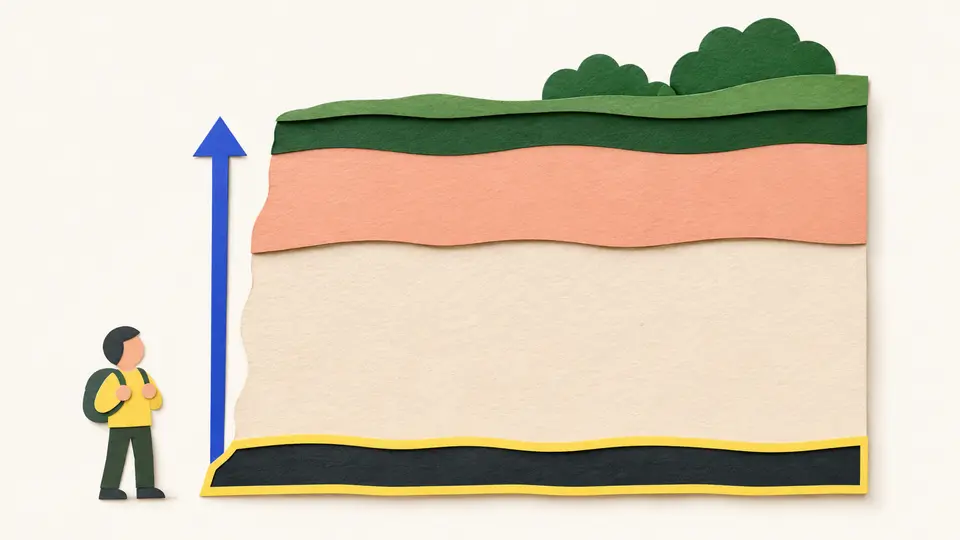
That set him thinking about how rock builds up in layers. In 1669 he published a rule. Where layers haven't been disturbed, the bottom one settled first, so it's the oldest, and each layer above it is younger. Geologists call the rule superposition.
It turns a cliff face into a record in order. You can say which event came before which, all the way up, without knowing a single date. Around 1800 the Scottish geologist James Hutton added that each layer stands for its own interval of time.
What the layers don't show is how long anything took. A tree ring is one year of growth, but rock has no such steady rate. A thick layer may be a quick burst of sediment and a thin one a long, slow build-up.
One cliff gives you one local sequence. To build a history of the whole Earth, you need to know that a layer here is the same layer as one a thousand kilometers away.
The answer came from William Smith, a surveyor nicknamed 'Strata'. He knew parts of southern England where limestone and shale lie stacked like slices of bread and butter, and his hobby was collecting the fossil shells in them. He noticed that certain layers held fossils found in no other layer.
Those are index fossils, and they work as markers. Each form of life existed only for a limited time. So when the same distinctive fossils turn up in a distant outcrop, the rock there formed in the same period.
With order and matching, geologists pieced together one worldwide sequence and divided it into Eras and Periods. It's like sorting human history into dynasties and reigns. You know what came before what, and you still don't have a date.
Try to recallTwo rock outcrops a thousand kilometers apart both contain a distinctive fossil shell found in no other layer. Explain what that lets geologists do, and what it still can't tell them.
It lets them identify the two layers as the same layer. An index fossil is a form of life that existed only for a limited period, so it marks that period wherever the rock is exposed. That's how a local sequence becomes one that holds across continents.
What it can't supply is any number. The match puts both outcrops at the same point in the sequence. How long ago that was, and how long the layer took to form, stay unknown.
One caution. The bottom-is-oldest rule assumes the layers still lie the way they settled. Where the crust has buckled and folded them, the order can be hard to read.
So geology had the order of Earth's history worked out, and no way to say how many years any of it covered. Layers and fossils don't contain a clock. That had to come from physics.
Lessons in this topic
How geologists ordered Earth's history without dates
Rock layers and the fossils in them gave geology the full order of Earth's history about a century before anyone could put a year on it.
How radioactive decay puts a date on a rock
Radioactive atoms decay at a fixed rate, which gives rocks the clock that layers never had. See why different clocks suit different ages.
How a fossil layer gets an age in years
Fossils sit in rocks that can't be dated directly. See how dated volcanic rock above and below pins an age on the layers in between.
Why the age of Earth doesn't come from an Earth rock
Earth has destroyed its own oldest rocks, so its age of 4.54 billion years was worked out with the help of meteorites.
Three quick stories from this topic
Steno's shark
A shark caught off Italy in 1666 led to the rule geologists use to order rock layers
Nicolas Steno dissected its head and saw that its teeth matched the 'tongue stones' found inside rocks. Working out how a tooth could end up in stone, he concluded that rock layers settle one on another, with the oldest at the bottom.
What tongue stones were thought to be
Some writers said the stones fell from the sky, and others that they grew inside rocks. Steno argued they were teeth from once-living sharks, buried in mud that later hardened.
Order without dates
Steno's rule, published in 1669, gives the order of the layers and says nothing about how long each one took. Dates had to wait for the discovery of radioactivity.
Radiocarbon starts with cosmic rays
Radiocarbon dating works because cosmic rays keep every living thing slightly radioactive
Cosmic rays turn nitrogen in the upper atmosphere into carbon-14, which mixes into the air and from there into every plant and animal. At death the supply stops and the carbon-14 halves every 5,730 years, so what's left gives the time since death.
The clock runs down
After about 50,000 years too little carbon-14 is left to measure. Radiocarbon can date a mummy's wrappings, and it can't date a rock millions of years old.
Rocks need slower clocks
Potassium-40 has a half-life of 1.25 billion years. The potassium-argon method reaches from rocks a few thousand years old to the oldest known.
Earth's age from a meteorite
Earth's age of 4.54 billion years was worked out using a meteorite that hit Arizona
Plate tectonics has destroyed Earth's first crust, and its oldest agreed rocks are about 4 billion years old. So scientists compared lead in Earth's oldest ores with lead in the Canyon Diablo meteorite, which has kept the Solar System's starting mix.
Meteorites supply the starting composition
Earth and the meteorites are treated as one system that started with the same lead isotope composition. The starting point is read from troilite in the Canyon Diablo iron meteorite, which contains no uranium and so hasn't changed.
Lead isotopes give an age of 4.54 billion years
That's the time needed for the ratio of lead-207 to lead-206 to evolve to the composition of the oldest terrestrial lead ores, with an uncertainty under 1%. More than seventy dated meteorites agree, at 4.53 to 4.58 billion years.
Sources
- Geologic Time: Relative Time Scale, U.S. Geological Survey
- Nicholas Steno, University of California Museum of Paleontology
- Geologic Time: Radiometric Time Scale, U.S. Geological Survey
- Geologic Time: Age of the Earth, U.S. Geological Survey
- Canyon Diablo (meteorite), Wikimedia Foundation