Science · Space & the universe
The Solar System
Meet the Sun, eight planets and the smaller bodies around them, get a feel for the real distances, and see why rocky worlds sit close in and giants far out.
What you will learn
- Name the main kinds of bodies in the Solar System and where they sit
- Apply the IAU's three tests for a planet and say why Pluto fails one
- Describe Solar System distances with the astronomical unit and light travel time
- Use a scale model to compare the sizes of the Sun and planets and explain why space between them is so empty
Lesson 1 of 4 · 4 min
One star and everything that circles it
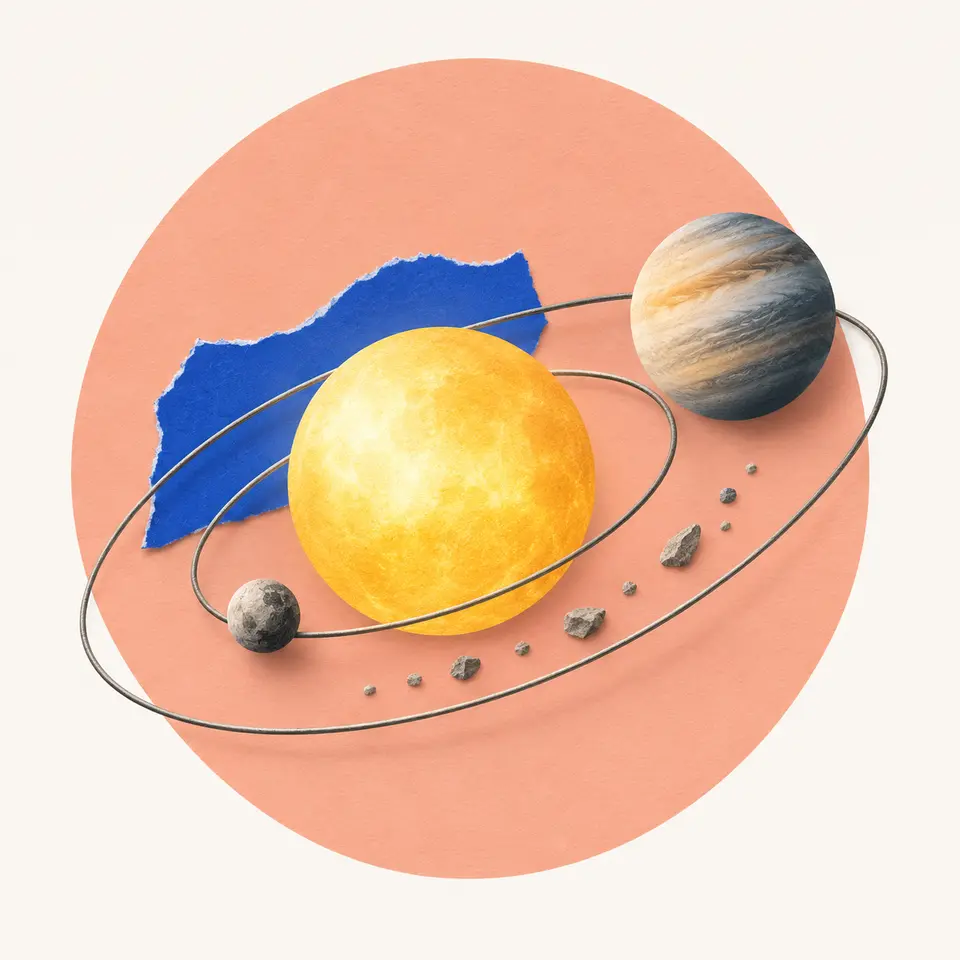
The Sun holds 99.86% of all the mass in the Solar System. Every planet, moon, asteroid and comet together makes up the last sliver. So what is in that sliver, and how is it arranged?
Closest in are four small rocky planets, Mercury, Venus, Earth and Mars. Farther out are four giant planets. Jupiter and Saturn are gas giants, made mostly of hydrogen and helium. Uranus and Neptune are ice giants. Jupiter and Saturn alone hold nearly 90% of everything that isn't the Sun.
Most planets have moons, and there are hundreds in all. Some are big. Jupiter's Ganymede and Saturn's Titan are both wider than Mercury.
The rest is rubble. The asteroid belt lies between Mars and Jupiter. The Kuiper belt, a ring of icy bodies, lies beyond Neptune. Comets fall in from both the Kuiper belt and much farther out. All of it is held by the Sun's gravity, which pulls each body inward while the body's sideways speed carries it around.
In 2005 astronomers found Eris, an icy world beyond Neptune with 25% more mass than Pluto. Quaoar and Sedna had turned up shortly before. Either all of them were planets, with more surely to come, or Pluto had company in a new group.
In August 2006 the International Astronomical Union, the body that names things in space, voted on a definition. A planet must orbit the Sun. It must be heavy enough that its own gravity pulls it nearly round. And it must have cleared its neighborhood, meaning it dominates the zone along its orbit.
Pluto passes the first two tests and fails the third. It shares its zone with thousands of other Kuiper belt objects. So the IAU calls Pluto a dwarf planet, along with Ceres, Eris, Makemake and Haumea. Moons don't count as planets of any kind, because they orbit a planet rather than the Sun.
Not everyone likes the rule. Some astronomers point out that it depends on location. A world the size of Mars could fail the third test if it orbited far enough out, where its zone would be too big to clear.
Try to recallWhich of the IAU's three tests for a planet does Pluto fail, and what does that test require?
Pluto fails the test of having cleared its neighborhood. A planet must dominate the zone along its orbit, and Pluto shares its zone with many other Kuiper belt objects. It does orbit the Sun and is nearly round, so it counts as a dwarf planet.
The Solar System is one star with almost all the mass, four rocky planets, four giants, hundreds of moons and two belts of leftovers. A planet orbits the Sun, is round and rules its orbit. Pluto misses that last test.
Lessons in this topic
One star and everything that circles it
Meet the members of the Solar System, from the Sun to the comets, and learn the three tests that decide what counts as a planet.
How big and how empty the Solar System is
Measure the distances with the astronomical unit and the speed of light, then shrink everything to a walkable model to see how small the planets are.
How a spinning cloud built the planets
Follow a collapsing cloud of gas and dust into the Sun and a flat disk, and see why the disk made rocky worlds close in and giants farther out.
Where the Solar System ends
Find the two edges of the Solar System, where the Sun's wind stops and where its gravity gives out, and see how far the Voyager probes have gone.
Three quick stories from this topic
No dodging needed
The Lucy probe crosses the asteroid belt without ever firing thrusters to dodge a rock
The belt holds roughly a million asteroids a kilometer or more across. Together they weigh only 3 to 4% of the Moon, spread around a whole orbit of the Sun, so they sit hundreds of thousands of kilometers apart.
Not like the films
Movie chases through packed rocks get it wrong. About 15 missions have flown into or past the belt.
Safe since 1972
Pioneer 10 was the first probe through, in 1972. Spacecraft have crossed since without incident.
A country-sized model
Sweden's Solar System model has its Sun in Stockholm and its Jupiter at the airport
The Sun is a 110-meter arena in Stockholm. On the same scale, Jupiter is a 7.5-meter sphere at Arlanda Airport 40 kilometers away, and the distant world Sedna is a 10-centimeter ball 912 kilometers away in Luleå.
The biggest of its kind
It's the largest scale model of the Solar System in the world, spread across much of the country.
Why it needs a country
The planets are tiny next to the gaps between them. Keep the sizes visible and the distances run to hundreds of kilometers.
Voyager's long cruise
Voyager 1 won't reach the Oort cloud for about 300 years, though it left in 1977
It travels about a million miles a day and has already left the Sun's wind behind. Even so, NASA estimates it may need around 30,000 years to pass out the far side of the cloud.
Past the wind, not the Sun
Voyager 1 crossed the heliopause in 2012, 121 AU out. The Sun's gravity still rules far beyond.
A shell nobody has seen
The Oort cloud starts thousands of AU out. Astronomers infer it from comets that fall in from every direction.
Sources
- Solar System, Wikipedia
- Our Solar System: Facts, NASA Science
- IAU Resolution B5: Definition of a Planet in the Solar System (2006), International Astronomical Union (archived copy)
- IAU definition of planet, Wikipedia
- Eris (dwarf planet), Wikipedia
- The Density of the Asteroid Belt, Lucy mission, Southwest Research Institute
- Asteroid belt, Wikipedia
- Oort Cloud: Facts, NASA Science
- Voyager 1, Wikipedia