Science · Forces, energy & matter
Gravity
Gravity pulls every mass toward every other mass. See why things fall at the same rate, why the Moon doesn't fall down, and how one law covers an apple and a planet.
What you will learn
- Explain why objects of different mass fall at the same rate without air
- Describe what g measures and how air resistance changes a real fall
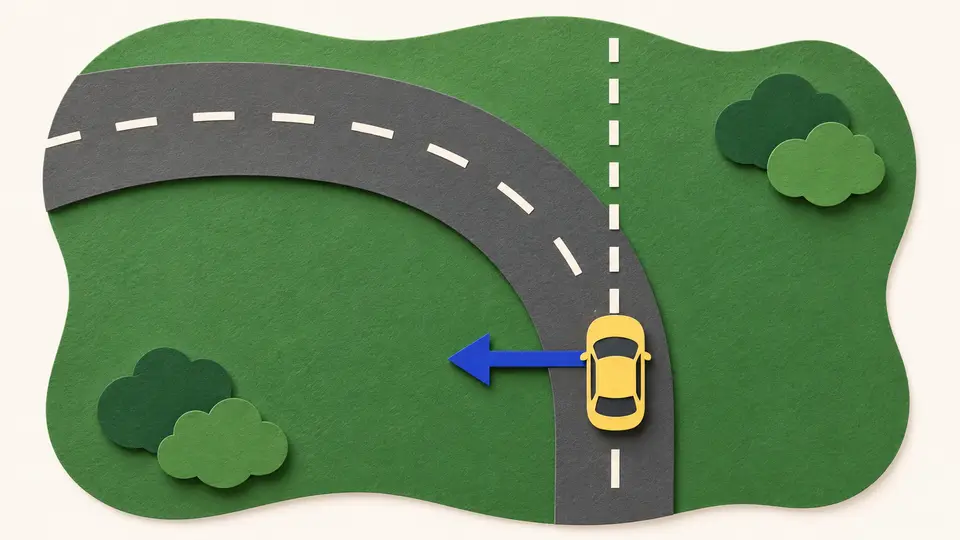
- Explain how an orbit is a fall with enough sideways speed to keep missing the ground
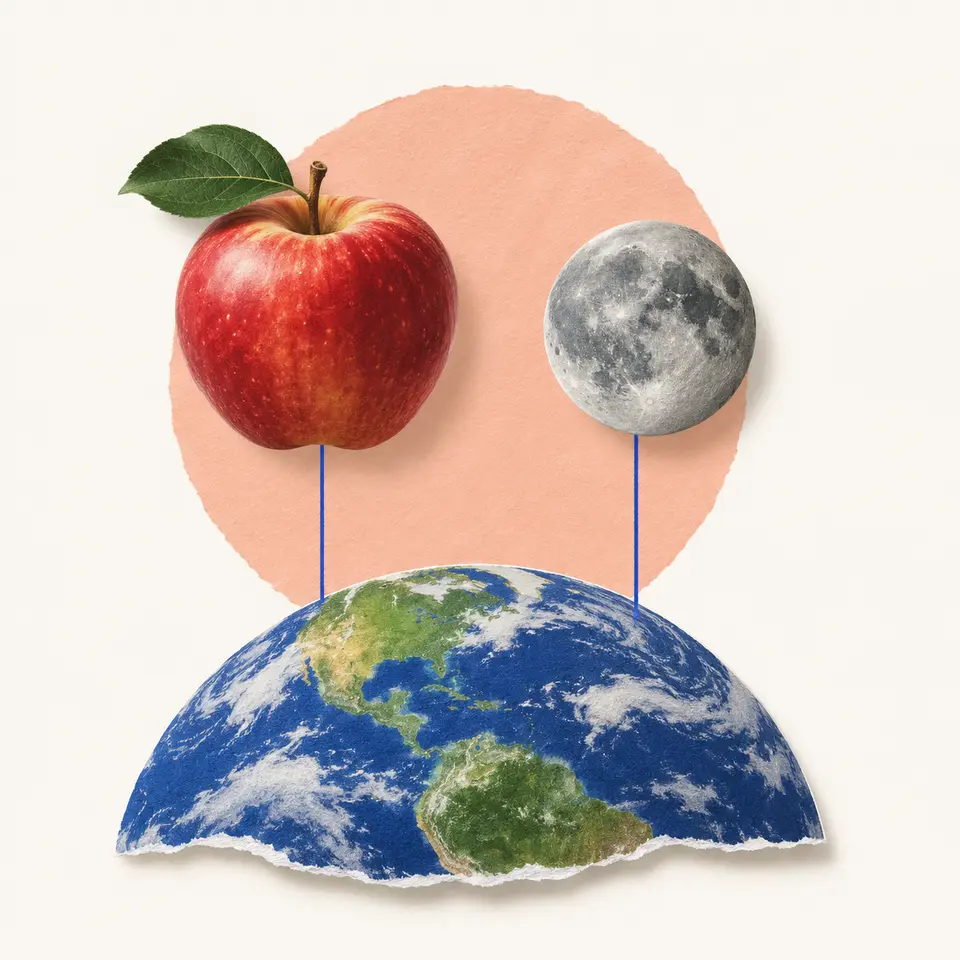
- Describe how Newton showed that the Moon falls toward Earth under the same gravity as an apple
Lesson 1 of 4 · 4 min
Why a hammer and a feather fall together
On August 2, 1971, the Apollo 15 commander David Scott stood on the Moon holding a 1.32 kilogram hammer and a falcon feather. He let go of both at once. With no air on the Moon, they fell side by side and hit the dust together.
That looks wrong, because on Earth a feather drifts. For nearly 2,000 years people followed Aristotle, who taught that heavier things fall faster. Italian experimenters had shown he was wrong by 1544, and Simon Stevin dropped weights from a church tower in Delft in the 1580s. The story of Galileo dropping balls from the Leaning Tower of Pisa is probably a thought experiment.
So why does weight make no difference? Two things cancel. Gravity pulls on each object in proportion to its mass, so the hammer gets a much bigger pull than the feather.
But mass also measures how hard something is to speed up. The hammer needs a bigger force for the same change in speed, in exactly the same proportion. A pull twice as strong on something twice as hard to move gives the same acceleration. So with only gravity acting, everything falls at the same rate.
Near Earth's surface, a falling object gains about 9.8 meters per second of speed every second. That number is called g. After one second you're moving at 9.8 meters per second. After two, 19.6. After three, about 29.
The value shifts a little with place. Because Earth spins and bulges at the middle, g is about 9.78 at the Equator and 9.83 at the poles. You'd weigh about 0.5% more standing at a pole.
Air changes the story. Air resistance grows as you speed up, until it pushes up as hard as gravity pulls down. Then you stop gaining speed. A skydiver falling belly-down levels off at about 55 meters per second, around 200 kilometers per hour. A feather, light for its size, reaches its top speed almost at once.
Try to recallWhat does it mean that g is about 9.8 meters per second squared, and why does a skydiver stop speeding up?
It means a falling object gains about 9.8 meters per second of speed for every second it falls. A skydiver stops gaining speed because air resistance grows with speed. At about 55 meters per second, the air pushes up as hard as gravity pulls down.
Without air, everything falls at the same rate, because a bigger pull goes with a bigger mass to move. Near Earth that rate adds about 9.8 meters per second each second, until air resistance catches up.
Lessons in this topic
Why a hammer and a feather fall together
Find out why heavy and light things fall at the same rate once air is out of the way, and what the number 9.8 tells you about every fall.
Orbiting is falling and missing
Fire Newton's imaginary cannon faster and faster until the ball never lands, then see why the Moon is falling toward Earth right now.
The law of gravity and how Earth was weighed
Learn how the pull between two masses depends on their size and distance, why it's so feeble between everyday things, and how a scientist in a shed found the mass of Earth.
Gravity on other worlds, and Einstein's bent space
See why a planet's surface gravity depends on its size as well as its mass, then meet Einstein's picture of gravity and the GPS clocks that need it.
Three quick stories from this topic
Weighing the world
Henry Cavendish worked out Earth's density with lead balls in a shed in 1798
Big lead balls tugged small ones on a hanging rod, twisting it by only about 0.16 degrees. He watched through telescopes in the shed walls to keep out drafts, and got 5.448 times water's density.
Close to today's figure
The accepted value now is 5.514. His result also hinted that Earth has a dense iron core.
Why it mattered
Measuring the pull between known masses fixed gravity's strength, which finally put a number on Earth's mass.
GPS and Einstein
GPS satellite clocks run fast by 38 microseconds a day because gravity is weaker up there
Weaker gravity speeds them up by about 45.85 microseconds a day, and their speed slows them by about 7.2. Left uncorrected, positions would drift by roughly 11 kilometers every day.
Set slow before launch
Engineers tune the satellite clocks to run slightly slow on the ground, so they keep time in orbit.
Einstein's gravity at work
General relativity says time runs faster where gravity is weaker. GPS has to account for it every day.
The falling Moon
The Moon falls about 1.4 millimeters toward Earth every second and never lands
In one second a dropped apple falls about 4.9 meters. The Moon, 60 times farther from Earth's center, feels a pull 3,600 times weaker, so its path bends toward us by only about a millimeter and a half.
Falling and missing
The Moon's sideways speed carries it past Earth as fast as it falls, so it circles every 27.3 days.
Newton's check
Newton compared the Moon's fall with falling objects on Earth around 1665 and found one force could explain both.
Sources
- The Apollo 15 Hammer-Feather Drop, NASA Goddard Space Flight Center, NSSDCA
- Apollo 15, Wikipedia
- Galileo's Leaning Tower of Pisa experiment, Wikipedia
- University Physics Volume 1, 13.2 Gravitation Near Earth's Surface, OpenStax, Rice University
- Gravity, Wikipedia
- Gravity of Earth, Wikipedia
- Terminal velocity, Wikipedia
- Cavendish experiment, Wikipedia
- Error analysis for the Global Positioning System, Wikipedia
- University Physics Volume 1, 13.1 Newton's Law of Universal Gravitation, OpenStax, Rice University