Science · Forces, energy & matter
Energy and its conservation
Energy changes form but the total never changes. Follow it through a roller coaster, a light bulb and a power station, trace it back to where it came from, and see how the law was proved.
What you will learn
- Tell kinetic energy apart from the stored forms of potential energy, and name the other common forms
- Trace how energy changes from one form to another in a roller coaster and a power station
- State the law of conservation of energy and tell it apart from the everyday idea of saving energy
- Explain what efficiency measures and why the wasted share of energy ends up as heat
Lesson 1 of 4 · 4 min
One quantity that keeps changing its form
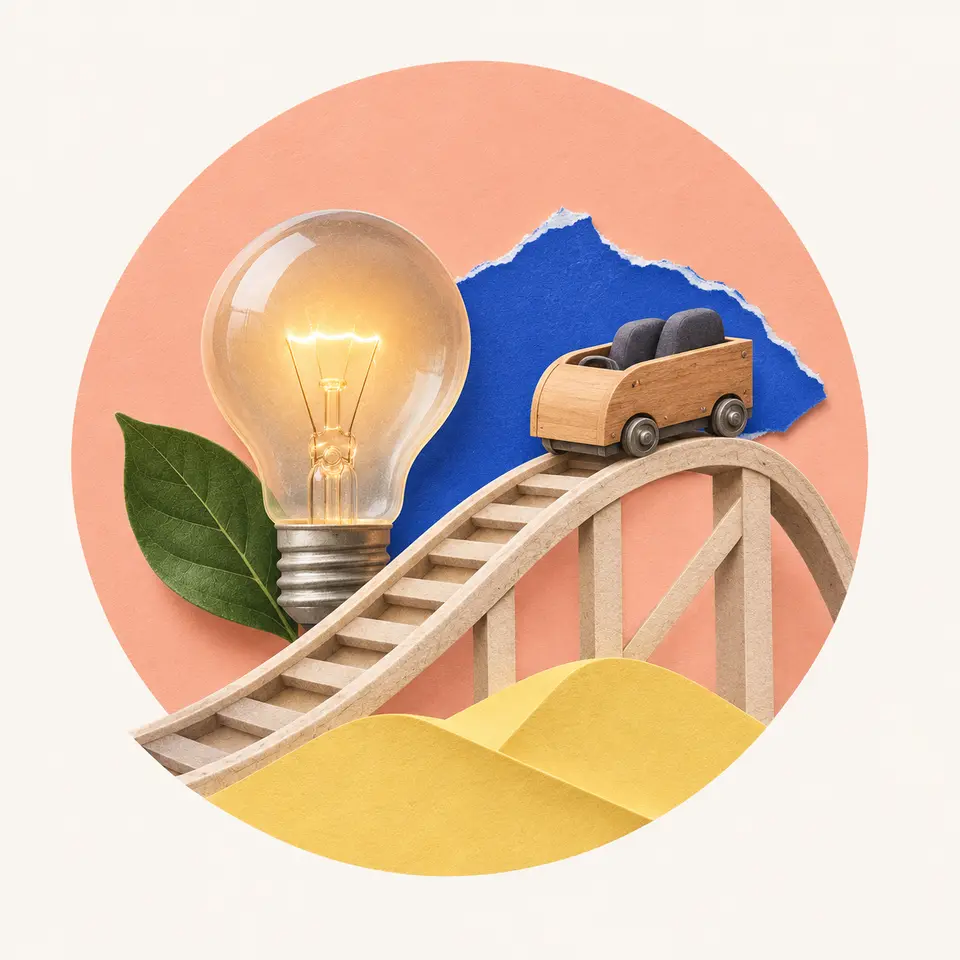
A roller coaster train has no engine. A chain drags it up the first hill and lets go, and from then on it rides on what that climb gave it. The thing the climb gave it is energy, the one quantity physics tracks through every change.
Energy comes in two broad families. Kinetic energy is the energy of motion, and it grows with the square of speed. So a car going twice as fast carries four times the energy, and needs about four times the distance to stop with the same brakes.
Potential energy is stored energy, held by position or arrangement. The train at the top of the hill stores it in its height. Food, fuel and batteries store chemical energy in the bonds between atoms, and the nucleus of an atom stores nuclear energy.
Three more forms turn up in almost every story. Thermal energy is the random jiggling of the atoms and molecules inside a thing, which is why it's tied to temperature. Electrical energy is carried by moving electrons, and light is radiant energy.
Energy matters because it changes form. On a coaster, the drop turns stored height into speed. As the train climbs the next hill, speed turns back into height, which is why the train slows as it rises.
A coal power station runs a longer chain. Burning coal turns chemical energy into heat. The heat boils water into steam, the steam spins a turbine, and the turbine turns a generator that makes electricity. Your lamp then turns the electricity into light and heat.
Every machine you use is a chain like these. Ask what form the energy arrives in and what form it leaves in, and you have the outline of how the machine works.
Try to recallA roller coaster train races down a hill and then climbs the next one. Describe its energy changes from the top of the first hill to the top of the second.
At the top of the first hill, the train's energy is mostly potential energy from its height. On the way down, height turns into kinetic energy, so the train speeds up. Climbing the next hill turns motion back into height, so it slows.
Energy is motion or storage, and it keeps changing form. Follow the changes and you can explain a coaster or a power station.
Lessons in this topic
One quantity that keeps changing its form
Meet the main forms of energy, from motion and height to fuel and heat, and follow energy as it changes from one form to another on a roller coaster and in a power station.
Why energy is never lost, only wasted
Learn what the law of conservation of energy says, why it isn't the same as saving energy, and why every machine still sheds part of its energy as waste heat.
Tracing the energy you use back to its source
Follow the energy in your food, fuel, wind and rivers back to sunlight and the fusion inside the Sun, and meet the few sources that start somewhere else.
The paddle wheel that proved heat is energy
See how a falling weight and a barrel of water overturned the idea that heat is a fluid, and why the law that came out of it rules out every perpetual motion machine.
Three quick stories from this topic
Mostly a heater
An old-style light bulb turns less than 5% of its electricity into light
The rest leaves the hot filament as heat. None of the energy is destroyed, and every bit of it can be accounted for. Most of it just warms the room instead of lighting it.
Conserved but wasted
The law of conservation of energy says the total never changes. Efficiency asks how much of it comes out in the form you wanted.
Power plants shed heat too
In a coal power plant, about 60% of the fuel's chemical energy leaves as heat through the chimney gases and the cooling towers.
The patent office's one exception
The US patent office normally needs no model, except for perpetual motion machines
Its examiners' manual says a model isn't ordinarily required to show that a device works, and names perpetual motion as the exception. A machine like that would break the conservation of energy.
Why they can't work
A machine that does work forever with no energy going in would be creating energy. Friction also drains whatever push it starts with.
An old dream
Inventors have tried since at least the 12th century, when Bhaskara described a wheel with weights meant to keep it turning forever.
The Sun's vanishing mass
The Sun turns about 4 million tonnes of its own mass into energy every second
Fusion in the core joins hydrogen into helium, and about 0.7% of the fused mass becomes energy. That steady loss powers the sunlight behind your food, your fuel and the wind.
Fusion in the core
In the Sun's core, hydrogen nuclei fuse into helium. The helium has slightly less mass than the hydrogen that made it, and the difference leaves as energy.
Stored sunlight
Crop plants catch 1% to 2% of the light that reaches them. Coal and oil hold sunlight caught by living things millions of years ago.
Sources
- Roller coaster, Wikipedia
- Kinetic energy, Wikipedia
- Forms of energy, US Energy Information Administration
- College Physics 2e, 7.6 Conservation of Energy, OpenStax, Rice University
- Potential energy, Wikipedia
- Incandescent light bulb, Wikipedia
- Laws of energy, US Energy Information Administration
- Manual of Patent Examining Procedure, 608.03 Models, Exhibits, Specimens, United States Patent and Trademark Office
- Perpetual motion, Wikipedia
- Sun, Wikipedia