Science · Cells, genes & microbes
How one cell becomes two
Follow the cell cycle from growth to division and find where its checkpoints sit. Then look at cancer as a failure of that control rather than as fast growth.
What you will learn
- Name the three parts of interphase and say what each one contributes
- Explain why a cell that has finished copying its DNA is still one cell
- Describe how the spindle makes sure each new cell gets one copy of every chromosome
- Explain why dividing the nucleus and dividing the cell are separate steps
Lesson 1 of 4 · 5 min
Why a cell copies everything before it splits
A fast-growing human cell in a lab dish takes about 24 hours to become two. The part you'd recognize, one cell pinching into two, fills only about half an hour of that. The cell spends the rest getting ready.
Biologists call the getting-ready part interphase. It has three stages that always run in the same order, called G1, S and G2.
G1, the first gap, lasts about nine hours. It's called a gap because little seems to change under a microscope, but chemically the cell is very active. It grows, and it stockpiles the building blocks of DNA and the energy it'll need to copy every chromosome.
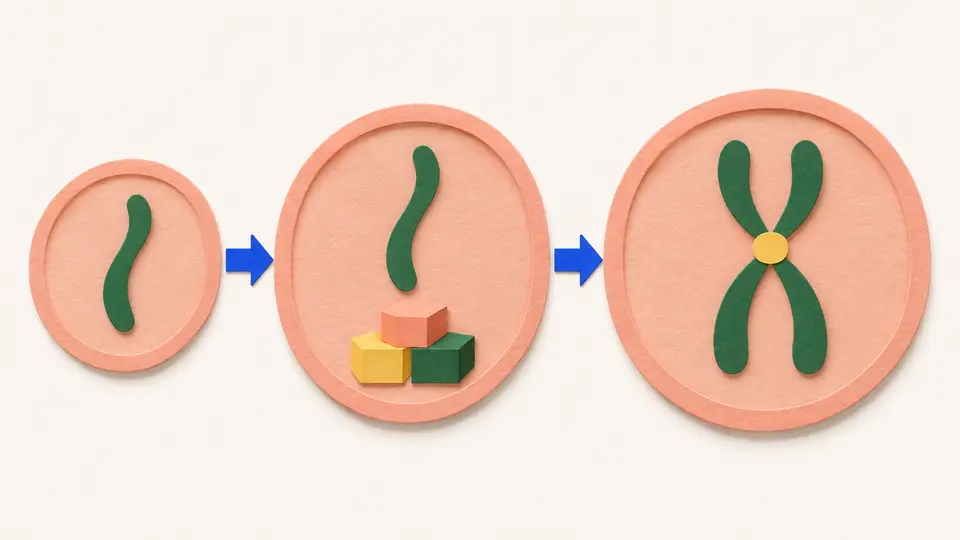
S takes about ten hours and is where the copying happens. Every chromosome is replicated, and the two identical copies stay joined at a pinched region called the centromere. A joined pair is called sister chromatids. The cell also duplicates its centrosome, the structure that will later organize the pulling apart.
G2, the second gap, takes about four and a half hours. The cell restocks the energy it spent on copying and makes the proteins it'll need to move chromosomes. It also takes apart its cytoskeleton, the cell's internal framework, so the pieces can be reused in the division machinery.
At the end of G2 the cell holds two complete sets of chromosomes, but it's still one cell with one nucleus. Nothing has been divided. Doubling and dividing are separate jobs, and the doubling comes first.
The order can't be reversed. If a cell split before it copied, each half would get only part of the instructions, and neither could rebuild what was missing. Copying first means one clean separation can give each side a complete set.
Try to recallA textbook diagram shows the cell cycle as a circle, with a small wedge labeled M and a much larger arc labeled interphase. Explain what the sizes represent and what happens during the larger arc.
The sizes show time. A cell spends most of the cycle in interphase, which runs G1, then S, then G2. In G1 the cell grows and stockpiles DNA building blocks and energy. In S it copies every chromosome, giving sister chromatids joined at the centromere. In G2 it restocks its energy, makes proteins for the division and takes apart its cytoskeleton for reuse. After all that it's still one cell, now holding two complete sets of chromosomes.
So the split you can see is the last half hour of a day's work. By then every chromosome is a joined pair of copies, all in one nucleus. What's left is a sorting job. One copy from each pair has to reach each end of the cell before it divides.
Lessons in this topic
Why a cell copies everything before it splits
A dividing cell spends nearly all its time preparing. Follow the three stages of that preparation, and see why the DNA has to be copied before anything is divided.
How a dividing cell sorts its chromosomes
See how fibers from opposite ends of a cell pull each pair of chromosome copies apart, and why dividing the nucleus and dividing the cell are separate steps.
The three checkpoints where a cell can stop dividing
A cell checks itself at three points before it divides. See what each check looks for, and why each one sits just before a step that can't be undone.
How broken cell-cycle controls lead to cancer
Cancer begins when the controls on cell division fail. Tell a stuck accelerator from a broken brake, and see why one gene, p53, is damaged in about half of all cancers.
Three quick stories from this topic
An eight-minute cell cycle
A fruit fly embryo gets through a whole cell cycle in about eight minutes
It saves time by skipping a step. The nucleus of the fertilized egg divides again and again without the cell splitting, which leaves one cell holding many nuclei. A fast-dividing human cell takes about 24 hours for one cycle.
Half an hour of dividing
In a fast-dividing human cell, growth takes about nine hours and copying the DNA ten. The dividing itself takes only about half an hour.
Cells that stop for good
Mature heart muscle cells and nerve cells sit in a resting state called G0. They rarely or never divide again.
Pinching versus building a wall
An animal cell divides by pinching in two, but a plant cell has to build a wall
A ring of protein fibers tightens around the middle of an animal cell until it splits. A plant cell has a wall around it and needs a new one between its halves. Small membrane sacs gather at its center and fuse into a plate that grows outward into that wall.
Two separate steps
Dividing the nucleus and dividing the cell are different jobs. Animal and plant cells sort their chromosomes in much the same way. The final cut is where they differ.
One step without the other
When the nucleus divides and the cell doesn't, the result is a single cell with more than one nucleus.
The gene damaged in half of cancers
One gene, p53, is damaged in about half of all human cancers
The p53 protein checks a cell's DNA before it's copied. It halts the cell cycle if it finds damage, calls in repair enzymes, and orders the cell to die if the repair fails. A cell that loses p53 loses all three safeguards at once.
Brakes and accelerators
Genes like p53 act as brakes on cell division. Other genes act as accelerators, and a mutation can leave one of those stuck on.
Cell death matters too
Normal cell division is balanced by programmed cell death. A faulty p53 can't order a damaged cell to die, so the cell survives and divides.
Sources
- 10.2 The Cell Cycle - Biology 2e, OpenStax, Rice University
- 10.3 Control of the Cell Cycle - Biology 2e, OpenStax, Rice University
- 10.4 Cancer and the Cell Cycle - Biology 2e, OpenStax, Rice University
- TP53 gene, MedlinePlus Genetics, US National Library of Medicine