Science · Cells, genes & microbes
How traits are inherited
Children resemble their parents but aren't copies of them. See how genes come in pairs, how Mendel's peas revealed the rules, and why most human traits don't follow simple ratios.
What you will learn
- Explain how Mendel's pea crosses showed that a hidden trait returns in about a quarter of the next generation
- Use dominant and recessive alleles to predict the offspring of a cross
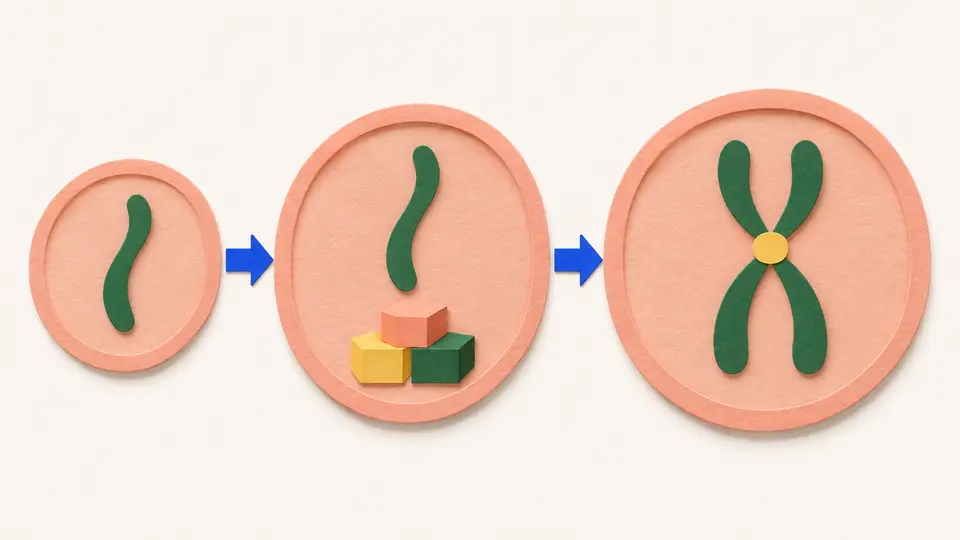
- Explain how meiosis gives each egg or sperm cell one copy of each chromosome pair
- Explain how random sorting and crossing over make siblings genetically different
Lesson 1 of 4 · 4 min
What Mendel's peas revealed about two copies of every gene
In the 1850s most people thought a child's traits were a blend of the parents', like mixing two paints. Gregor Mendel, a friar in Brno, tested that idea in his abbey's garden. Between 1856 and 1863 he grew some 28,000 plants, most of them peas.
Peas suited him because they come in clear either-or forms. Seeds are round or wrinkled, yellow or green. He followed seven traits like these, crossing plants that always bred true and counting what came out.
When he crossed yellow-seeded plants with green-seeded ones, every offspring had yellow seeds. Blending would have predicted a yellowish green. Then he let those offspring breed among themselves, and green came back.
His counts show how often. One crop gave 6,022 yellow seeds and 2,001 green, about 3 to 1. Round against wrinkled gave 5,474 to 1,850, nearly the same ratio. Mendel called the trait that showed up first dominant and the one that hid for a generation recessive.
Mendel's answer, in today's words, is that each plant carries two copies of each gene, one from each parent. The versions of a gene are called alleles. Write the yellow allele Y and the green allele y.
The first-generation plants were Yy. Y is dominant, so one copy is enough to make yellow. Each Yy parent passes on Y or y at random. So their offspring come out about 1 YY, 2 Yy and 1 yy in every 4. Only yy shows green, which gives the 3 to 1.
People work the same way for some conditions. In cystic fibrosis, both parents usually carry one altered copy and feel fine. Each child has a 1 in 4 chance of getting two.
Try to recallTwo pea plants are both Yy for seed color, where yellow Y is dominant. What share of their offspring would you expect to have green seeds, and why?
About 1 in 4. Each parent passes on Y or y at random, so offspring come out about 1 YY, 2 Yy and 1 yy. Only yy plants lack a dominant Y, so only they have green seeds.
Traits don't blend. Each gene comes in two copies, one dominant allele can hide a recessive one, and two carriers have a 1 in 4 chance of a child who shows the hidden trait.
Lessons in this topic
What Mendel's peas revealed about two copies of every gene
Follow a monk's pea experiments to the rule that every gene comes in two copies, and learn to predict what a cross will produce.
Why brothers and sisters turn out different
See how your body makes egg or sperm cells with half its chromosomes, and why that shuffle makes every sibling a new mix.
Height, eye color and the myth of the one-gene trait
See why most human traits come from many genes plus the world you grow up in, and why classroom examples like tongue rolling are wrong.
Why color blindness runs through mothers to sons
Learn why traits carried on the X chromosome show up mostly in males, then read a family tree to track one down the generations.
Three quick stories from this topic
8 million kinds of egg
One person can make 8,388,608 different chromosome mixes in their eggs or sperm
Each egg or sperm gets one chromosome from each of 23 pairs, chosen at random. Two choices, 23 times over, gives more than 8 million mixes, before crossing over shuffles the pieces further.
Then the swap
Matching chromosomes trade stretches of DNA at least once per pair, so each one passed on is a patchwork.
Why siblings differ
Ordinary siblings share about half their DNA on average. Only identical twins nearly match.
The ignored pea paper
Mendel's paper founding genetics was cited only about three times in 35 years
Gregor Mendel presented his pea results in Brno in 1865 to about forty listeners. Readers saw it as a paper about breeding hybrids, and it sat largely unread until two other scientists reached the same results around 1900.
28,000 plants
Between 1856 and 1863 he grew some 28,000 plants, most of them peas, and counted their traits.
Rediscovered
Hugo de Vries and Carl Correns duplicated his work around 1900, and both credited Mendel.
The tongue-rolling myth
The geneticist who called tongue rolling a one-gene trait later said he was embarrassed
Alfred Sturtevant proposed it in 1940. Then studies found non-rolling parents with rolling children, and identical twins who differed. By 1965 he regretted seeing it listed as an established case.
Twins disagree
In one 1952 study, 7 of 33 identical twin pairs differed, despite sharing their DNA.
Still taught
It remains one of the most common classroom examples of a simple genetic trait.
Sources
- Gregor Mendel, Wikipedia
- Experiments on Plant Hybridization, Wikipedia
- Experiments in Plant Hybridization (1865), English translation, MendelWeb
- Allele, Dominant and Recessive glossary entries, US National Human Genome Research Institute
- Mendelian inheritance, Wikipedia
- What are the different ways a genetic condition can be inherited?, MedlinePlus Genetics, US National Library of Medicine
- Meiosis, Wikipedia
- Myths of human genetics, Tongue rolling, John H. McDonald, University of Delaware
- Tongue rolling, Wikipedia