Science · Cells, genes & microbes
Cells, the units of life
Every living thing is made of cells. See what's inside one, how a bacterial cell differs from yours, and why cells stay so small.
What you will learn
- Describe what Hooke and Leeuwenhoek first saw through their microscopes
- Name what every cell has and state the three claims of cell theory
- Explain how the nucleus, ribosomes, endoplasmic reticulum and Golgi work together to make and ship proteins
- Describe what mitochondria and the cell membrane do for the cell
Lesson 1 of 4 · 4 min
The smallest thing that's alive
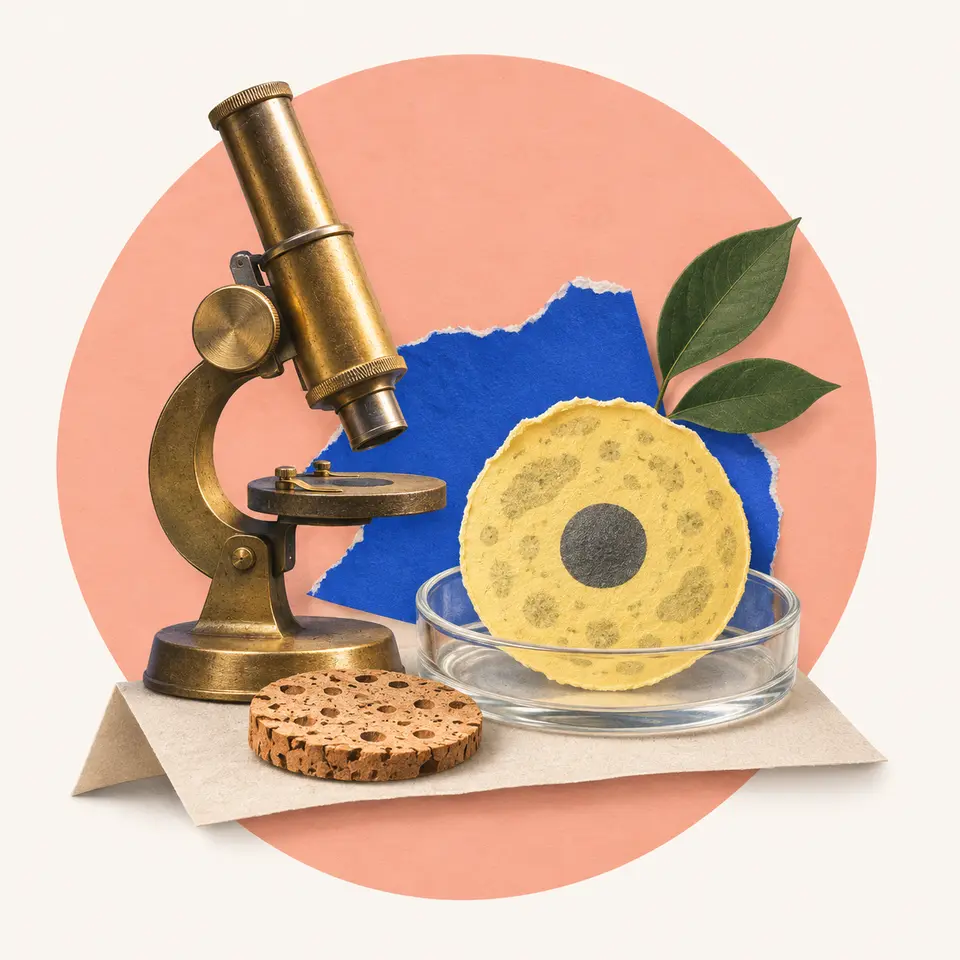
In 1665 Robert Hooke sliced cork thin and looked at it through a microscope. He saw rows of tiny boxes. They reminded him of the small rooms monks lived in, so he called them cells. His book of drawings, Micrographia, became the first scientific best-seller.
Hooke had seen only empty walls. Cork is dead tissue from a tree's bark, so the living contents were long gone. His microscope was too weak to show anything inside, and he didn't think his cells were alive.
A few years later a cloth merchant in Delft did better. Antonie van Leeuwenhoek wanted a closer look at thread, so he taught himself to make tiny glass lenses. His single-lens microscopes magnified up to about 270 times, far beyond Hooke's.
He pointed them at ditch water and at scrapings from his own teeth. They were full of moving creatures he called animalcules, little animals. In a 1676 letter to the Royal Society he argued that things that move this way must be alive. He had seen single-celled life, including bacteria.
By 1839 two German scientists had looked at enough tissue to draw a big conclusion. Matthias Schleiden said plants are built of cells, and Theodor Schwann said animals are too. In 1855 Rudolf Virchow added that every cell comes from another cell, an idea Robert Remak had already published.
Together these make cell theory. All living things are made of one or more cells. The cell is the smallest unit that's alive. New cells only come from cells that already exist.
Every cell, from a bacterium to one of your nerve cells, has the same basic kit. A thin membrane wraps it and controls what gets in and out. Inside is a watery gel called cytoplasm. There's DNA holding the instructions, and there are ribosomes that read those instructions to build proteins.
Try to recallWhat are the three claims of cell theory, and what four things does every cell contain?
Cell theory says all living things are made of cells, the cell is the smallest living unit, and new cells come from existing cells. Every cell has a membrane, cytoplasm, DNA and ribosomes.
Better lenses turned Hooke's empty boxes into living cells, and by 1855 biologists agreed that every living thing is made of cells that come from other cells. You can now name the four things every cell carries.
Lessons in this topic
The smallest thing that's alive
See how a slice of cork and a draper's homemade lens revealed cells, and what every cell, from a bacterium to a brain cell, carries inside.
A tour inside one of your cells
Walk through a human cell part by part, from the nucleus that stores the plans to the mitochondria that supply the power.
Two ways to build a cell
Compare a bacterium with one of your cells, then a plant cell with an animal cell, and see which differences matter most.
Why cells stay small, and the bacterium inside you
Work out why a cell can't just keep growing, then meet the evidence that your mitochondria were once free-living bacteria.
Three quick stories from this topic
Half the cells aren't you
Your body carries about 38 trillion bacteria and only about 30 trillion human cells
A 2016 estimate replaced the old claim that bacteria outnumber your cells ten to one. The counts are close, yet all those bacteria weigh only about 0.2 kg, because each is far smaller than a human cell.
Mostly in the gut
Most of the bacteria live in the large intestine.
Two cell plans
Bacteria are prokaryotes, with no nucleus and roughly 10,000 times less volume than a typical cell of yours.
Bacteria on a draper's teeth
Some of the first bacteria anyone saw came from a cloth merchant's own teeth
Antonie van Leeuwenhoek sold linen and ribbon in Delft. He ground his own tiny lenses, magnifying up to about 270 times, and found moving creatures in scrapings from his teeth.
No formal training
He taught himself lensmaking to inspect thread, then turned the lenses on ditch water, blood and teeth.
Letters to London
He described what he saw in hundreds of letters to the Royal Society, which helped found the study of microbes.
The paper fifteen journals refused
The paper arguing your mitochondria were once bacteria was turned down about fifteen times
Lynn Margulis wrote it in 1966 as a junior professor in Boston. It finally appeared in 1967, was largely ignored for a decade, then genetic evidence made it the standard account.
Own DNA, own division
Mitochondria carry a loop of DNA like a bacterium's and divide by splitting, as bacteria do.
A swallowed partner
The leading theory says a cell took in a bacterium some 1.7 to 2 billion years ago.
Sources
- Cell theory, Wikipedia
- Micrographia, Wikipedia
- Antonie van Leeuwenhoek, Wikipedia
- Cell (biology), Wikipedia
- Ribosome, Wikipedia
- Revised estimates for the number of human and bacteria cells in the body, PLOS Biology (Sender, Fuchs and Milo, 2016)
- Prokaryote, Wikipedia
- Lynn Margulis, Wikipedia
- On the origin of mitosing cells, Journal of Theoretical Biology (L. Sagan, 1967), Europe PMC record