Science · Space & the universe
The Moon's changing phases
See each phase as a changing view of a sunlit sphere, then use that geometry to explain the Moon's schedule and its eclipses.
What you will learn
- Explain how our viewing angle produces lunar phases.
- Tell ordinary phases apart from Earth's shadow falling on the Moon.
- Predict the phase an observer somewhere else would see at the same moment.
- Read waxing and waning as changes in how much of the sunlit part you can see.
- Use the positions of the Sun and Moon to explain roughly when the Moon is visible.
- Estimate the time of day from the Moon's phase and position, and name the method's limits.
Lesson 1 of 4 · 5 min
Where does the missing Moon go?
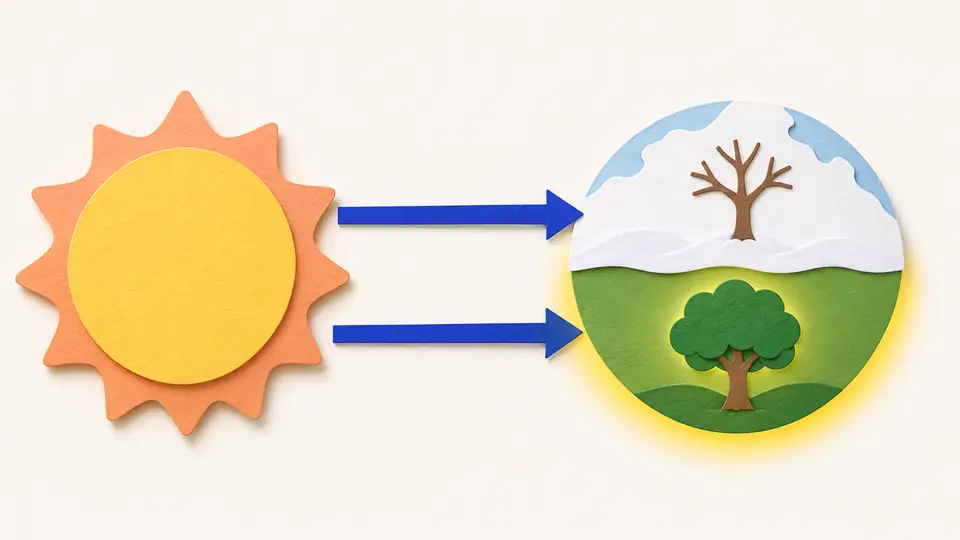
A crescent Moon looks as though someone has taken most of it away. The rock is all still there, and so is the light. The Moon makes no light of its own. Moonlight is reflected sunlight, and the Sun always lights half of the Moon. The shape you see depends on how much of that sunlit half faces Earth.
Picture a ball lit by a lamp in a dark room. Walk around the ball while the lamp stays put. From one spot the bright half fills your view, and from another it's a thin crescent. The ball and the lamp haven't changed. Only the direction you're looking from has.
With the real Moon you don't walk around the ball. The Moon's orbit carries it around you, about once a month, and that changes your viewing direction.
Near new Moon, the Moon is in the Sun's direction and its sunlit side faces away from us. Near full Moon, it sits opposite the Sun in our sky and its sunlit side faces us. In between we see part of each side. The Moon stays half lit the whole time. Only our view of that half changes.
It's tempting to blame Earth's shadow for the dark part. That can't be right for a crescent. A crescent Moon sits near the Sun in our sky, and Earth's shadow points directly away from the Sun, nowhere near it. The dark part of a crescent is the Moon's own night side.
Try to recallA friend says every crescent Moon is Earth's shadow covering the Moon. How would you correct them?
From Earth, a crescent shows only a small part of the Moon's sunlit half. Earth's shadow causes lunar eclipses, which happen at full Moon when the alignment is right.
If a phase is only a viewing angle, it should depend on where you stand. It does, but you have to travel a long way. Everyone on Earth sees the same phase on the same night, because the Moon is about 30 Earth-widths away. What changes is which way up it looks. From the Southern Hemisphere the Moon appears upside down compared with the northern view.
Go far enough and the phase itself changes. An observer out in the direction of the Sun would always see the lit half face on. To them the Moon would look full, whatever we see that night.
The best test is to turn around and look back at Earth. At new Moon, the side of the Moon facing us is dark. Someone standing there and looking up at Earth has the Sun behind them, so Earth's whole sunlit face is turned their way. Our new Moon is their full Earth.
You can see the evidence from your own street. Beside a thin crescent, the rest of the Moon's disk sometimes glows faintly. That glow is earthshine, sunlight bounced off a nearly full Earth onto the Moon's night side.
So a phase is a matter of where you look from. The Moon is always half lit. From Earth we see anywhere from none of that half to all of it.
From the Moon, Earth goes through phases too, and they're the opposite of ours. A thin crescent Moon for us is a nearly full Earth for someone standing on it.
Lessons in this topic
Where does the missing Moon go?
The Moon is always half lit. See why we get a crescent on some nights and a full disk on others, and why Earth's shadow has nothing to do with it.
Why is the Moon out in daylight?
Each phase of the Moon keeps its own hours. Link the phase to when the Moon rises and sets, and learn to tell a growing crescent from a shrinking one.
Why isn't there an eclipse every month?
Add the tilt of the Moon's orbit to the phase model, and tell the two kinds of eclipse alignment apart.
Why the Moon's month has two lengths
Separate the Moon's 27.3-day orbit from its 29.5-day phase cycle, then explain why one face always points at Earth.
Three quick stories from this topic
The red Moon
A fully eclipsed Moon turns red, lit by every sunrise and sunset on Earth at once
Earth blocks the direct sunlight, but some passes through the rim of its atmosphere and reaches the Moon. The air scatters the blue light away and lets the red through, the same way it reddens the Sun at dusk.
Why the eclipse isn't black
In a total lunar eclipse the Moon moves into the inner part of Earth's shadow. The only sunlight that reaches it has been filtered through Earth's atmosphere.
A dustier sky makes a redder Moon
The more dust or cloud there is in Earth's atmosphere during the eclipse, the redder the Moon appears.
Earthshine
The dark part of a crescent Moon glows faintly because Earth is shining on it
Seen from the Moon at that time, Earth is nearly full and bright enough to light the lunar night. The glow is called earthshine. It's sunlight that bounced off Earth, reached the Moon and came back to your eye.
The light takes an extra trip
The path runs from the Sun to Earth, from Earth to the Moon, and then from the Moon to your eyes. The crescent itself is lit directly by the Sun.
The missing rock was there all along
A phase changes how much of the directly lit part we see. Earthshine can make the rest visible without changing the phase.
The far side of the Moon
Nobody had seen the far side of the Moon until a Soviet spacecraft flew past it in 1959
The Moon spins exactly once for every trip around Earth, so the same face always points at us. The hidden side isn't dark. It gets as much sunlight as the near side, and at new Moon it's in full daylight.
One turn per orbit
The Moon takes the same time to spin once on its axis as it does to orbit Earth. This is called synchronous rotation, and NASA describes the two bodies as tidally locked. Turning exactly once per trip keeps one hemisphere pointed at Earth all month, so the other hemisphere never comes into view from the ground.
The far side isn't dark
The hidden hemisphere gets as much sunlight as the near side, and it has its own day and night as the Moon rotates. At new Moon, it's the far side that sits in full sunlight.
Sources
- Moon Phases, NASA Science
- Eclipses, NASA
- Top Moon questions, NASA
- Moon facts, NASA