Science · Oceans, weather & climate
The water cycle
The same water keeps moving between sea, air, land and living things. See what drives it, how long water stays in each place, and why the fresh water people can use is such a small share.
What you will learn
- Trace water through evaporation, condensation, precipitation and runoff
- Explain how the Sun and gravity power the water cycle
- Describe how Earth's water splits between oceans, ice and groundwater
- Explain why rivers and lakes supply so much water despite holding so little
Lesson 1 of 4 · 4 min
What keeps the world's water moving
In 1674 a bankrupt Paris tax official named Pierre Perrault published a short book with a big claim. He'd estimated the rain falling on the Seine's basin and compared it with the river's flow. The rain was easily enough to feed the river.
That sounds obvious now. For centuries it wasn't. Many scholars doubted rain could supply a river, so they had seawater seeping into underground caverns and rising to feed springs. Perrault's numbers backed a closed loop instead, where the same water goes round and round. That loop is the water cycle.
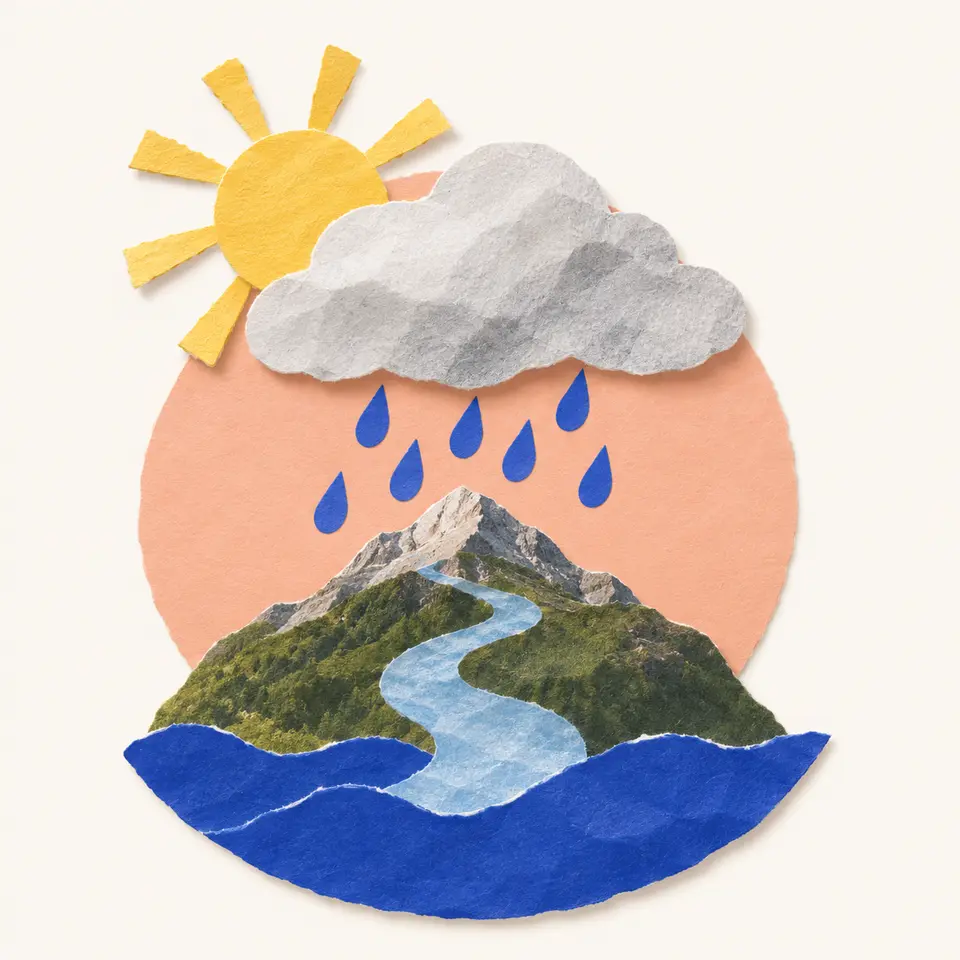
Follow one drop. The Sun warms the sea surface and the water evaporates, turning from liquid into an invisible gas called water vapor. Rising air carries the vapor up to where it's colder.
In the cold air the vapor condenses back into tiny droplets, and a mass of droplets is a cloud. The droplets collide and grow until they're heavy enough to fall as precipitation, which means rain, snow, sleet or hail.
On land the water splits up. Some flows over the ground as runoff into streams and rivers. Some soaks into the soil, called infiltration, and refills the water underground. Plants take some up and release it from their leaves as vapor, called transpiration. Almost all of it reaches the sea in the end.
Two things drive the whole loop. The Sun's energy lifts water up, because turning liquid into vapor takes heat. Gravity brings it back down, pulling rain from clouds and water downhill to the sea.
The heat used to evaporate water doesn't vanish. The vapor carries it as latent heat, meaning heat stored in the change from liquid to gas. When the vapor condenses into cloud, that heat goes back into the air. Weather systems carry vapor around the globe, so they carry its heat too. The water cycle moves energy as well as water.
Try to recallWhat two things drive the water cycle, and what does each one do?
The Sun's energy evaporates water, lifting it into the air as vapor. Gravity pulls precipitation down from clouds and makes water flow downhill back to the sea. The heat taken up in evaporation is released when the vapor condenses.
Water loops from sea to sky to land and back. The Sun's heat lifts it, gravity returns it, and the vapor carries heat along the way.
Lessons in this topic
What keeps the world's water moving
Follow a drop from the sea into a cloud, onto land and back again, and see what powers each step.
Why so little of Earth's water is easy to use
See how Earth's water splits between sea, ice and rock, and why rivers and lakes, a tiny share, supply so much of what people use.
How long water stays in the air, the sea and the ice
Work out a residence time from a pool's size and its flow, and see why water pumped from deep underground may not come back for thousands of years.
Why warming brings both heavier rain and worse drought
See why warmer air holds more water vapor, why that makes downpours heavier, and how the same warming dries out soils elsewhere.
Three quick stories from this topic
The rain-counting tax man
A bankrupt tax official showed in 1674 that rain alone could feed a river
Pierre Perrault compared the rain falling on the Seine's basin with the river's flow and found the rain was easily enough. Many scholars before him thought rivers were fed by seawater rising through caverns.
The old idea
For centuries, scholars doubted there was enough rain to supply rivers and springs. Many thought seawater seeped into caverns and rose to feed them.
A famous brother
Perrault published his book, On the Origin of Springs, anonymously. His younger brother Charles wrote the Tales of Mother Goose.
Rivers hold almost nothing
All the world's rivers together hold about 0.0002% of Earth's water
That's about 2,120 cubic kilometers out of roughly 1.4 billion. Rivers still supply much of the water people use, because runoff and groundwater keep flowing into them.
Where the rest is
About 96.5% of Earth's water is in the oceans. Of the fresh water, about 69% is frozen and 30% is underground.
Small but fast
A river is a small store with a large flow. For supply, what counts is how quickly water arrives, not how much sits there.
The sky's thin layer
If all the water in the air rained out at once, it would cover Earth just 2.5 cm deep
The atmosphere holds about 12,900 cubic kilometers of water at any moment. Yet about 495,000 cubic kilometers pass through it each year, so its water is replaced nearly 40 times a year.
A short stay
An average water molecule spends about 9 days in the air before falling as rain or snow.
Slow pools
The oceans keep water for about 3,200 years on average, and deep groundwater for around 10,000.
Sources
- Pierre Perrault (scientist), Wikipedia
- Water cycle, Wikipedia
- The water cycle, NASA Earth Observatory
- Water cycle, US Geological Survey Water Science School
- Where is Earth's water?, US Geological Survey Water Science School
- How much water is there on Earth?, US Geological Survey Water Science School