Science · Oceans, weather & climate
The greenhouse effect
Follow energy into and out of Earth, see how greenhouse gases shift that balance, and tell a forcing from a feedback.

What you will learn
- Tell incoming sunlight apart from the thermal infrared radiation Earth gives off.
- Explain how greenhouse gases slow heat loss and warm the surface.
- Explain how adding greenhouse gases strengthens a natural process that already exists.
- Point to evidence that tells recent greenhouse warming apart from increased solar input.
Lesson 1 of 4 · 3 min
Why isn't Earth a frozen planet?
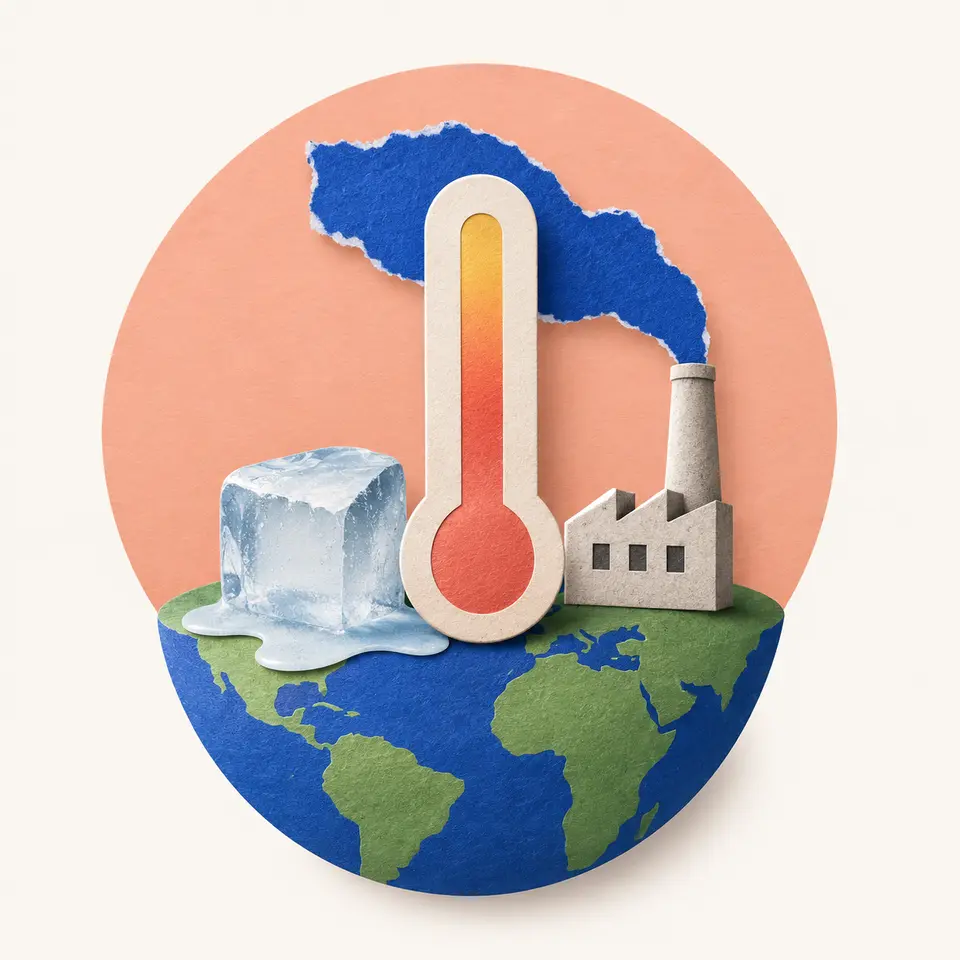
Earth's surface averages about 15 degrees Celsius, or 59 Fahrenheit. Without the greenhouse effect it would be about 33 degrees Celsius colder, a frozen planet under the same Sun.
So sunlight alone doesn't set the temperature. To see what does, follow the energy in both directions, in as sunlight and back out to space.
About half the sunlight reaching Earth's atmosphere passes through the air and clouds and is absorbed by the surface, which warms up. A warm surface gives off radiation of its own, called thermal infrared. It's the same kind of thing as visible light, with longer waves that eyes can't see.
So the energy leaving Earth is a different kind of radiation from the sunlight that arrived.
Think of it as a budget. Sunlight is the income and outgoing infrared is the spending. If the two match, Earth's temperature holds steady. If more comes in than goes out, energy builds up and the planet warms.
The budget covers the whole planet over years, so it says nothing about tomorrow's weather where you live.
Most of the air lets infrared pass. A few gases, among them carbon dioxide, methane and water vapor, absorb it. They catch about 90% of the heat the surface radiates and send it out again in every direction, including back down.
So heat leaves for space more slowly, and the surface ends up warmer than it would be without them. These are the greenhouse gases.
That's the natural greenhouse effect, and life depends on it. It makes the 33-degree difference between a frozen Earth and the one you live on.
So a greenhouse gas isn't a pollutant by definition. The question about today's warming is what happens when people add more of these gases to a balance that already exists.
Try to recallHow can greenhouse gases warm Earth even though energy keeps escaping to space?
Greenhouse gases absorb the infrared the surface gives off and send it out again in every direction, which slows heat loss to space. With the same sunlight coming in and heat leaving more slowly, the surface sits at a higher temperature. Energy never stops flowing out.
Lessons in this topic
Why isn't Earth a frozen planet?
Follow sunlight in and infrared out to see how greenhouse gases keep Earth about 33 degrees Celsius warmer than it would otherwise be.
What changes when carbon dioxide increases?
Carbon dioxide is natural, and there's now nearly 50% more of it in the air. See how that strengthens the greenhouse effect, and how scientists ruled out the Sun.
Why does water vapor amplify warming?
Water vapor is the most abundant greenhouse gas, yet it follows the warming instead of starting it. See the difference between a forcing and a feedback.
Where the Sun's 340 watts per square meter go
Put numbers on Earth's energy budget, then see why an imbalance of about one watt per square meter still matters.
Three quick stories from this topic
More heat from the air than the Sun
Earth's surface gets about twice as much energy from the air above it as from sunlight
Averaged over the planet, the surface absorbs 48% of the sunlight arriving at the top of the atmosphere. Greenhouse gases in the air radiate infrared back down equal to about 100% of it. NASA calls this back radiation, and it's the greenhouse effect at work.
Two big flows in opposite directions
Greenhouse gases absorb infrared from the ground and radiate it in every direction, including back down. The surface sends up infrared equal to about 117% of incoming sunlight and gets about 100% back, so the net upward flow is 17%. This extra heating from the atmosphere is the natural greenhouse effect.
Why the numbers add up to more than 100
Every percentage is measured against the sunlight arriving at the top of the atmosphere, and the same energy can be absorbed and re-emitted several times before it escapes. NASA notes that these flows are estimates with uncertainty, refined using satellite and ground observations.
33 degrees of natural warming
Earth's natural greenhouse effect keeps the planet about 33 degrees Celsius warmer
The surface averages about 15 degrees Celsius. NASA says that if carbon dioxide were removed, the greenhouse effect would collapse and the temperature would fall by roughly 33 degrees, leaving a frozen planet under the same Sun.
How the gases do it
Greenhouse gases absorb about 90% of the heat the surface radiates and send it out again, which slows its escape to space.
What people changed
Human activity has raised carbon dioxide in the air by nearly 50% since 1750. That strengthens an effect that was already there.
Water vapor follows the warming
Water vapor, the most abundant greenhouse gas, amplifies warming but doesn't start it
The amount of water vapor in the air depends on temperature. When carbon dioxide warms the planet, more water evaporates from the ocean, and the extra vapor traps more heat. NASA calls it a feedback, which amplifies warming that other gases begin.
Forcing and feedback
A forcing changes Earth's energy balance directly, as added carbon dioxide does. A feedback is a response to that change which makes it larger or smaller.
Positive doesn't mean good
A positive feedback pushes the same way as the change that set it off. Water vapor is one, because warming adds vapor and vapor adds warming.
Sources
- The causes of climate change, NASA
- What is the greenhouse effect?, NASA
- Climate and Earth's energy budget, NASA Earth Observatory