Science · Living things & evolution
The tree of life and how species are classified
All known life descends from shared ancestors and can be drawn as one branching tree. See how living things are sorted and named, what the main branches are, and how DNA redrew the picture.
What you will learn
- Explain what it means that all known life shares common ancestors
- Read a branching tree to tell which living groups are most closely related
- Describe the three domains of life and how archaea were recognized
- Place plants, fungi and animals on the eukaryote branch and say how each one gets food
Lesson 1 of 4 · 4 min
One family tree for every living thing
Around July 1837, Charles Darwin drew a small branching sketch in a notebook and wrote "I think" above it. Twenty-two years later, a more careful branching diagram became the only illustration in On the Origin of Species.
The picture carried his big idea. Species aren't separate creations. They split from earlier species, which split from earlier ones still. Follow any two branches back far enough and they meet.
This is common descent. Any two living species share an ancestor somewhere in the past. The more recent that shared ancestor, the more closely related the two species are.
Biologists think all known life traces back to one last universal common ancestor, which lived about 3.9 billion years ago. One clue is that nearly every living thing, from bacteria to people, reads its DNA with the same genetic code.
Biologists draw these relationships as evolutionary trees. Time runs from the root to the tips. The tips are living groups. Each place where a line splits, called a node, stands for a common ancestor.
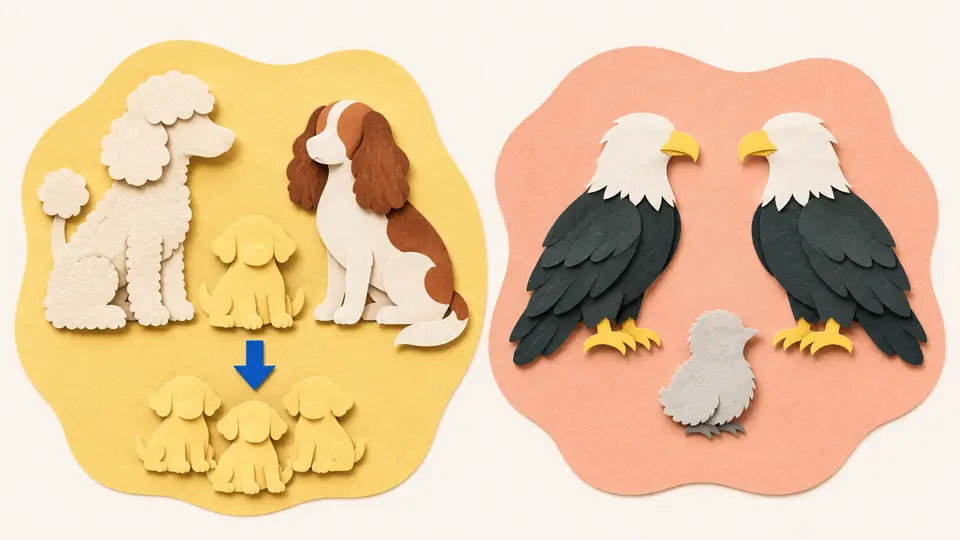
Two groups that split from the same node are sister groups, each other's closest relatives. To compare any two tips, trace them back to where their lines meet.
Try to recallOn an evolutionary tree, how do you tell which of two living groups is closer to a third, and why doesn't left-to-right order matter?
Trace each pair back to the node where their lines meet. The pair that meets at the more recent node is more closely related. Left-to-right order doesn't matter because the branches at any split can be swapped without changing who shares which ancestor.
All known life shares ancestors, and a tree shows who shares the most recent one. You can now read one by following the branches back to where they meet, without treating any tip as more advanced.
Lessons in this topic
One family tree for every living thing
See why biologists draw all life as a single branching tree, and learn to read one without falling for the ladder of progress.
The three great branches of life
Meet bacteria, archaea and the eukaryotes, and see how a study of one molecule split the microbes in two.
How every species gets a two-part name
See how Linnaeus gave species short Latin names and nested ranks, and where his ranks mislead.
Why birds are dinosaurs and mushrooms are your cousins
See how naming only true branches puts birds among the dinosaurs, and how DNA moved fungi next to animals.
Three quick stories from this topic
Darwin's only picture
On the Origin of Species had just one illustration, a branching tree
Darwin's 1859 book argued for evolution in words, with a single diagram of species splitting over thousands of generations. He'd first sketched the idea in a notebook in 1837, under the words "I think".
Branches meet
Trace any two branches back and they join at a shared ancestor.
One tree for all
Biologists now think all known life descends from one ancestor about 3.9 billion years ago.
Most species unnamed
About 86% of Earth's plant, animal and fungus species may still have no name
After 250 years of naming, about 1.2 million species with nucleated cells are catalogued. A 2011 estimate put the real total near 8.7 million, so most are still waiting for a scientist to describe them.
Linnaeus's 10,000
The 1758 edition of Systema Naturae listed only about 10,000 species.
Two-part names
Each new species gets a genus and a species name, like Homo sapiens.
A third branch of life
The microbiologist who found a whole new domain of life was called a crank
In 1977 Carl Woese and George Fox showed that archaea differ from bacteria as much as plants do from animals. Leading biologists objected, and it took years for the three-domain tree to win.
One molecule
They compared a piece of RNA found in the ribosomes of every cell.
Lookalikes
Archaea look like bacteria under a microscope, and many live in extremely hot or salty places.
Sources
- Tree of life (biology), Wikipedia
- Common descent, Wikipedia
- Understanding phylogenies, Understanding Evolution, University of California Museum of Paleontology
- Reading trees, a quick review, Understanding Evolution, University of California Museum of Paleontology
- Trees, not ladders, Understanding Evolution, University of California Museum of Paleontology
- How many species are there on Earth and in the ocean?, PLOS Biology (Mora and others, 2011)
- Carl Woese, Wikipedia