Science · Ecosystems & the environment
How energy and matter move through an ecosystem
Energy passes through an ecosystem once and leaves as heat, while matter cycles back again. That's why the two have to be tracked separately.
What you will learn
- Name the three ways organisms get energy, and say which of those organisms make their own food
- Tell gross primary productivity from net primary productivity, using a measured example
- Calculate a trophic level transfer efficiency and say what it means for the length of a food chain
- Explain why an ectotherm turns more of what it eats into biomass than an endotherm does
Lesson 1 of 4 · 5 min
Where an ecosystem gets its energy
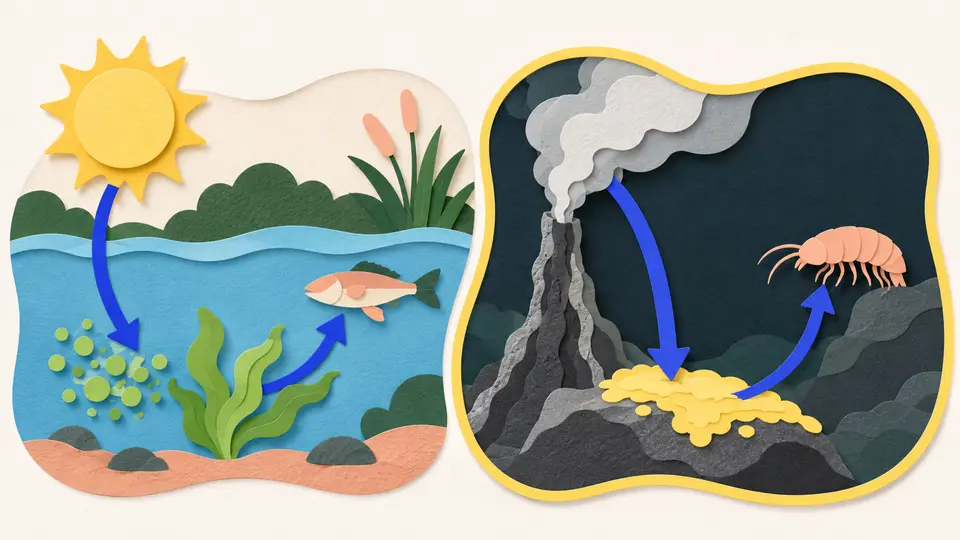
At a hydrothermal vent on the deep seafloor, no sunlight ever arrives. Yet shrimp, squat lobsters and hundreds of mussels crowd around it. Where does their energy come from?
Every ecosystem runs on energy from somewhere. Organisms get it in three ways, by photosynthesis, by chemosynthesis, or by eating other organisms. The first two build food from raw materials. The third moves food that already exists.
Organisms that make their own food are autotrophs. Photoautotrophs use sunlight. They're the familiar ones, plants, algae and photosynthetic bacteria, and they power most of the world's ecosystems.
Chemoautotrophs use the energy in inorganic molecules instead. They're mostly bacteria living where light never reaches, in dark caves and at vents. At the vents, many of them run on hydrogen sulfide coming out of the seafloor.
Both kinds are producers. Everything else is a heterotroph, an organism that gets its energy by eating others. Energy enters at the producers and moves up through the eaters in steps called trophic levels. An organism's level depends on how many transfers separate it from the producers.
How much energy comes in? Gross primary productivity is the rate at which producers capture energy. They don't keep it all, because producers respire too, and the energy they spend staying alive leaves as heat. What's left is stored as biomass, meaning new living material. That's net primary productivity. Only that part is there for a consumer to eat.
Think of gross pay and take-home pay. Gross is what you earn, and take-home is what's left to spend. The analogy stops there, because nobody collects the producers' deductions. They just leave as heat.
Silver Springs in Florida shows the gap. Its producers captured 20,810 kilocalories per square meter per year. Their own respiration took 13,187. That left 7,623 as net primary productivity. Roughly two thirds of what they captured was gone before any consumer could touch it.
So what a level captures and what it passes on are two different numbers. Quote the gross figure when you mean the net one, and you overstate what an ecosystem can support. At Silver Springs you'd be out nearly threefold.
Try to recallProducers in the Silver Springs ecosystem in Florida captured 20,810 kilocalories per square meter per year, and 13,187 of that went to respiration and heat. How much is available to the primary consumers, and what is that quantity called?
7,623 kilocalories per square meter per year, which is the net primary productivity. Gross primary productivity is everything the producers captured. Subtract what they used for their own respiration and you're left with the net figure, the energy actually stored as biomass and available to be eaten.
So every ecosystem stands on producers, running on light or on chemistry. They capture energy, spend most of it on themselves, and store the rest as new growth.
Only that stored part, the net figure, is on the menu for everything above them. At Silver Springs it was about a third of what came in.
Lessons in this topic
Where an ecosystem gets its energy
Every ecosystem runs on energy that producers capture from sunlight or from chemicals. Most of what they capture is spent before anything can eat it.
Why food chains are short
About a seventh of the energy at one level reaches the next, and that single number explains why no ecosystem has a tenth trophic level.
Why some ecological pyramids stand on their heads
Count organisms or weigh them and the diagram can come out upside down. Measure energy and it never does, and the reason is a law of physics.
Matter returns, energy doesn't
Energy makes a one-way trip and leaves as heat, while atoms cycle indefinitely. Nitrogen shows how an element can be everywhere and still be scarce.
Three quick stories from this topic
Caterpillar versus squirrel
A caterpillar turns food into body about ten times as efficiently as a squirrel
A leaf-eating caterpillar builds about 18% of the energy it absorbs into new tissue. A squirrel eating acorns may manage as little as 1.6%. The squirrel is warm-blooded, so most of its energy goes into holding its temperature and leaves as heat.
The cost of staying warm
Animals that hold a steady body temperature spend most of the energy they absorb on heat. Cold-blooded animals are about ten times more efficient at turning food into tissue.
The same loss on a receipt
One comparison puts 1,000 dietary calories at about 1 cent as corn or soybeans and 19 cents as beef. Cattle are warm-blooded, so much of the energy in their feed never becomes meat.
Nitrogen everywhere, out of reach
Air is about 78% nitrogen, and plants can't use a single molecule of it
Nitrogen gas is two atoms held by a triple bond that plants can't break. Bacteria can, including the ones living in the root nodules of peas and beans. So an ecosystem can run short of nitrogen while surrounded by it.
Bacteria are the only way in
Bacteria fix it, including cyanobacteria in water, Rhizobium inside the root nodules of legumes, and free-living Azotobacter in soil. That narrow route is why nitrogen limits production in many ecosystems.
What happens when people widen the way in
Burning fossil fuels and fertilizer runoff push fixed nitrogen into ecosystems fast. The results include acid rain, nitrous oxide, and eutrophication, which strips oxygen from water and kills the animals in it.
An upside-down pyramid
In the English Channel, the eaters outweigh the eaten about five to one
Measurements found 4 grams of phytoplankton per square meter and 21 grams of the zooplankton that eat them. The phytoplankton multiply so fast, and get eaten so fast, that only a little is present at any moment.
A snapshot hides the turnover
Biomass is a standing stock, a snapshot of what's present. Phytoplankton are eaten almost as fast as they appear, so little is there at any instant, even though a great deal is produced over a year.
The pyramid that can't invert
Plot energy produced per unit area per unit time and the shape is guaranteed. Each level draws from the one below and loses some as heat, so the first two laws of thermodynamics keep it upright.
Sources
- Energy flow through ecosystems, OpenStax, Biology 2e
- 46.3 Biogeochemical Cycles - Biology 2e, OpenStax, Rice University