Science · Ecosystems & the environment
Food webs and ecological knock-on effects
Read who eats whom, tell the flow of energy apart from the recycling of materials, and reason carefully about indirect ecological effects.
What you will learn
- Read the direction of energy transfer in a food web.
- Explain why species feed through connected routes instead of one fixed chain.
- Explain why only some food energy becomes biomass available to the next consumer.
- Explain why recycling nutrients doesn't create a closed cycle of usable energy.
Lesson 1 of 4 · 3 min
Which way does a food-web arrow point?
Draw an arrow between a rabbit and the fox that eats it. It's tempting to aim it at the rabbit, since the fox does the hunting. Ecologists aim it at the fox.
In a food web, an arrow points from the organism being eaten to the eater. It follows the food, and the energy in it, into the animal that swallows it. So an arrow from a leaf to a caterpillar means the caterpillar eats the leaf.
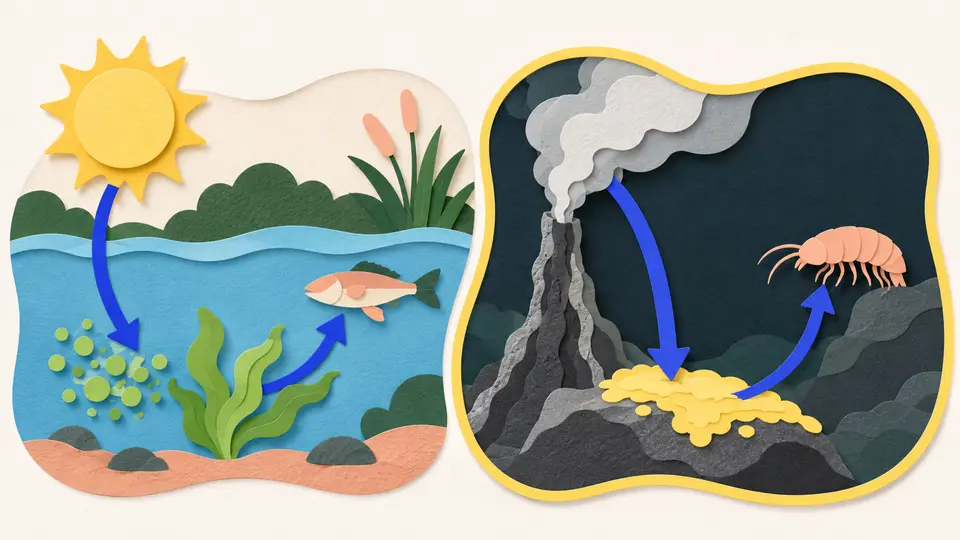
Many food webs start with primary producers, such as plants and algae, which use sunlight to build their own food. Everything else is a consumer. It feeds on other organisms or their remains.
A food chain traces one route. In Lake Ontario, green algae are eaten by snails, the snails by a small fish called the slimy sculpin, and the sculpin by Chinook salmon.
Now picture a simple garden. A caterpillar eats a leaf, and a bird eats the caterpillar. The leaf's stored energy moves along those two arrows, first into the caterpillar and then into the bird.
A drawing like this records only the links someone chose to draw. It doesn't list everything a caterpillar or a bird eats.
A chain leaves out the alternatives. In Lake Ontario, the yellow perch eats smaller animals, and it also eats the sculpin. The opossum shrimp eats tiny animals and the algae they graze on, so it feeds at two levels at once.
A food web draws all those routes together. That lets you see how a change in one population could reach several others by different paths.
One route in the web runs through dead material. Decomposers, mostly bacteria and fungi, feed on dead plants, dead animals and waste. Other organisms eat the decomposers, so that material rejoins the living web.
Leave them out and the diagram seems to stop whenever something dies. In a meadow, plants feed grazers while they're alive, and they feed bacteria, fungi and small invertebrates once they're dead.
Try to recallWhy might a food web describe an ecosystem better than one food chain?
A chain shows a single route. A web shows that one species can have several foods and several predators, and can feed at more than one level. So it shows the different paths a change could take.
Lessons in this topic
Which way does a food-web arrow point?
Read a food web's arrows the right way round, and see what a web shows that a single chain leaves out.
Why does energy thin out along a food chain?
See where the energy in food goes at each step up a food chain, and why recycling nutrients can't recycle energy.
How a predator changes plants it never eats
Follow an indirect effect from sea otters to kelp, and see why the same food-web arrows can give a big effect in one place and a small one in another.
Why the top predator carries the poison
See how a poison that doesn't break down grows more concentrated at each step up a food chain, while the energy thins out.
Three quick stories from this topic
Otters and kelp forests
Sea otters keep Alaska's kelp forests standing without eating any kelp
Otters eat sea urchins, and urchins graze on kelp. A survey of 153 Alaskan sites found kelp plentiful and urchins scarce where otters lived, and the reverse where they didn't.
A three-link chain
Fewer otters means more urchins, and more urchins means less kelp. The otter affects the kelp only through the animal in between, which ecologists call an indirect effect.
Same arrows, different strength
When otters spread into southeast Alaska, urchins fell by nearly 100% and kelp surged. In the Aleutian Islands urchins fell by about 50% and kelp came back far more slowly.
Energy thins out fast
In one Florida spring, the top fish got a thousandth of the energy its plants captured
Howard Odum measured Silver Springs level by level. Its plants and algae captured about 20,800 kilocalories per square meter a year, and the fish at the top took in 21. At each step, most of the energy left as heat or went uneaten.
Where it goes
At each step some food goes uneaten, some passes through unabsorbed, and the eater burns energy to stay alive. Only what becomes new body tissue can feed the next level.
Matter comes back, energy doesn't
Decomposers return nutrients to the plants, so matter cycles. The energy leaves as heat, which is why the spring needs sunlight coming in all the time.
DDT and broken eggshells
DDT left fish-eating birds laying eggs too thin to survive the nest
DDT washed into waterways and grew more concentrated at each step up the food chain. Bald eagles, also hit by shooting and habitat loss, fell to 417 known nesting pairs in the lower 48 states by 1963. A 2018 to 2019 survey estimated 71,467.
Many meals, one body
In some aquatic ecosystems, organisms at each trophic level ate many organisms from the level below. So the persistent pesticide built up step by step and reached its highest concentration in the apex consumers, the birds that ate fish. It was shown to harm those bird populations.
From evidence to a ban
Rachel Carson's 1960s bestseller Silent Spring brought the problem to public attention, and the United States banned DDT in the 1970s. Biomagnification is still the reason health agencies advise caution about some large predatory fish today.
Sources
- Ecology of ecosystems, OpenStax, Biology 2e
- Energy flow through ecosystems, OpenStax, Biology 2e
- Sea otters and kelp forests in Alaska: Generality and variation in a community ecological paradigm, U.S. Geological Survey Publications Warehouse (Estes and Duggins, Ecological Monographs, 1995)
- Bald eagle (Haliaeetus leucocephalus), U.S. Fish and Wildlife Service