Science · Ecosystems & the environment
Ecosystems, habitats and niches
An ecosystem is a community of living things plus the place they live in. See how ecologists describe one, what a niche is, and why similar climates grow similar communities on different continents.
What you will learn
- Tell an individual, a population, a community and an ecosystem apart
- Explain what an ecosystem includes beyond its living things and why that matters
- Tell a species' habitat apart from its niche
- Explain why two species can't share one niche for long and how they avoid it
Lesson 1 of 4 · 4 min
From one butterfly to a whole ecosystem
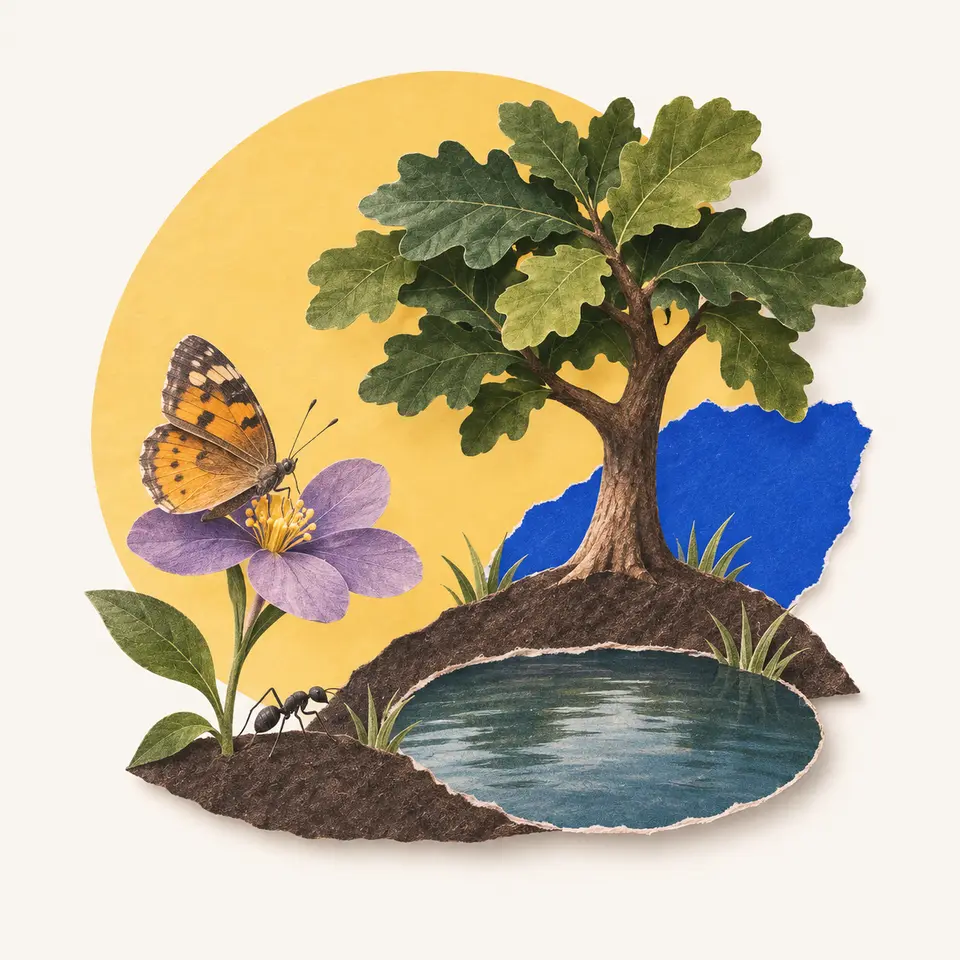
The Karner blue is a small butterfly listed as endangered in the United States. Its females lay eggs on just one plant, wild lupine. Ecologists study it at several levels, and each asks a different question.
At the level of the individual, they ask how one butterfly is built and behaves to fit its surroundings. A population is all the members of one species living in the same area at the same time. Population ecologists count Karner blues and ask why their numbers rise or fall.
A community is all the different species in an area and the ways they interact. The Karner blue's community includes ants. The caterpillars give off a sugary liquid the ants feed on, and the ants guard the caterpillars from spiders and predatory insects. Both sides gain, a partnership ecologists call mutualism.
An ecosystem is the community plus the nonliving parts of the place, such as air, water, soil and fire. Ecologists call the living parts biotic and the nonliving parts abiotic. Ecosystem ecologists also track how energy and nutrients move between the two. All of Earth's ecosystems together make the biosphere.
This level explains things the others can't. Karner blues live in oak-pine barrens with poor, low-nitrogen soils. Wild lupine thrives only in open ground, and natural wildfires used to keep it open by clearing trees and shrubs. When people put the fires out, shrubs closed in and lupine declined, taking away the only plant the butterfly lays its eggs on.
Try to recallWhat does an ecosystem include that a community doesn't, and why does that matter for the Karner blue butterfly?
An ecosystem adds the nonliving parts, such as soil, water and fire. For the Karner blue, wildfires kept the ground open for wild lupine. Stopping the fires let shrubs crowd out the lupine the butterfly depends on.
Individuals make up populations, populations make up communities, and a community plus its soil, water and fire is an ecosystem.
Lessons in this topic
From one butterfly to a whole ecosystem
Follow one endangered butterfly up through the levels ecologists use, and see what an ecosystem adds that a list of species leaves out.
Where a species lives and how it makes a living
Tell a habitat from a niche, and see why two species competing for exactly the same things can't share a place for long.
What sets the limits on where a species can live
See how the scarcest resource caps growth, how each species has a range it can tolerate, and why most species live in only part of that range.
Why similar climates grow look-alike living worlds
See how temperature and rainfall sort land into biomes, and why unrelated plants on different continents end up looking alike.
Three quick stories from this topic
Butterflies with bodyguards
Karner blue caterpillars pay ants in sugar to guard them from spiders
The caterpillars ooze a sugary liquid and give off ant-like scents that draw ants in. The ants feed and in return drive off spiders and predatory insects, which raises the caterpillars' survival.
A rare butterfly
The Karner blue is endangered in the United States, and its females lay eggs only on wild lupine.
A fire-loving plant
Wild lupine needs open ground. Natural wildfires used to clear it, and putting them out has let shrubs crowd the lupine out.
Twins from two continents
A South African succulent and a Mexican cactus look like twins but aren't related
The baseball plant, Euphorbia obesa, grows in South Africa's dry Karoo. It closely resembles the cactus Astrophytum asterias, because similar dry climates favored the same round, ribbed, water-storing shape.
Convergent evolution
When unrelated lineages face the same conditions, natural selection can push them toward the same solutions.
Same climate, same biome
That's why shrubland like California's chaparral also grows around the Mediterranean and in southern Australia.
The lake split in two
In 1973 scientists hung a curtain across a Canadian lake to test what feeds algae
Both halves of Lake 226 got carbon and nitrogen, and only one also got phosphorus. That half bloomed bright green with algae while the other stayed clear. Phosphorus was the limiting nutrient.
From lake to law
The experiments in Ontario's Experimental Lakes Area helped lead to bans on phosphates in household detergents.
The scarcest wins
Growth is set by the scarcest resource. Adding more of what's already plentiful changes almost nothing.
Sources
- Biology 2e, 44.1 The scope of ecology, OpenStax, Rice University
- Biology 2e, 45.6 Community ecology, OpenStax, Rice University
- Euphorbia obesa, Wikipedia
- Biology 2e, 44.3 Terrestrial biomes, OpenStax, Rice University
- Lake 226, Wikipedia
- Experimental Lakes Area, Wikipedia