Science · Earth & its history
Dinosaurs
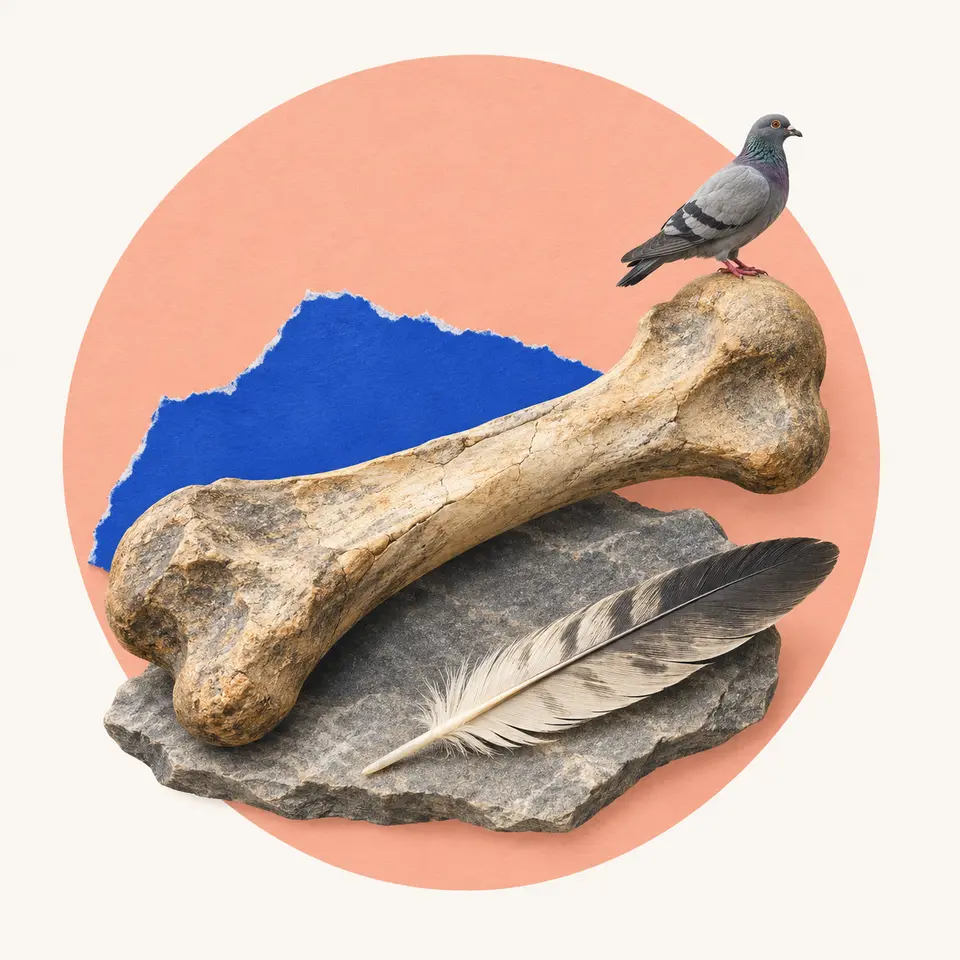
Dinosaurs ruled the land for more than 130 million years, and birds are their living descendants. See what makes an animal a dinosaur, how fossils reveal how they lived, and what ended their reign.
What you will learn
- Use the upright stance to tell dinosaurs from animals often mistaken for them
- Name the main dinosaur groups and explain why birds belong to one of them
- Explain how bone structure reveals a dinosaur's age and growth
- Describe how fossils show feathers, color and behavior
Lesson 1 of 4 · 4 min
What makes an animal a dinosaur
Picture a lizard running. Its legs stick out sideways and its body swings from side to side. A dinosaur stood differently. Its legs went straight down beneath its body, like a horse's or a bird's.
That stance came from the hip. A dinosaur's hip had a sideways-facing socket, and the top of the thigh bone turned inward to fit it. Standing upright likely let early dinosaurs breathe easily while moving, which gave them stamina.
So many famous prehistoric animals aren't dinosaurs. Flying pterosaurs were distant cousins. Plesiosaurs and ichthyosaurs were sea reptiles. Crocodiles are close relatives, but their legs sprawl. Woolly mammoths are mammals that came millions of years after the last non-bird dinosaur.
Dinosaurs appeared in the Triassic and took over the land after an extinction about 201 million years ago. Their reign was long. Stegosaurus lived 155 to 145 million years ago, Tyrannosaurus about 69 to 66 million, so more time separates them than separates T. rex from you.
Paleontologists define dinosaurs as the last common ancestor of Triceratops and modern birds, plus all its descendants. The family splits into two big branches. Ornithischians were plant-eaters, including armored ankylosaurs, plated stegosaurs, horned ceratopsians and duck-billed hadrosaurs.
Saurischians include the long-necked sauropods, the largest land animals that ever lived, some nearly 40 meters long. They also include the theropods, mostly two-legged meat-eaters such as Tyrannosaurus and Velociraptor.
Birds are theropods too. They evolved from small theropods and share their skeletons, so by that definition they sit inside the dinosaur family. Dinosaurs aren't all extinct. Scientists call the extinct ones non-avian dinosaurs, and over 11,000 species of birds are alive today.
Try to recallWhy do paleontologists say birds are dinosaurs rather than just related to them?
Dinosaurs are defined as the last common ancestor of Triceratops and modern birds plus all its descendants. Birds evolved from small theropods and share their skeletons, so they sit inside the dinosaur family. That makes them living dinosaurs.
Dinosaurs stood with their legs straight beneath them, which rules out pterosaurs, sea reptiles and crocodiles. They split into ornithischians and saurischians, and birds are saurischian theropods, so dinosaurs still live among us.
Lessons in this topic
What makes an animal a dinosaur
See the upright legs that set dinosaurs apart, meet the main groups, and find out why a pigeon counts but a pterosaur doesn't.
How fossils reveal age, feathers and color
See how a slice of bone gives a dinosaur's age, and how fossils preserve feathers, color and moments of behavior.
The asteroid that ended the age of dinosaurs
Follow the clues from a thin clay layer to a buried crater in Mexico, and see why birds, crocodiles and turtles made it through.
From slow lizards to feathered cousins of birds
See how one small predator overturned the old picture of dinosaurs, and what fossils from China, Mongolia and Argentina added.
Three quick stories from this topic
The iridium clue
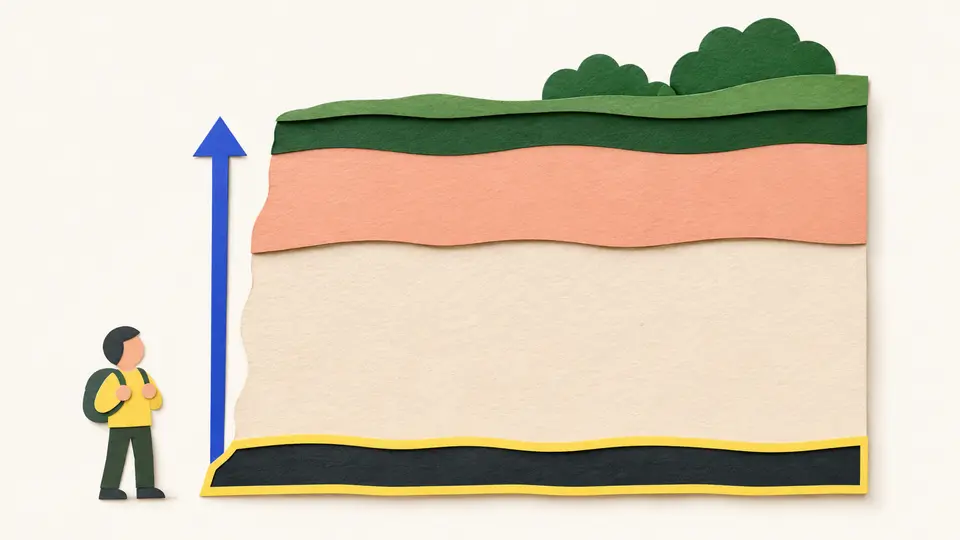
A thin clay layer laid down 66 million years ago holds up to 160 times the usual iridium
Iridium is rare in Earth's crust but more common in material from space. In 1980, the Alvarez team used that spike, found in Italy, Denmark and New Zealand, to propose that an asteroid killed the dinosaurs.
The missing crater
The crater, Chicxulub, lies buried under Mexico's Yucatán Peninsula. It's about 200 kilometers wide.
A worldwide layer
Debris from Chicxulub turns up in the same boundary layer around the world, right where the extinctions begin.
The egg thief that wasn't
Oviraptor, the egg thief, was really sitting on its own nest
It was found on a nest of eggs in Mongolia in 1923 and named for stealing them. Later finds of its relatives in the same pose, arms spread over their eggs, showed they were brooding like birds.
A parent's pose
Related dinosaurs laid eggs in round mound nests and sat over them with their arms around the edge.
Bird-like behavior
Brooding is one of many bird traits found in theropods, the dinosaur group that birds belong to.
Stegosaurus and T. rex
Less time separates you from T. rex than T. rex from Stegosaurus
Stegosaurus lived about 155 to 145 million years ago, and Tyrannosaurus about 69 to 66 million years ago. That gap of over 75 million years is longer than the 66 million since T. rex died out.
A very long reign
Dinosaurs dominated the land from about 201 million years ago until 66 million years ago, more than 130 million years.
Films mix them up
Stories often put Stegosaurus and T. rex side by side, but no Stegosaurus ever met a Tyrannosaurus.
Sources
- Dinosaur, Wikipedia
- Introduction to the Dinosauria, University of California Museum of Paleontology
- Stegosaurus, Wikipedia
- Tyrannosaurus, Wikipedia
- Extraterrestrial cause for the Cretaceous-Tertiary extinction (Alvarez and others, Science, 1980), Europe PMC
- Chicxulub crater, Wikipedia
- Oviraptor, Wikipedia
- Citipati, Wikipedia