Philosophy & Ethics · Art & beauty
What is art?
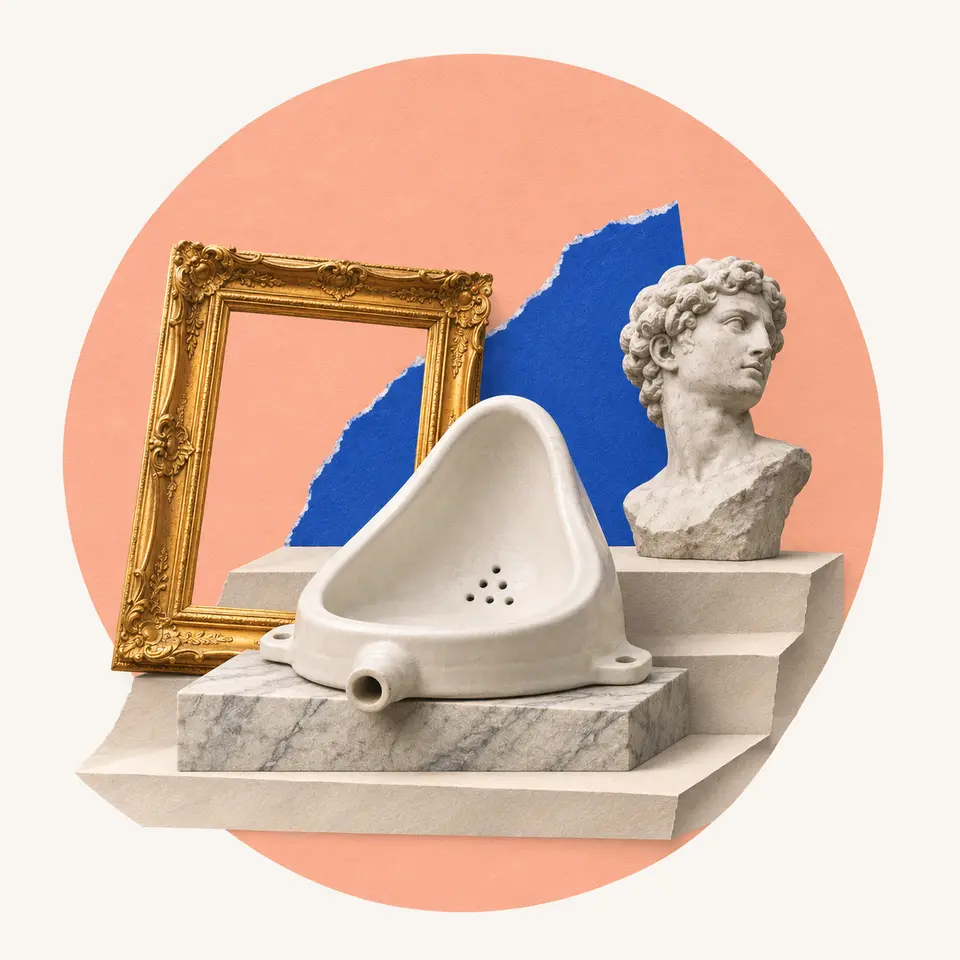
In 1917 a urinal was sent to an art exhibition, and every definition of art since has had to deal with it. Compare art as imitation, feeling and form, as whatever the art world accepts, and as no definition at all.
What you will learn
- Describe what happened when Fountain was submitted to the 1917 exhibition, including the dispute over who made it
- Explain why Fountain defeats the idea that art must be skilled, beautiful or made by hand
- Describe art as imitation, as the passing on of feeling and as significant form
- Explain why each single-property definition of art fails as a full definition
Lesson 1 of 4 · 4 min
The urinal that broke the rules of art
In April 1917, New York's new Society of Independent Artists opened its first exhibition. Its rule was no jury, so members could show what they liked. About 2,500 paintings and sculptures came in. One entry was a store-bought porcelain urinal, laid on its back and signed "R. Mutt".
The board argued over whether it was art at all. A majority called it indecent, and Fountain was hidden behind a partition for the whole show. Marcel Duchamp, a board member who had sent it in under the false name, resigned.
Who chose the urinal is disputed. It's usually credited to Duchamp. Some historians argue it was the idea of his friend, the artist Elsa von Freytag-Loringhoven. In a 1917 letter to his sister, Duchamp wrote that "one of my female friends" had sent it in under a male name.
The original was soon lost. Duchamp's biographer Calvin Tomkins thinks it was probably thrown out as rubbish. What survives is a photograph by Alfred Stieglitz and replicas made later.
A small magazine, The Blind Man, defended the piece. "Whether Mr Mutt with his own hands made the fountain or not has no importance," it said. "He CHOSE it." He took an ordinary object and gave it a new title and point of view.
Duchamp called these works readymades, everyday objects raised to the dignity of art "by the artist's act of choice." That's a hard test for old ideas. If Fountain is art, art needn't show skill or be made by hand. It needn't aim at beauty either, though Stieglitz said people found his photograph of it beautiful.
Plenty of people still say it isn't art. The art world disagrees. In 2004, 500 British art professionals voted it the most influential artwork of the 20th century.
Try to recallWhy does the urinal called Fountain cause trouble for the idea that art must be skilled, beautiful or handmade?
Fountain was a factory-made urinal that the artist chose and didn't make. If it counts as art, then skill, handwork and beauty can't be requirements. Its defenders said the choice and the new point of view were what mattered.
Fountain was chosen, not made, and the art world treats it as art. Any definition of art now has to explain that.
Lessons in this topic
The urinal that broke the rules of art
See what happened when a store-bought urinal was sent to a 1917 art show, and why it still troubles every definition of art.
Imitation, feeling and form as answers
Compare three classic answers to what art is, from Plato, Tolstoy and Clive Bell, and see why each one lets in things that aren't art.
Danto's boxes and the art world
See why two identical boxes can differ as art and non-art, and test the theory that the art world decides.
Maybe art can't be defined
Meet the idea that art is an open concept, then test a list-based account on video games and images made with AI.
Three quick stories from this topic
AI image wins a ribbon
An image made with AI won a state fair's fine art competition in 2022
Jason Allen made the picture in Midjourney from at least 624 prompts and revisions. It won the Colorado State Fair's digital art category for emerging artists. In 2023 the US Copyright Office refused to register it unless he disclaimed the AI-made parts.
Whose work is it
The Copyright Office's Review Board found more than a trivial amount of the image was made by AI, and copyright requires human authorship.
What it tests
On the cluster account of art, the picture has aesthetic qualities. The question is how much of its skill and point of view belongs to a person.
The lost urinal
The urinal voted the 20th century's most influential artwork was probably thrown away
In 2004, 500 British art professionals ranked Fountain first. The 1917 original vanished soon after, and Duchamp's biographer Calvin Tomkins thinks it was likely thrown out as rubbish. A photograph by Alfred Stieglitz and later replicas are what survive.
Hidden at its debut
The 1917 exhibition promised no jury, yet its board hid the urinal behind a partition for the whole show.
Why it still matters
Fountain was chosen, not made. If it's art, then skill, beauty and handwork can't be what makes something art.
The 2,000-times boxes
Warhol's wooden copies of soap-pad cartons cost about 2,000 times as much as the real ones
Arthur Danto made the comparison in his 1964 essay "The Artworld". Nothing you could see explained the gap. Danto concluded that seeing something as art takes a knowledge of art theory and history.
Same look, different thing
Danto noted the company could make its cartons from plywood without making art, while Warhol could use cardboard and still have art.
The artworld
Danto called that background of theory and history the artworld. George Dickie later built the institutional theory of art on it.
Sources
- Fountain (Duchamp), Wikipedia
- Théâtre D'opéra Spatial, Wikipedia
- Review Board decision on Théâtre D'opéra Spatial (September 5, 2023), United States Copyright Office
- The Artworld, Journal of Philosophy 61 (1964), Arthur Danto, via Masaryk University course archive