Philosophy & Ethics · Knowledge & truth
René Descartes
Descartes tried to doubt everything he believed and rebuild from one certainty, "I think, therefore I am". Follow what he claimed to prove, how he got from his mind back to the world, and the objections raised at once.

What you will learn
- Explain why Descartes wanted to rebuild knowledge on one secure foundation
- Describe how his method of doubt sets aside any belief open to doubt
- Explain why "I am, I exist" survives even the deceiver doubt
- Describe what the cogito leaves unproved and how Descartes uses God to reach the world
Lesson 1 of 4 · 4 min
Why Descartes decided to doubt everything
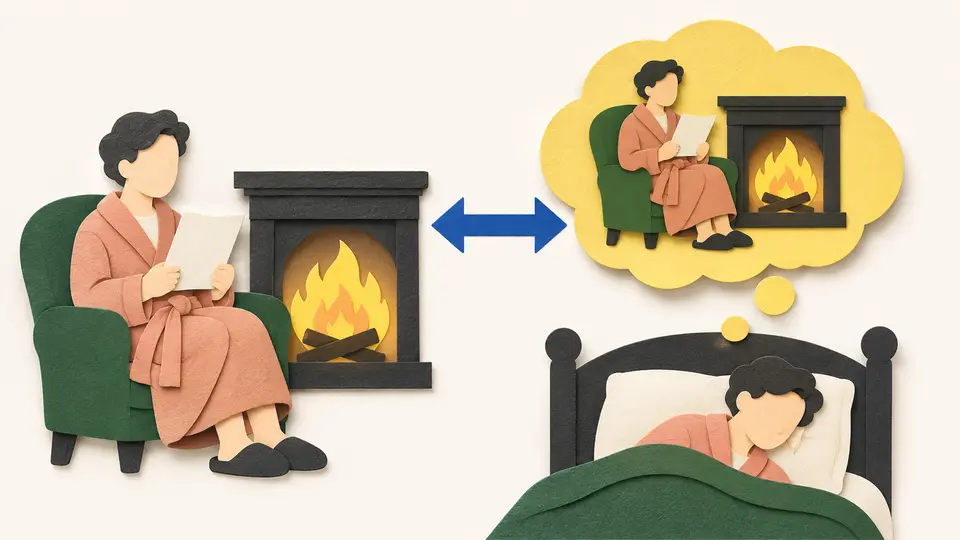
In November 1619 a 23-year-old French soldier, René Descartes, was stuck in winter quarters at Neuburg in Germany. According to his early biographer, he shut himself in a heated room to escape the cold. That night he had three dreams, and he took them as a sign that he'd found a new philosophy.
Why would anyone want a new one? At his Jesuit school, La Flèche, philosophy followed Aristotle. Descartes later wrote that he left school "beset by so many doubts and errors" that he'd gained only a sense of his own ignorance. He saw that philosophers disagreed, and that the sciences borrowing their principles inherited the disagreement.
So he wanted a single foundation that nothing could shake, with everything else built on top. In his Discourse on the Method, published in 1637, he recalled a thought from that winter. A town planned by one architect is better laid out than an old one that grew from a village, with new buildings squeezed between old walls.
Knowledge, he thought, should be built the way the planned town is. Most of what he believed had piled up since childhood, from many hands. He'd clear the ground and start again.
His tool was doubt. The Meditations on First Philosophy, published in 1641, open with the need to "demolish everything completely and start again right from the foundations". He didn't have to show a belief was false to set it aside. Finding some reason for doubt was enough.
He compared this to a basket of apples. If you fear some are rotten, you tip them all out, then put back only the ones you can see are sound. Checking beliefs one by one would never end, so he tested their sources instead.
The senses sometimes mislead, and you can't always tell waking from dreaming. His strongest doubt was a powerful deceiver who might trick him even when he adds two and three.
Try to recallIn Descartes's method of doubt, what did he need before setting a belief aside, and why did he test the sources of beliefs?
He needed only some reason for doubt, not proof that the belief was false. Checking every belief singly would never end, so he doubted whole sources at once, like the senses, which sometimes mislead. Whatever survived could serve as a foundation.
Descartes doubted so he could build. He set aside every belief open to any doubt, hoping that whatever survived could hold up everything else.
Lessons in this topic
Why Descartes decided to doubt everything
Meet the soldier-philosopher who wanted to rebuild knowledge from scratch, and see how his method of doubt was meant to clear the ground.
The one thing doubt can't touch
See why "I think, therefore I am" survives even an all-powerful deceiver, what it leaves unproved, and how Descartes used God to get back to the world.
Mind and body as two different things
Follow Descartes's argument that the mind isn't made of matter, and the question from Princess Elisabeth of Bohemia that he couldn't answer.
The Cartesian circle and what Descartes left behind
See the charge that Descartes used reason to prove God and God to prove reason, how he answered it, and what philosophy and mathematics kept from him.
Three quick stories from this topic
Elisabeth's question
In 1643 a 24-year-old princess asked Descartes a question his dualism couldn't answer
Elisabeth of Bohemia asked how a mind with no extension could move a body. Things move by contact, she reasoned, and something that takes up no space has nothing to push with.
Descartes's reply
He admitted to her that he didn't have a good answer. Some of his followers decided God lines up each mind with its body.
Still alive
Jaegwon Kim called her letter the first causal argument that the mind is physical.
Banned in 1663
Descartes wanted Jesuit schools to teach his physics, and the Church banned his books
He'd studied at the Jesuit college of La Flèche and wanted his work adopted in schools like it. In 1663, 13 years after his death, his works went on the Index of Prohibited Books.
Taught elsewhere
His physics was taught in the Netherlands, France, England and parts of Germany. Followers in France kept promoting it after the ban.
What he was up against
His physics of bare matter in motion replaced Aristotle's. The universities taught Aristotle, and orthodox theologians, Catholic and Protestant, strongly backed him.
The missing cogito
"I think, therefore I am" never appears in Descartes's Meditations
He first wrote it in French in 1637, "je pense, donc je suis", so readers without Latin could follow. The Latin cogito, ergo sum came in 1644, while the Meditations say "I am, I exist".
The same idea, reworded
In the Meditations the point is that "I am, I exist" is true whenever he thinks it. Even an all-powerful deceiver can't make it false.
Why it survives doubt
Doubting is a kind of thinking. So the moment you doubt that you exist, you prove that you do.
Sources
- René Descartes, Wikipedia
- René Descartes, Stanford Encyclopedia of Philosophy
- Discourse on the Method, translated by John Veitch, Project Gutenberg
- Descartes' Epistemology, Stanford Encyclopedia of Philosophy
- Elisabeth of Bohemia, Stanford Encyclopedia of Philosophy
- Elisabeth of the Palatinate, Wikipedia
- Cogito, ergo sum, Wikipedia