Philosophy & Ethics · Knowledge & truth
Could you be a brain in a vat?
If you can't rule out that you're dreaming or being deceived, it's hard to see how you know anything about the world. The skeptic's case fits in three lines, and each of the best-known replies to it comes at a cost.
What you will learn
- Explain how Descartes' dreaming argument casts doubt on beliefs that come from the senses
- Distinguish Descartes' method of doubt from doubting things in everyday life
- Lay out the brain-in-a-vat argument as two premises and a conclusion
- Explain the closure principle and why it's hard to give up
Lesson 1 of 4 · 5 min
Why Descartes couldn't prove he was awake
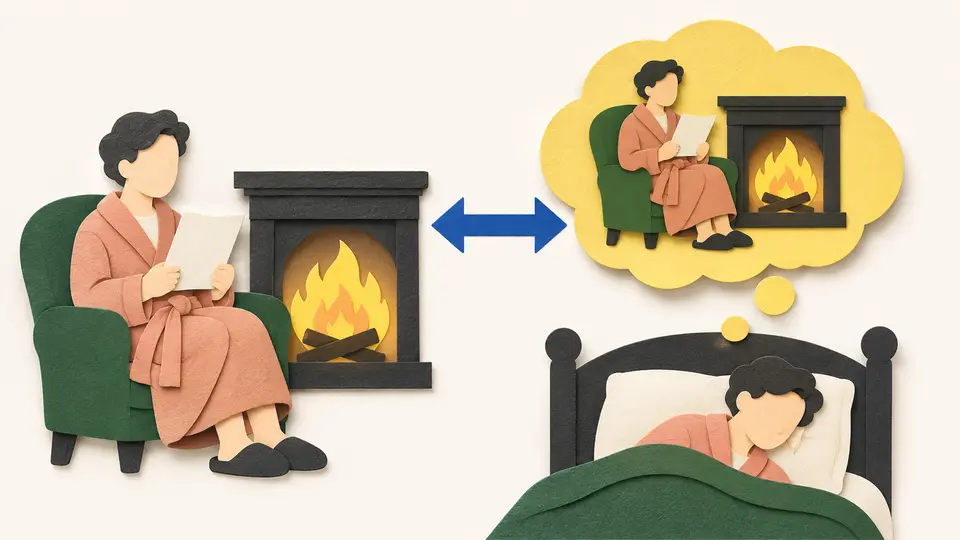
In his Meditations of 1641, René Descartes describes himself sitting by the fire in a winter dressing gown, a piece of paper in his hands. Nothing could seem more obvious than that he's awake. Then he recalls how often he's been convinced of this very scene while lying undressed in bed.
He has been tricked, he admits, by "exactly similar thoughts while asleep." So the argument needs only one claim, that a dream at its best feels just like waking life. From it he concludes that "there are never any sure signs by means of which being awake can be distinguished from being asleep."
If he can't know he's awake, he can't know anything whose truth assumes he is. That includes knowing he's holding a piece of paper.
Then Descartes raised the stakes. Suppose a deceiver of the utmost power were making it seem that there's an earth and a sky when there's none. Such a deceiver could make him go wrong even when he adds two and three.
Today's version is a bodiless brain in a vat, wired to a supercomputer that stimulates it just as an ordinary brain in a body is stimulated. In each story your experience would be exactly as it is now, and most of what you believe about the world would be false.
Descartes didn't suspect he was dreaming, the way you might suspect a friend of lying. He granted that "no sane person has ever seriously doubted" that there really is a world and that human beings have bodies.
His doubt was a method. He resolved to hold back his assent from any opinion that wasn't completely certain, as carefully as from one that was plainly false. That way he could build knowledge on whatever survived.
He kept the method out of practical life. When you have to act, he wrote, you'll sometimes have to choose among options you know nothing about. He described a man who refused all food to the point of starvation because he couldn't be certain it wasn't poisoned. That man, Descartes said, would rightly be regarded as insane.
Everyday doubt fastens on one claim for a particular reason. Descartes' doubt is called universal because it reaches every belief at once. It's called hyperbolic, meaning deliberately exaggerated, because he wanted its reasons to be as strong as possible.
The philosopher Charles Peirce objected that we shouldn't "pretend to doubt in philosophy what we do not doubt in our hearts." Descartes would presumably agree that his wasn't a doubt of the heart. It was a test for beliefs he went on holding every day.
Try to recallDescartes set out to doubt whether the world exists, yet said no sane person has ever seriously doubted it. How do those two claims fit together?
Descartes' doubt was a deliberate method for testing beliefs. He resolved to withhold assent from anything not completely certain, as carefully as from what's plainly false, to see what could survive. He never seriously believed the world might not exist, and he kept the method out of practical life, where refusing food that might be poisoned would be madness. So he could apply hyperbolic doubt in philosophy while agreeing that nobody seriously doubts the world in ordinary life.
Descartes' challenge is to name a sign, available to you right now, that couldn't also turn up in a dream or a vat. The dream, the deceiver and the vat all make that one demand, and they feed one short argument. To reject its conclusion, you have to say which step fails.
Lessons in this topic
Why Descartes couldn't prove he was awake
Descartes found that a dream can feel just like waking life, and he used that to doubt everything his senses told him. See how the argument runs, and why he never meant it as advice for daily life.
The skeptic's argument in three lines
Two premises that each look hard to deny lead to the conclusion that you know almost nothing about the world. See how the argument is built and why its first premise is so hard to give up.
How a zoo zebra and two hands answer the skeptic
Fred Dretske used a zebra to argue that knowledge doesn't always carry across what it entails. G. E. Moore held up his hands and ran the skeptic's argument in reverse. Each reply comes at a price.
Could a brain in a vat even think that it's in one?
Hilary Putnam argued that a brain that had always been in a vat couldn't truly think so, which would make the scenario refute itself. See how the argument works and what it leaves open.
Three quick stories from this topic
Moore's two hands
G. E. Moore claimed to prove the external world exists by holding up his two hands
"Here is one hand," he told the British Academy in 1939, "and here is another," gesturing with each. He called it a perfectly rigorous proof. His grounds were that he knew both statements to be true, and that they entail the existence of things outside our experience.
Reversing the skeptic
The skeptic argues that you can't rule out being a brain in a vat, so you don't know you have hands. Moore ran it the other way. He knows he has hands, so he knows he isn't in any such scenario.
Why critics weren't moved
Wittgenstein wrote that Moore's mistake lay in countering the assertion that one cannot know something by saying "I do know it." The proof persuades nobody who doubts.
Descartes and the poisoned food
Descartes said that starving yourself for fear your food is poisoned would be insane
The philosopher who doubted the whole world in 1641 kept that doubt out of daily life. It was a method for finding which beliefs are certain. When you have to act, he wrote, you'll sometimes have to choose among options you know nothing about.
A method, not a mood
In the Meditations he resolved to hold back his assent from any opinion that wasn't completely certain, as carefully as from one that was plainly false, to see what survived.
What he never doubted in practice
He granted that no sane person has ever seriously doubted that there really is a world and that human beings have bodies.
Putnam's self-refuting vat
Hilary Putnam argued that a brain raised in a vat couldn't truly think it was in one
Its word "vat" would come from pictures fed in by a machine, never from contact with a real vat. So the word wouldn't refer to real vats. If the brain said "I am a brain in a vat," Putnam concluded in 1981, the sentence would be false.
A causal constraint on reference
"One cannot refer to certain kinds of things, e.g. trees," Putnam wrote, "if one has no causal interaction at all with them, or with things in terms of which they can be described."
What it leaves open
A brain moved into a vat last night would keep its ordinary meanings for a while. And Thomas Nagel replied that being unable even to think the truth about your situation is skepticism too.
Sources
- Descartes' Epistemology, Stanford Encyclopedia of Philosophy
- Content Externalism and Skepticism, Stanford Encyclopedia of Philosophy
- George Edward Moore, Stanford Encyclopedia of Philosophy
- Contemporary Skepticism, Internet Encyclopedia of Philosophy