Philosophy & Ethics · Society & justice
What does it mean to be free?
Freedom can mean that no one stands in your way, or that you're in charge of your own life. Compare the two concepts Isaiah Berlin set apart, then weigh a third view that says being free means having no master.
What you will learn
- Distinguish negative liberty from positive liberty using the story of a smoker driving to a tobacco shop
- Identify which thinkers and political arguments typically draw on each of Berlin's two concepts
- Explain how Berlin thought the idea of a divided self could turn positive liberty into a license to coerce
- Explain why tying freedom to your actual desires would make a contented slave count as free
Lesson 1 of 4 · 6 min
Are you free when nobody stops you?
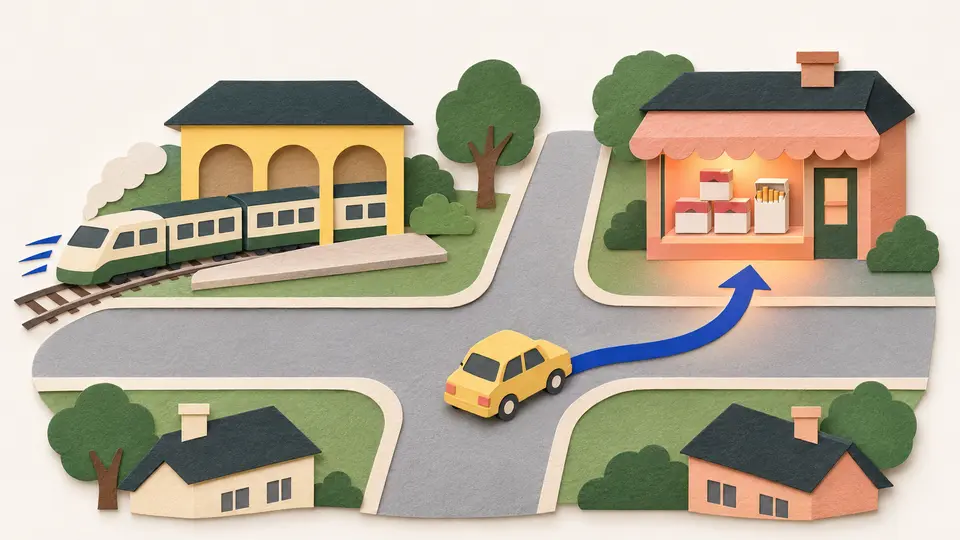
You're driving through town. At a fork you turn left, and nobody made you. At a crossroads you turn right, and nobody would have stopped you from going left or straight on. There's hardly any traffic and no police roadblock. As a driver, you seem completely free.
Now add one detail. You made those turns because you're addicted to cigarettes and desperate to reach the tobacco shop before it closes. Turning right means you'll probably miss a train to an appointment you care about. You know that, and you long to be rid of the craving. You're less driving than being driven.
So are you free? It depends which of two things you mean. On one view, liberty is the absence of obstacles outside you. You're free as long as nobody prevents you from doing whatever you might want. On the other, liberty is the presence of control. You're free only if you steer your own life toward what you take to be your real interests.
The driver is free on the first view and unfree on the second. The first counts how many doors are open to you. The second asks whether you go through the right doors for the right reasons.
The philosopher Isaiah Berlin named the two in a 1958 lecture at Oxford. He called the first negative liberty, because it's the absence of something, such as barriers or interference. He called the second positive liberty, because it needs the presence of something, such as self-control.
Hardly anyone says they're against liberty. So political arguments are often fights over what the word means, and Berlin's two concepts pull in different directions.
If liberty means being left alone, a state that does less interferes less. Liberals generally hold that anyone who favors individual liberty should place strong limits on the state. If liberty means running your own life, being left alone may not be enough. Critics of liberalism argue that liberty as self-determination can require state intervention of a kind liberals don't normally allow.
The classic writers are usually sorted along the same line. Classical liberals such as Benjamin Constant, Wilhelm von Humboldt, J. S. Mill and Herbert Spencer count as defenders of the negative concept. Their critics, such as Jean-Jacques Rousseau, G. W. F. Hegel, Karl Marx and T. H. Green, count as defenders of a positive one.
Rousseau shows how far the positive idea can reach. For him, you're free when you take part in the process by which your community governs itself.
You can hear both concepts in arguments today. The negative one usually lies behind defenses of freedom of movement, religion and speech. It backs the case against paternalism, where the state overrides your choices for your own good. It's often invoked to defend private property too.
The positive one appears when someone says a government should create the conditions people need to be self-sufficient. Both the welfare state and a universal basic income have been defended on those grounds.
Try to recallOne politician wants the state kept out of people's lives, and another wants it to help citizens become self-sufficient. Which concept of liberty is each using, and which thinkers are classed with each?
The first politician is using negative liberty, the view that you're free when no one stands in your way, which liberals use to argue for strong limits on the state. Constant, Humboldt, Spencer and Mill are typically classed with it. The second is using positive liberty, the view that freedom means self-determination or self-realization, which has been used to defend the welfare state and a universal basic income. Rousseau, Hegel, Marx and Green are typically classed with that side.
When someone says a law makes people more free or less free, ask which freedom they mean. Fewer obstacles in your way is negative liberty. More control over your own life is positive liberty. The addicted driver shows the two can come apart, which is how both sides of an argument can claim the same word.
Berlin didn't think these were the only meanings. He picked them out of more than two hundred ways of thinking about political liberty, because he saw both at the center of the ideological struggles of his own day.
Lessons in this topic
Are you free when nobody stops you?
A driver nobody stops can still be steered by a craving. Tell apart the two kinds of liberty Isaiah Berlin named, and see which political arguments lean on each.
Can you be forced to be free?
Berlin warned that positive liberty can justify coercion. See why a contented slave troubles the idea that freedom means getting what you want.
Is a slave with a kind master free?
Republican thinkers say freedom means having no master, however kind. See why, then test the objection that this is only freedom from interference made secure.
Free from what, and free to do what?
Gerald MacCallum argued that every claim about freedom names an agent, a constraint and a purpose. Use his formula to see where theories of freedom disagree, then ask whether being poor makes you less free.
Three quick stories from this topic
The contented slave
If freedom means getting what you want, a perfectly contented slave is perfectly free
Philosophers use her to test that definition. If freedom is having nothing in the way of your wants, you get freer by wanting less. Isaiah Berlin compared the strategy to getting rid of a wounded leg's pain by cutting off the leg.
How the definition was repaired
Defenders of negative liberty changed the wording. You're free when nobody prevents you from doing whatever you might want to do, whether or not you want it now.
The inner citadel
Taken to the extreme, freedom by wanting less is the path of ascetics and Stoics. Liberals object that it can hide oppression, since people often cope with being denied things by pretending they never wanted them.
Berlin and the revolution
The thinker who warned that freedom can excuse tyranny saw Russia's revolutions as a boy
Isaiah Berlin was born in Riga in 1909, and his family was living in Petrograd through both revolutions of 1917. In a 1958 lecture at Oxford he traced how the ideal of being your own master had been twisted by dictators who claimed to be freedom's true champions.
Two kinds of liberty
The lecture set negative liberty, being left alone, against positive liberty, being in control of your own life. Berlin thought the second had been put to more sinister uses.
No enemy of either
Berlin counted both as genuine values. He later regretted not saying more about the evils negative liberty had been used to justify, such as exploitation under laissez-faire capitalism.
Priestley's penny
A power that can take one penny can take your last, Joseph Priestley argued in 1769
He was writing about the American colonies, which England governed lightly. Priestley described them as living in servitude all the same. What made a people unfree, on his view, was the power held over them, however little of it was used.
Domination without interference
Philip Pettit and other republicans call this domination, being subject to someone's arbitrary power whether or not it's used. On their view, a lightly ruled colony is unfree because its rulers could govern it as much as they liked.
Freedom through institutions
For republicans, the remedy lies in institutions. Pettit writes that you enjoy non-domination "from the moment that the institutions are in place" to block arbitrary interference. In 1656 James Harrington called a republic where equal citizens live under the rule of law an "empire of laws and not of men."
Sources
- Positive and Negative Liberty, Stanford Encyclopedia of Philosophy
- Isaiah Berlin, Stanford Encyclopedia of Philosophy
- Republicanism, Stanford Encyclopedia of Philosophy