History · Everyday life in the past
How ancient Rome fed a million people
Rome imported the grain for a city of a million. Follow the wheat from Egyptian fields across the sea to the port of Ostia, up the Tiber and into a baker's oven.
What you will learn
- Say what the cura annonae was and what share of the grain its famous dole covered.
- State how much grain Rome needed a year and how many people that fed.
- Explain why most of Rome's grain traveled by sea and what that meant for the sailing year.
- Describe the grain ships and the terms on which the state recruited their owners.
Lesson 1 of 4 · 5 min
How Rome fed a million people on imported grain
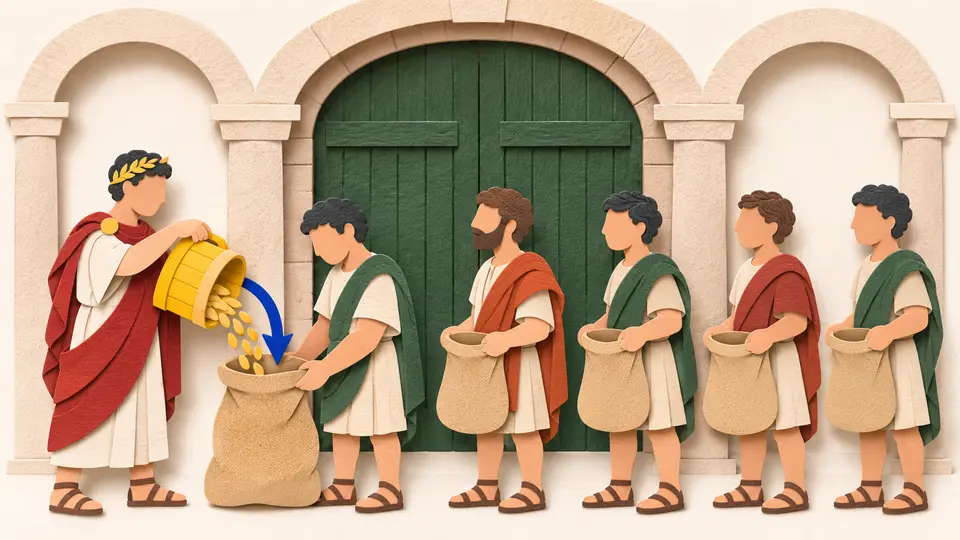
Every month, about 200,000 men in ancient Rome collected free grain from the state. That handout, the grain dole, is the famous part of how the city was fed. It was also the smaller part.
Rome held about a million people by the second century AD, and it imported its grain. The system that brought it in was the cura annonae, "the care of the grain." The dole accounted for 15% to 33% of those imports. Most of the rest was sold on the market.
The dole started small. In 123 BC Gaius Gracchus carried a law, over fierce opposition from conservative landowners, that let poorer citizens buy a monthly ration below the market price. The ration was five modii, about 33 kilograms. Around 40,000 men qualified.
Then it grew. In 58 BC the politician Clodius made the grain free and opened it to an estimated 320,000 men. Julius Caesar cut the list to 150,000. Augustus set it at 200,000, where it stayed for centuries.
Every emperor after Augustus took responsibility for it. Tiberius said in 22 AD that neglecting the grain supply would mean "the utter ruin of the state." The poet Juvenal summed up the bargain of cheap food and public games as "bread and circuses."
How much grain did a million people need? Modern estimates run from 150,000 to 272,000 metric tons a year. One puts it at 237,000 metric tons, enough to give each person about 2,300 calories a day from grain alone.
Now set the dole against that. A ration of five modii a month was "ample for two people" and well short of what three needed. So a man with a wife and children couldn't feed them on it.
Anyone off the list, or with more mouths to feed, had four choices. They could buy grain at city prices, find a patron, go into debt or go without.
So the dole was a subsidy for a named group of citizens. The city's real food supply was the trade around it, run by merchants and investors for profit.
Try to recallRome needed somewhere between 150,000 and 272,000 metric tons of grain a year, and the dole covered 15% to 33% of imports. What do those two figures tell you about how the city was actually fed?
Most of the food arrived through the market. The dole went to about 200,000 men, and their five modii a month was ample for two people and short for three. Families and anyone off the list bought at city prices, found a patron, borrowed or went without. The state guaranteed a floor for some citizens while merchants and shippers moved the bulk.
A million people needed roughly a quarter of a million metric tons of grain a year, all of it imported. The free dole covered a third of that at most, and one ration fed two people. The market fed everyone else.
Lessons in this topic
How Rome fed a million people on imported grain
Rome's free grain went to about 200,000 men and covered a third of its imports at most. See how the dole grew and who fed everyone else.
Why Rome's grain came by sea
Shipping grain across the Mediterranean cost less than carting it 75 miles. See what that meant for where the grain grew, how long the ships took and who owned them.
Ostia, the port where Rome's grain came ashore
Follow the grain from a seagoing ship to a warehouse in Rome, then see why the buried port of Ostia is such good evidence and where that evidence stops.
Why Rome's free grain became free bread
Most people on the dole had nowhere to grind or bake their wheat. See how mills, bakers and water power stood between the sack and the loaf, and how they changed the dole itself.
Three quick stories from this topic
Free grain, no kitchen
Most Romans on the grain dole couldn't bake at home because landlords banned cooking fires
They lived in apartment blocks where the risk of fire was high. So they took their free wheat to a neighborhood mill and bakery and paid a small fee. By the late third century, the state was handing out bread.
A ration for two
The dole gave about 200,000 men five modii of grain a month, about 33 kilograms. That was ample for two people and too little for three.
Water did the grinding
By the early third century, most of the grain eaten in Rome was ground by water power. That let the state hand out flour, and later bread.
Cheaper by sea
In Roman times, shipping grain across the Mediterranean cost less than carting it 75 miles
A four-ox wagon carried 350 to 500 kilograms, while a grain ship averaged about 70,000. So Rome's wheat came from Egypt, North Africa and Sicily, and North African farmers grew it close to the ports.
Ten days out, seventy back
The run from Ostia to Alexandria took ten days to two weeks with the wind behind. The laden return was a fight against foul winds that took at least a month and often more, averaging close to seventy days.
Two to three thousand voyages a year
Each voyage carried about 70,000 kilograms. The ships were privately owned, and the state paid for their service with tax exclusions, citizenship and insurance for anyone who would sail through the winter.
A seaport left inland
Ostia, the seaport of ancient Rome, now lies 3 kilometers from the sea
Silt from the Tiber pushed the coastline out. After the town was abandoned, sand dunes covered it, which is why its streets, shops and apartment blocks are better preserved than any Roman town except Pompeii and Herculaneum.
Where the grain came ashore
Ostia stood at the mouth of the Tiber. Grain was moved onto barges there and hauled about 30 kilometers upriver to Rome.
A town of 50,000
About 50,000 people lived there in the second century AD. Its apartment blocks had shops at street level and cheaper flats reached by outside stairs.
Sources
- Cura annonae, Wikimedia Foundation
- Ostia Antica, Wikimedia Foundation