History · Archaeology & historical evidence
Pompeii's body casts and what they can prove
See how Pompeii's plaster figures were made, what bombing, repair and copying did to them, and why DNA overturned stories long told about the victims.
What you will learn
- Explain how a void left by a body can preserve its shape
- Distinguish a modern cast from an untouched ancient body
- Explain why an excavated object's later history matters for interpretation
- Distinguish a copy from the earlier object it represents
Lesson 1 of 4 · 4 min
How Pompeii's plaster bodies were made
The figures that visitors to Pompeii remember look like people who turned to stone. They're made of plaster, and the first of them were made in 1863.
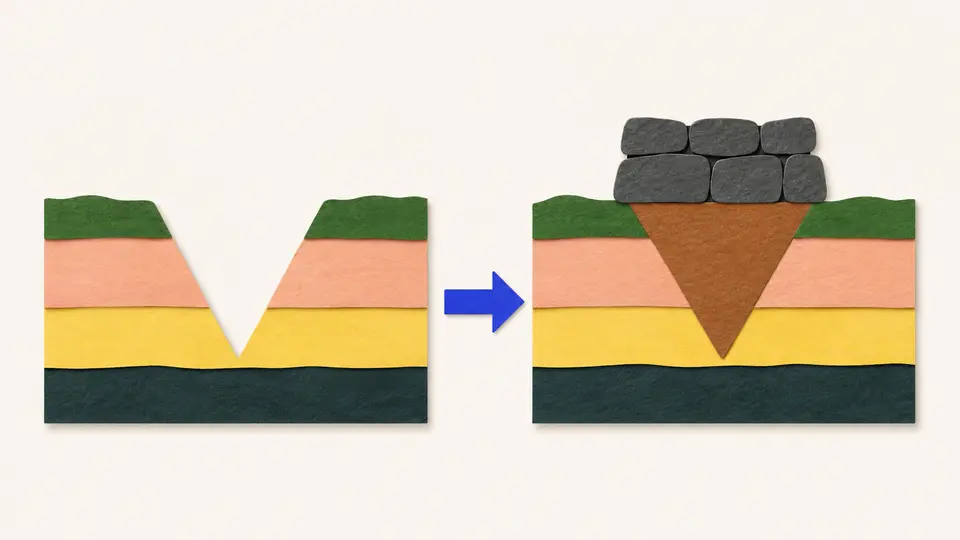
Mount Vesuvius erupted in 79 CE, the year 79 of the Common Era, and buried the Roman city. Late in the eruption, a fast surge of hot ash killed everyone still in the city and covered them where they fell. The ash hardened around each body. The flesh later decomposed, and what remained was a body-shaped hollow with the bones still inside.
The archaeologist Giuseppe Fiorelli worked out how to use those hollows. From 1863, his excavators poured liquid plaster into a hollow and let it set. Then they removed the ash around it. What came out was a cast of the space, with the victim's bones held inside the plaster.
The ash had worked like a mold for a statue. The comparison stops there. A sculptor makes a mold on purpose, and this one formed by accident around a person who died. So a cast is archaeological evidence in a way a statue isn't.
Most victims were never cast. Excavators have found the remains of more than 1,000 people at Pompeii. They've made only a little over a hundred casts.
The difference comes from when each person died. In the eruption's first phase, pumice stones rained down and roofs collapsed under the weight. The people killed then were found as bones. The ash that hardened into hollows came later, and it caught those who were still in the city.
So the casts record one group of victims. They can't stand in for everyone who died at Pompeii.
A cast preserves a body's pose and outline in striking detail. It still can't tell you the person's name, job or last thoughts. Each of those is a separate claim that needs its own evidence.
Even the shape can mislead. One cast was long described as a pregnant woman. In 2015, 26 casts were X-rayed or CT scanned, and the swollen belly is now thought likely to be bunched-up clothing. So when you look at a cast, keep apart what the plaster records and what a later storyteller added.
Try to recallWhy is it misleading to describe a Pompeii cast as an untouched person who turned to stone during the eruption?
The cast was made later, from 1863 on, by pouring plaster into the hollow a body left in hardened ash. The shape is ancient, but the figure is a modern object. Nobody was literally turned to stone.
A Pompeii cast is two ages in one object. The shape and the bones come from 79 CE. The plaster comes from 1863 or later.
Lessons in this topic
How Pompeii's plaster bodies were made
See how a hollow in hardened ash became a plaster figure, and why the casts aren't people turned to stone.
What happened to Pompeii's casts after they were made
Follow the casts through bombing, repair and 3D copying, and learn to tell an older cast, a restoration and a copy apart.
A bracelet didn't prove a mother
A 2024 DNA study overturned a famous mother-and-child story from Pompeii. See what the result proves and what it leaves open.
Where a cast stands is part of the evidence
Compare casts left where the bodies lay with casts moved into display cases, then see what DNA ruled out for a supposed family and a famous embrace.
Three quick stories from this topic
Plaster casts with bones inside
Pompeii's famous bodies are plaster casts with the victims' real bones inside
Ash hardened around each body, then the flesh decayed and left a hollow holding the bones. From 1863, excavators poured liquid plaster into those hollows, and it set around whatever bone was there. Nobody turned to stone.
A later method made the shape visible
From 1863, Fiorelli's casting method filled the surviving cavities. The resulting forms link ancient burial conditions to modern archaeological work.
A form isn't a biography
A cast can preserve physical detail without telling you a person's name, family role or final thoughts. Those claims need other evidence.
The Pompeii mother who was male
A Pompeii victim long shown as a mother holding her child was genetically male
The adult wore a heavy gold bracelet and had a young child on their hip, so the pair was presented for decades as mother and child. In 2024, DNA from bone inside the plaster casts showed the two weren't biological relatives either.
The result changed a specific claim
The adult was genetically male, and the child wasn't a biological relative. Jewelry and physical closeness hadn't established the assumed relationship.
Leave the unknown parts unknown
The DNA didn't show whether the two knew or cared for each other. Biological kinship and social relationships are different questions.
Pompeii's casts were bombed in 1943
Bombing in 1943 destroyed or badly damaged many of Pompeii's body casts
The plaster figures were on display at the site when bombs hit it during the Second World War. A team under the archaeologist Amedeo Maiuri restored part of what was left, so a cast seen today can carry twentieth-century repairs.
A second disaster
The site's museum building was seriously damaged in September 1943 and reopened in 1948 after restoration. Not every cast could be saved.
Repairs are part of the evidence
A cast records an ancient shape, but it has been displayed, moved and mended since. Knowing what changed after excavation is part of reading it.
Sources
- The casts, Archaeological Park of Pompeii
- Ancient DNA challenges stories told about Pompeii victims, Harvard Medical School
- Ancient DNA challenges prevailing interpretations of the Pompeii plaster casts, Current Biology (Pilli et al., 2024)
- Antiquarium, Archaeological Park of Pompeii