History · Archaeology & historical evidence
How a dig knows what came first
Nothing at an archaeological site comes with a date attached. Two methods do almost all the work. One puts events in order, and the other pins a piece of wood to a calendar year.
What you will learn
- Define a context and explain why the unit of excavation is an action rather than an object.
- State the principles that put contexts in order.
- Explain why a find's date isn't the date of the context that held it.
- Say what a sealed context gives you and how contexts are grouped into phases.
Lesson 1 of 4 · 6 min
Why archaeologists count a ditch as two events
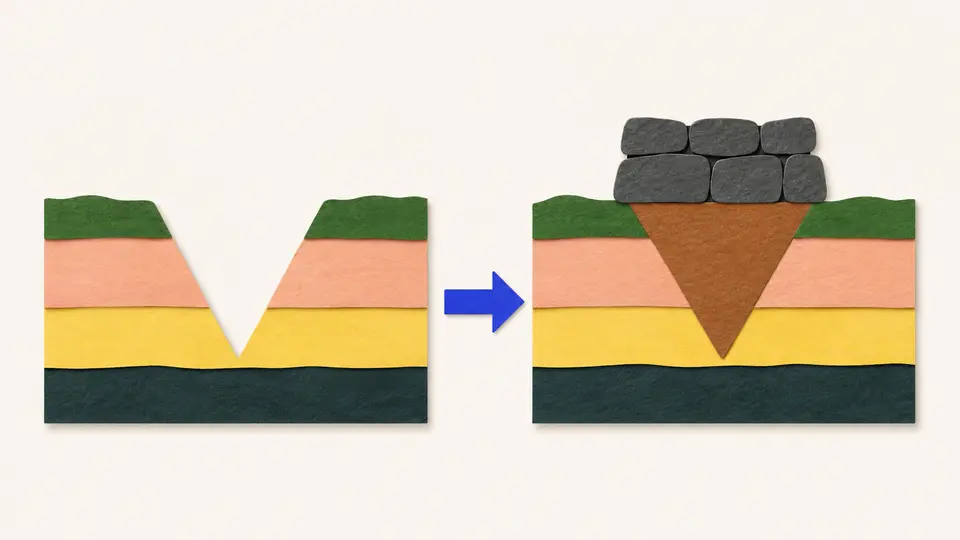
Picture a ditch someone dug centuries ago and later filled back in. An archaeologist records it as two events, the digging and the filling. Counting events instead of objects is what turns a hole in the ground into a timeline.
Nothing on a site comes with a date attached. What a site does have is an order in which things happened. Reading that order is called stratigraphy, an idea borrowed from geology. Each single event or action that left a trace you can detect is called a context.
A context can be a deposit, such as the soil that fills a ditch. It can be a structure, such as a wall. Or it can be a cut, the surface left when someone removes what was there before. A cut has zero thickness and contains nothing. It's an absence with a shape, and it still counts, because digging the ditch was something that happened.
Once events are the units, you can put them in order. The fill of a ditch is later than the cut, because you have to dig before you can backfill. Archaeologists chart these relationships in a diagram called a Harris matrix. On it, later contexts sit higher and earlier ones lower, wherever they lie in the ground.
A short list of rules puts contexts in order. They come from geology, adapted for ground that people have dug into and built on. Two were widely accepted by the 1970s, and the archaeologist Edward Harris proposed three more.
The first is superposition. In layers left as they were first made, the upper ones are younger and the lower ones older. Each had to be laid on something already there, or cut out of it.
The second is that a layer can be no older than the most recent object found in it. Say a layer holds a coin. That layer can't have formed before the coin was made.
Harris's three say what a layer should look like. Original horizontality says loose material tends to settle flat. So a tilted layer was laid on a slope, or follows the shape of the hollow it fell into.
Lateral continuity says a deposit ends at the edge of its basin or thins away to a feather edge. So if a layer stops at a sharp vertical face, part of it was removed by digging or erosion. You have to find the rest or explain why it's missing.
Stratigraphic succession says a context's place in the sequence is set by the contexts it physically touches, the lowest of those above it and the highest of those below.
Try to recallA deposit exposed in section has had its edge cut off vertically. What does the principle of lateral continuity tell you to do about it?
Treat the vertical edge as a sign that something is missing, not as the deposit's original shape. As laid down, a deposit ends at the edge of its basin or thins away to a feather edge. So a sharp vertical edge means later excavation or erosion removed part of it. You have to look for the rest elsewhere on the site, or explain why it's gone.
A dig records events, and an empty cut counts as one. Two rules do most of the ordering. What lies on top came later, and no layer is older than the newest object inside it.
Lessons in this topic
Why archaeologists count a ditch as two events
A dig is recorded event by event, and even an empty hole counts as one. Learn what a context is and the five rules that put contexts in order.
Why a find doesn't date its layer
The pottery in a layer looks like a date stamp. It isn't one, and two ways that finds end up in the wrong layer show why.
How tree rings pin wood to a calendar year
Follow the chain from one ring a year to matched ring patterns, and see how a burst of cosmic radiation in 993 dated a Norse site to 1021.
What a tree-ring date doesn't tell you
Tree rings can name the year a tree was cut down. See why that isn't the date of the building or painting made from it, and what the method can still prove.
Three quick stories from this topic
Tree rings put Vikings in 1021
Tree rings show Vikings were cutting wood in Newfoundland in exactly 1021
A burst of cosmic radiation in 993 left a carbon-14 spike in that year's ring in trees around the world. Researchers found the spike in wood the Norse had cut with metal tools, then counted the rings out to the bark.
Three trees, one year
Wood from three different trees at the site gave the same cutting year. It's the only secure calendar date for Europeans in the Americas before Columbus.
Why a spike works as an anchor
Tree rings usually get calendar dates by matching their pattern against a dated regional record. A worldwide carbon-14 spike fixes one ring to a known year where no such record exists.
The newest find dates the layer
Archaeologists date a layer by the newest object in it, however old the rest are
A layer can't have formed before the latest thing inside it was made. Older objects prove much less, because digging a trench through earlier ground scoops up what's there and buries it again in the new fill.
Residual finds are old objects in a later layer
A trench cut through older deposits scoops their contents into its own backfill. The objects really are old, but the deposit holding them isn't.
Intrusive finds are later objects in an older layer
If excavators undercut a fill, material from the later context can drop into the earlier layers beneath, making an old layer look young. The latest-evidence rule doesn't catch this one.
A coot's nest read like a dig
An Amsterdam coot's nest held 30 years of layered litter, down to a 1994 World Cup wrapper
Researchers dated the nest's layers from the expiry dates on food packaging the birds had built with. At the very bottom was a Mars wrapper advertising the 1994 football World Cup. Plastic doesn't rot, so each season's layer stayed put.
Newest on top
Coots added material year after year, so lower layers were older. That's superposition, the first rule archaeologists use to put a site in order.
Dated by what's inside
A layer can be no older than the most recent object in it. In the nest that object carried a printed date. On a dig it's more likely a coin or a piece of pottery.
Sources
- Stratigraphy (archaeology), Wikimedia Foundation
- Dendrochronology, Wikimedia Foundation
- Evidence for European presence in the Americas in AD 1021, Nature
- From Steno to Snickers: the Anthropocene through the eyes of a coot, Leiden University
- Birds documenting the Anthropocene: Stratigraphy of plastic in urban bird nests, Ecology (Hiemstra, Gravendeel and Schilthuizen, 2025)