History · Human origins & civilizations
Uruk and the first cities
Around 3100 BCE Uruk may have held 50,000 people. See how records, rations and shared work held it together, and what its surviving bowls and tablets can and can't prove.
What you will learn
- Explain how shared supplies and specialized work create a need for coordination
- Use Uruk as an example without claiming that every city began the same way
- Explain why bookkeeping was an important early use of writing
- Distinguish a writing system from a language
Lesson 1 of 4 · 4 min
Who kept Uruk, one of the first cities, running?
Around 3100 BCE, the city of Uruk may have held up to 50,000 people. It stood in what is now southern Iraq, and it was the largest urban area in the world at the time. BCE stands for Before Common Era.
Think about what one building project needed in a place like that, with no phones and no spreadsheets. The builders had to eat. Bricks had to arrive. Someone had to keep track of it all. Uruk was a hub of trade and administration, and how its people depended on one another tells you more than its size does.
Start with a potter who makes containers all day while other people supply the food. That's specialized work. People spend their time on different tasks, so they depend on exchanges with one another. In Uruk, houses were even grouped into districts by their occupants' professions.
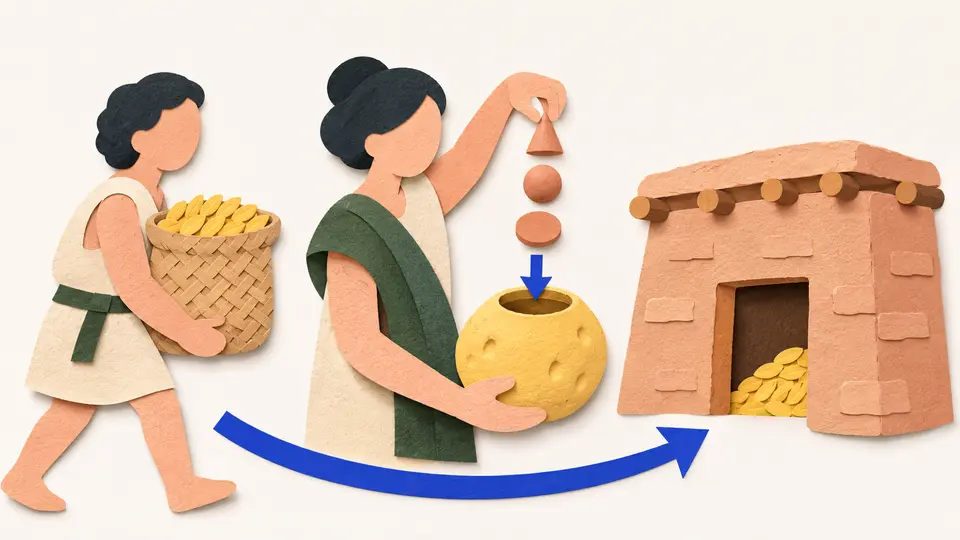
Larger shared projects need a way to gather supplies and hand them out. The earliest records from cities such as Uruk tracked bread and beer rations.
Uruk also had two great sacred districts. One was dedicated to the goddess Inanna and the other, older one to the god Anu. Their temples show that city life included shared religious spaces as well as homes and work.
But a large building doesn't tell you who ordered it, who worked on it or who benefited. Inanna's district was walled off from the rest of the city, and it's unclear why. It may have served ceremony or kept most people out. Questions like that need other evidence.
Uruk is often called the first city. It's safer to call it one of the earliest great cities. What counts as a city depends on which features you compare, and the excavated evidence is incomplete. The site's oldest layers lie almost unexplored, deep in river mud.
So think of Uruk as a case study, a place where trade, administration, building and worship were concentrated. It isn't a sequence every other society had to follow.
Try to recallWhy is Uruk useful for studying early cities, even though it isn't a model for every city?
Its buildings and records reveal a major early center of shared work, trade, administration and worship. But evidence from one place can't establish a single route to city life everywhere.
So a city is a web of dependencies as well as a place on a map. In Uruk the builders needed the storehouse, the storehouse needed farmers and potters, and all of them needed someone keeping count. Follow the food, the work and the records, and you can see how tens of thousands of people held together.
Lessons in this topic
Who kept Uruk, one of the first cities, running?
Around 3100 BCE Uruk may have held 50,000 people. See how specialized work, shared stores and records held a city that size together.
The first writing kept track of bread and beer
The oldest known writing began as storehouse bookkeeping in cities like Uruk. See why a city needed it, and why cuneiform is a script and not a language.
What a throwaway bowl can and can't prove about Uruk
Crude, mass-produced bowls from Uruk's time turn up across Mesopotamia. See what they show, what they only suggest, and why shared pottery doesn't prove shared rule.
How Uruk outlived its own era by three thousand years
Archaeologists named a whole era after Uruk. See what that label covers, and how the city stayed inhabited for more than three thousand years after its peak.
Three quick stories from this topic
The throwaway bowl of Uruk
About three quarters of the pottery at Uruk-culture sites is one crude, mass-produced bowl
The beveled-rim bowl is small, undecorated and found discarded in large piles across Mesopotamia. The leading explanation is that workers were paid in grain measured out in it. Then they seem to have thrown it away, like a takeout container.
Observation and interpretation
The bowl's shape and the piles of discards can be checked by looking. The ration idea is an interpretation, and some researchers think the bowls were for baking bread.
What the spread doesn't prove
Workshops made these bowls as far from Uruk as Mari, in the far north. Shared pottery shows a connection. It doesn't show that Uruk ruled those places.
The largest city of 3100 BCE
Around 3100 BCE the largest city on Earth was Uruk, with up to 50,000 residents
Uruk stood in what is now southern Iraq. A brick wall nine kilometers long, built around 3000 BCE, enclosed it, and its houses were grouped by their occupants' professions. Other settlements of the time were generally about 10 hectares, and Uruk covered 250.
A city runs on dependence
Tens of thousands of people doing different work needed stores of food and a way to hand it out. The earliest records from cities like Uruk tracked bread and beer rations.
One of the first, not the template
Uruk is a case study of how one early city worked. Much of the site is still unexcavated, and other cities didn't have to follow its path.
Uruk's three-thousand-year afterlife
Uruk stayed inhabited for more than three thousand years after its peak
The city's greatest influence ended around 3100 BCE. Under the Seleucid kings, nearly three thousand years later, it may still have held 40,000 people. Residents only began leaving around 300 CE, and its temples were kept up into the seventh century CE.
Rank fell, but life went on
After its period of greatest influence, Uruk remained a regional seat of power, though a diminished one. Lugalzagesi made it his capital, and Sargon of Akkad renovated its temple districts after 2334 BCE. The city also outlasted many Sumerian neighbors through the Seleucid and Parthian periods.
Why the long middle matters
The eventual desertion, which began around 300 CE and was largely complete by about 700 CE, has been linked to depleted resources and the loss of political and commercial power. How Uruk ruled and why it rose are still debated, because much of the site is unexcavated.
Sources
- Uruk: The First Great City, World History Encyclopedia
- How to write cuneiform, British Museum
- Uruk, Wikipedia
- Beveled rim bowl, Wikipedia