History · Everyday life in the past
Life in a medieval village
Most people in medieval western Europe were peasants farming land they didn't own. See how a village shared its fields, what it owed the lord and the church, and how its year of work and fasting ran.
What you will learn
- Explain how an open-field village divided and shared its farmland
- Describe what villagers owed the lord and the church
- Describe the work of the farming year and when food ran short
- Describe what villagers ate and how the church calendar shaped it
Lesson 1 of 4 · 4 min
Shared fields, the lord's farm and a tenth for the church
This topic is about western Europe, and mostly England, where the records are richest. Take Elton in Cambridgeshire in the late 1200s. Its lord was an abbot from a nearby monastery. About 113 tenants farmed there, and with their families the village held perhaps 500 to 600 people.
Elton's plowland lay in huge open fields, unfenced and several hundred acres each. Each field was cut into long, thin strips. A family might hold about 70 strips, roughly 20 acres, scattered across every field. That gave each household some good soil and some poor, so one bad patch couldn't ruin it.
In a three-field village, one field got wheat or rye in autumn and one got barley, oats or beans in spring. The third lay fallow, resting to recover. Animals grazed the fallow and the stubble together. Few families owned a full team of six to eight oxen, so neighbors shared them. That's why the village ran on agreed rules.
Peasants held their land from the lord in return for rent and labor. The lord couldn't evict a tenant without legal cause, and the holding passed to the tenant's children. But part of the manor was the lord's own farm, called the demesne.
A serf spent part of each week working the demesne. He plowed, harvested, dug ditches and mended fences there, then worked his own strips in the time left.
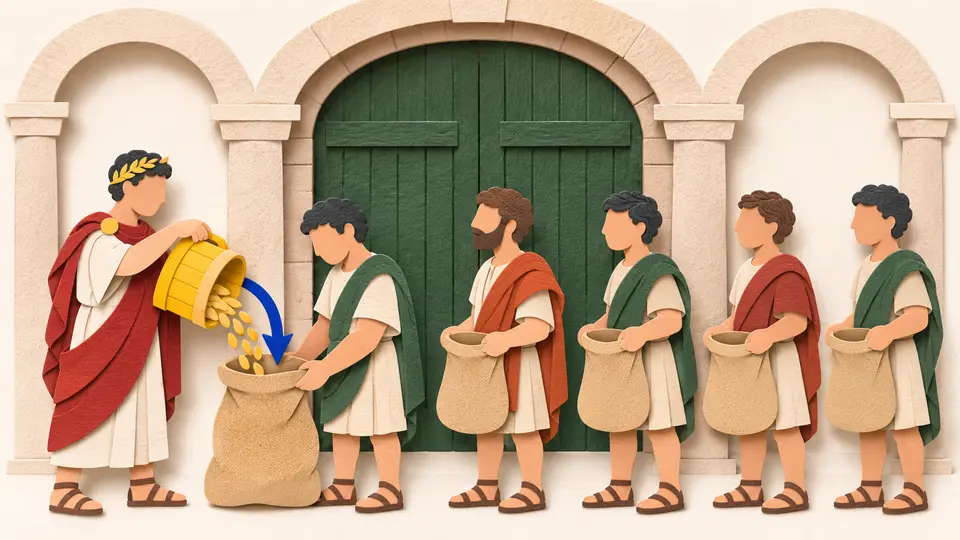
The church took the tithe, meant to be a tenth of crops and other produce. It often collected less, but peasants still found it heavy. The church also held strips of its own in the fields. So a family's harvest fed three households, theirs, the lord's and the parish's.
Try to recallWhat did a peasant family in medieval England owe to the lord of the manor and to the church?
To the lord they owed rent and labor, including days each week working his own farm, the demesne. To the church they owed the tithe, meant to be a tenth of their crops and produce.
A village shared its land in scattered strips under rules everyone had to follow. In return, each family worked the lord's farm, paid him rent and gave the church a tithe.
Lessons in this topic
Shared fields, the lord's farm and a tenth for the church
See how a western European village shared its fields in thin strips, and what every peasant family owed to the lord and to the church.
A peasant's year from Plough Monday to Michaelmas
Follow a medieval English village through its farming year, from January plowing to the hungry weeks before harvest, and see what people ate along the way.
Serfs, free tenants and the manor court
See what made a serf unfree, how serfs got out, and how villagers used the lord's own court and old documents to push back.
How we know, from court rolls to a lost village
See what the lord's paperwork can and can't tell us about peasants, and what a deserted Yorkshire village and its churchyard add.
Three quick stories from this topic
Two shepherds, 1,240 sheep
Two shepherds and 1,240 sheep replaced the plowing village of Wharram Percy
In 1543 and 1544 a flock grazed the Yorkshire village's old strip fields, where about 40 peasant families had lived. Rising wool prices made sheep pay better than tenants, so landowners evicted families.
The last plowing
The last arable strips at Wharram Percy were turned into pasture in 1527, after decades of shrinking.
What's left
Grassy humps around a ruined church still show the house plots, which archaeologists dug every summer from 1950 to 1990.
Beavers as fish
On medieval fast days, beavers and puffins sometimes counted as fish
The church forbade meat for about a third of the year, including all of Lent. People stretched the word fish to cover whales, barnacle geese, puffins and even beavers, whose tails were thought fish-like.
A third of the year
Fast days and Lent took meat off the table for most Christians, and Lent banned eggs and dairy too.
Bending the rules
Most people kept the fasts, but loose definitions of fish let some keep eating animals they liked.
Paying your own marriage fine
Some medieval English women saved their wages to pay the lord's marriage fine
Serfs owed their lord a fine called merchet when a child married. Records show young women working in service away from home who saved up and paid it themselves, buying the right to choose a husband.
What merchet was
It was one of the fines that marked a serf as unfree, and paying it proved that status in court.
A choice for a price
Paying it with their own earnings let some women decide whom to marry instead of leaving it to a father.
Sources
- Open-field system, Wikipedia
- Serfdom, Wikipedia
- Economy of England in the Middle Ages, Wikipedia
- History of Wharram Percy Deserted Medieval Village, English Heritage
- Medieval cuisine, Wikipedia
- Merchet, Wikipedia
- Villein, Wikipedia