History · Everyday life in the past
Daily life in ancient Egypt
Most ancient Egyptians were farmers and workers, not pharaohs. See what they ate, how they were paid in grain, what women could own, and what a village of tomb builders left in thousands of written notes.
What you will learn
- Explain how the Nile flood set the farming year and what ordinary Egyptians ate
- Explain how farmers paid the state and how workers were paid
- Describe an ordinary New Kingdom house and household
- Explain the legal rights Egyptian women had over property and their limits
Lesson 1 of 4 · 4 min
Bread, beer and the flood that set the year
Most ancient Egyptians were farmers, not pharaohs or priests. And Egypt gets almost no rain, so their farming depended on the Nile's yearly flood. The Egyptians named their three seasons after it, Akhet for the flood, Peret for growing and Shemu for harvest.
From about June to September the river rose over its banks and left a layer of rich silt. Farmers built crisscrossing earth walls that trapped the water in basins, so the soil soaked longer. When the water drew back, they plowed and sowed. From about March to May they cut the grain with sickles, then threshed and winnowed it.
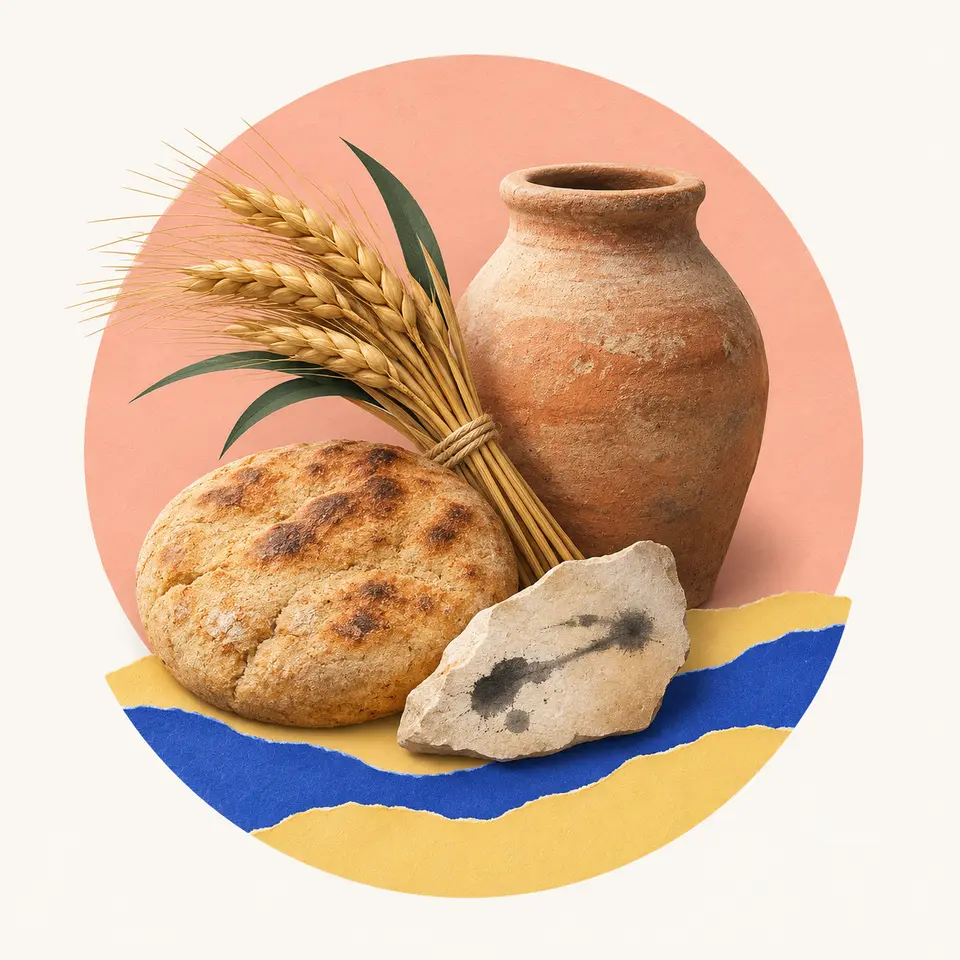
The two big crops were emmer wheat and barley. They became the two staples, bread and beer. Both were usually made at home, in the same place, because the same yeast served for both. Beans, lentils, onions, garlic and lettuce filled out meals.
Bread had a hidden cost. Grit from the grinding stones got into the flour and wore down teeth.
Most farmers didn't own their crops. The harvest belonged to whoever owned the land, the state, a temple or a noble family. Taxes were set by the amount of land. Officials read flood heights on gauges called Nilometers and used them to set taxes too.
Farmers also owed labor. Under a system called corvée, the state drafted them to dig canals, cut stone or build temples. Much of it happened during the flood, when the fields were under water.
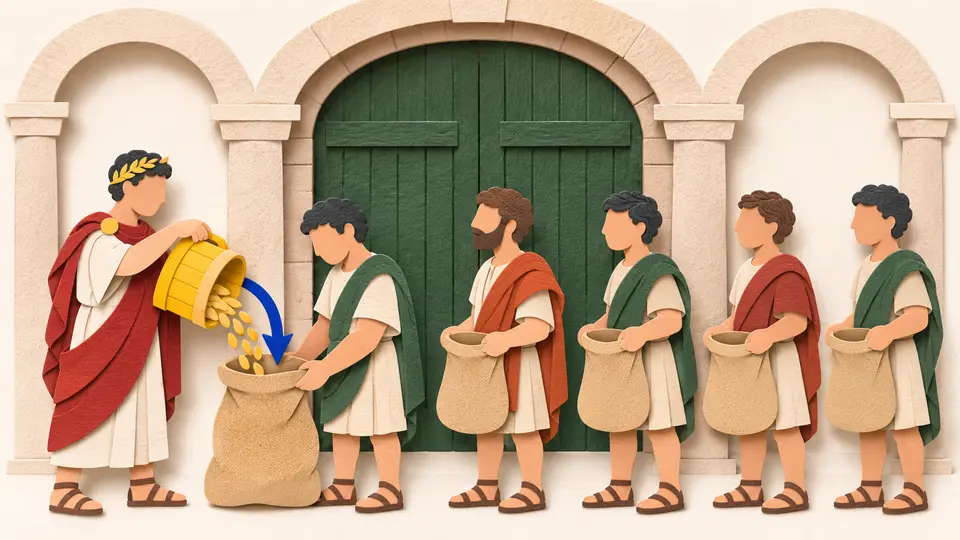
There were no coins until the 400s BCE. Workers were paid in grain. A simple laborer might get about 5 and a half sacks a month, roughly 200 kg, and a foreman about 7 and a half. Goods had fixed prices in deben, a weight of copper. A shirt cost 5 deben and a cow 140.
Try to recallHow did an ordinary ancient Egyptian farmer pay the state, and how were workers paid?
The farmer paid taxes set by the land he worked and owed corvée labor, such as digging canals or building temples, often during the flood. Workers had no coins and were paid in grain, sacks of it each month.
The Nile's flood set the farmer's year, and its grain became bread, beer, taxes and pay. An ordinary Egyptian gave the state a share of the crop and weeks of labor, and was paid back in sacks of grain.
Lessons in this topic
Bread, beer and the flood that set the year
See how the Nile's yearly flood shaped every farmer's calendar, what ordinary Egyptians ate, and how they paid the state in grain and labor.
Homes, families and what Egyptian women owned
Step inside a mudbrick house in a village of tomb builders, and see what Egyptian law let women own, inherit and give away.
Deir el-Medina, where tomb builders went on strike
Read over the shoulders of the men who built royal tombs, through their sick notes and work registers, and see why they staged history's first recorded strike.
Learning to write, and why scribes boasted
See who learned to read in ancient Egypt, how a boy trained by copying texts, and what being able to write was worth.
Three quick stories from this topic
Gritty bread
Ancient Egyptian bread was so gritty it wore people's teeth down
Grain was ground by hand between stones, and fine grit from the stones mixed into the flour. Bread was a staple, so the grit slowly ground away tooth enamel.
Bread and beer
Emmer and barley made the two staples, bread and beer, usually prepared at home with the same yeast.
A daily cost
The wear came from the grinding stones themselves, which made the bread a major cause of damaged teeth.
Naunakhte's will
In 1145 BCE an Egyptian woman cut four of her eight children out of her will
Naunakhte, probably about 80, told the village court at Deir el-Medina that those four hadn't looked after her in old age. They got nothing of hers, only what came from their father.
Her own property
Egyptian women could own, inherit and leave property, and hers stayed her own through two marriages.
Why it survives
The village court wrote down her statement on papyrus, which archaeologists found in the 1920s.
The first recorded strike
Egypt's royal tomb builders staged the first recorded strike, crying 'We are hungry.'
Late in Ramesses III's reign, in the 1150s BCE, the men of Deir el-Medina put down their tools. Their grain rations were weeks late, and they refused to work until their complaint reached the vizier.
Paid in grain
The tomb builders earned rations of grain, so late pay meant their families went short.
What it won
Rations came and work resumed, and later the workers chose their own representatives instead of trusting their chiefs.
Sources
- Ancient Egyptian calendar, Wikipedia
- Ancient Egypt, Wikipedia
- Ancient Egyptian agriculture, Wikipedia
- Ancient Egyptian cuisine, Wikipedia
- Corvée, Wikipedia
- Naunakhte, Wikipedia
- Deir el-Medina, Wikipedia
- Ramesses III, Wikipedia
- Strike action, Wikipedia