History · Trade, migration & encounters
Monsoon winds and the dhows that sailed them
A wind that reverses twice a year works like a schedule. The ships, the crews and the trading seasons of half an ocean were built around reading it.
What you will learn
- Explain why land and sea heating at different rates makes the wind reverse with the seasons.
- Describe the two phases of the South Asian monsoon and when each one runs.
- Explain why a reversing wind makes a long round trip practical under sail.
- Work out what a missed sailing window cost a merchant and how sailors fixed their position at sea.
Lesson 1 of 4 · 6 min
Why the monsoon wind reverses twice a year
Picture a wind that blows in from the ocean for months, then turns around and blows out to sea for months more. That's a monsoon, a wind that reverses with the seasons and brings the rains with it. The word is thought to come from the Arabic mawsim, meaning season.
The reversal starts with a difference between land and water. Water has a high heat capacity. Warming a gram of it by one degree takes about five times the energy that granite needs. The sea also mixes heat down to about fifty meters, while rock can only conduct it slowly downward. So the sea changes temperature slowly, and land heats and cools far faster.
In the warm months the land heats up, the air above it expands and pressure falls. Moist air flows in from the ocean. In the cold months the land cools faster than the sea, pressure over it rises and the flow runs the other way.
That's the classic picture, and scientists no longer treat it as the whole cause. They now describe the monsoon as part of a planet-wide belt, where winds from the two hemispheres meet, that shifts north and south each year. The contrast between land and sea sets how far the belt travels.
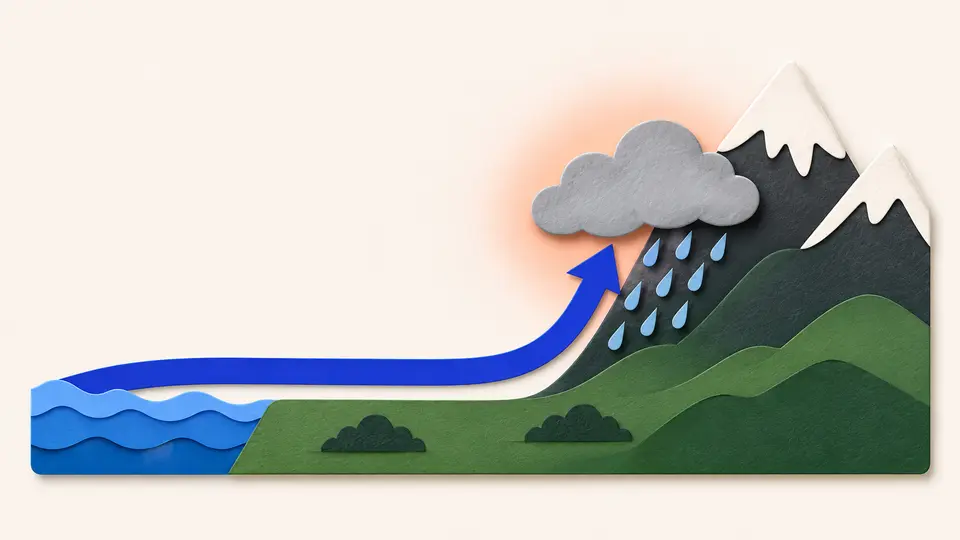
In South Asia the summer phase runs from June to September. The Thar Desert and the land around it heat up strongly, and a low-pressure area forms over the northern subcontinent. Moisture-laden winds rush in from the Indian Ocean.
The Himalayas block those winds from Central Asia and force them upward. The rising air cools, and the rain falls. Nearly 80% of India's rain arrives in this season.
The winds first strike the Western Ghats, the mountains along India's southwest coast, and drop their rain on the seaward side. That makes Kerala the first state to get the monsoon. Its usual arrival there, June 1, is taken as the start date for all of India.
Around September the land cools quickly. Pressure builds over northern India, and cold, dry air sweeps down from the Himalayas toward the ocean. This is the northeast or retreating monsoon, which runs from October to December.
On its way out the air picks up moisture over the Bay of Bengal and drops it on peninsular India and Sri Lanka. That's why Chennai, on the east coast, gets little rain in summer. The state around it, Tamil Nadu, gets 50% to 60% of its rain from the retreating monsoon.
Try to recallChennai gets comparatively little rain from the southwest monsoon and a great deal from the northeast one. What does that tell you about where each phase picks up its moisture?
The southwest phase blows in from the Indian Ocean and drops its rain on the seaward side of the Western Ghats, so little reaches the east coast. The northeast phase runs the other way, off the cooling land, and picks up moisture crossing the Bay of Bengal before it reaches Chennai. That's why Tamil Nadu gets 50% to 60% of its rain between October and December.
So the monsoon has two phases that blow in opposite directions, on dates you can write down a year in advance. Sailors built their trade on that last property.
Lessons in this topic
Why the monsoon wind reverses twice a year
The monsoon blows one way for months and then turns around. See why land and sea heat at different rates, and when each phase arrives in South Asia.
How sailors rode the monsoon out and home
A reversing wind gives a sailing ship a following wind in both directions, as long as it leaves on time. See what a missed season cost, and how sailors found their latitude with a card on a string.
Why Arabian shipowners had their dhows built in India
The ships that used the monsoon were themselves a product of the crossing. See what a dhow is, and why Omani and Yemeni owners went to Kerala for timber, shipwrights and coconut rope.
Where the word dhow came from, and what it hides
The people who built and sailed these ships had no single word for them. See how Europeans made dhow a catch-all, and what the label leaves out about the ships and their cargo.
Three quick stories from this topic
Ships sewn with coconut rope
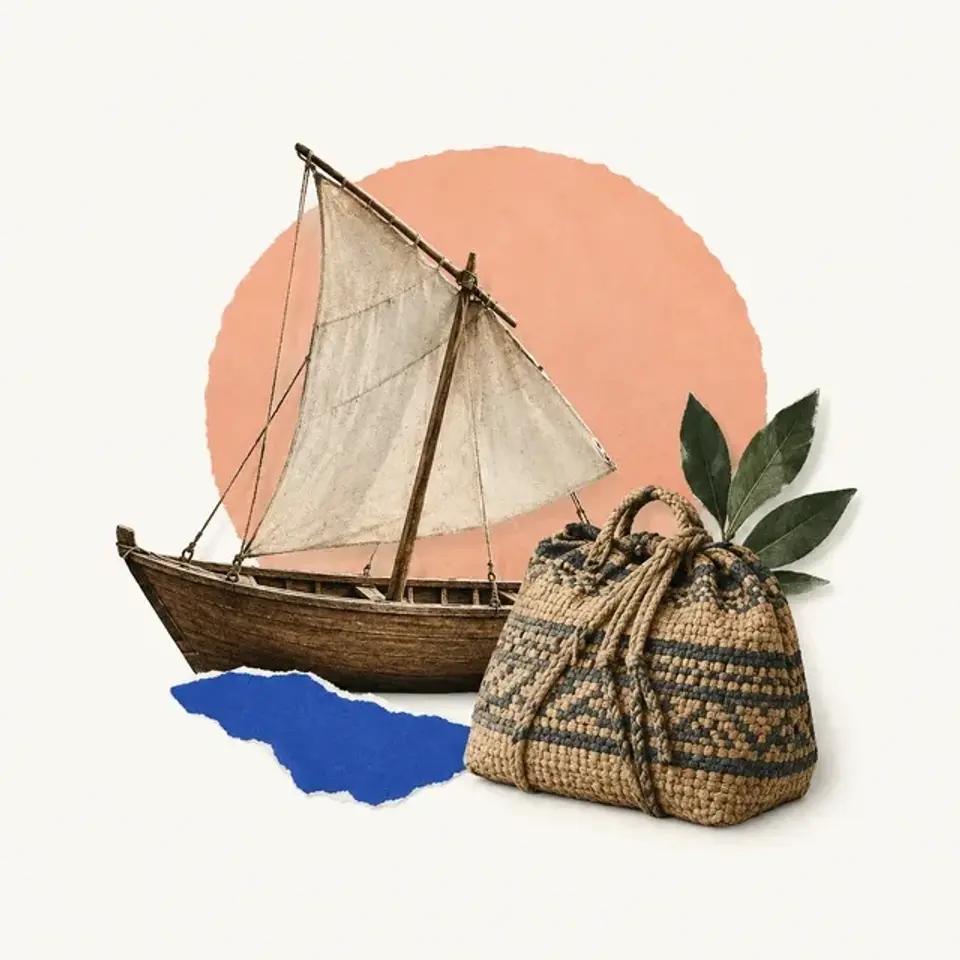
For centuries Omani shipowners had their dhows built in India and sewn with coconut rope
They went to Beypore, on the coast of Kerala, for its forest timber, its skilled shipwrights and its coir, a rope made from coconut fiber. In earlier times that rope held a hull's planks together in place of nails.
A ship as a trade good
The vessels that carried the monsoon trade were themselves ordered across the ocean by the people who would sail them.
Still called urus
Beypore's vessels are called urus in Malayalam, the local language. Settlers of Yemeni descent have long been among their builders.
A year's rain in four months
Nearly 80% of India's rain falls during the summer monsoon, from June to September
In those months, land heated by the summer sun draws moist wind in off the Indian Ocean. The Himalayas force that air upward, where it cools and drops its rain. Then the wind turns around and blows back out to sea.
Why the wind turns
Land heats and cools far faster than the sea. In summer, low pressure over the hot land pulls ocean air in, and in the cold months the flow reverses.
The other coast's turn
The retreating wind picks up moisture over the Bay of Bengal. Tamil Nadu, in India's southeast, gets 50% to 60% of its rain from it.
Navigating by a card on a string
Indian Ocean sailors read their latitude from a wooden card on a string held in the teeth
The tool is called a kamal. A sailor slid the card along the knotted string until it filled the gap between the horizon and the Pole Star. Counting the knots gave the star's height, and so how far north the ship was.
A wind that brings you home
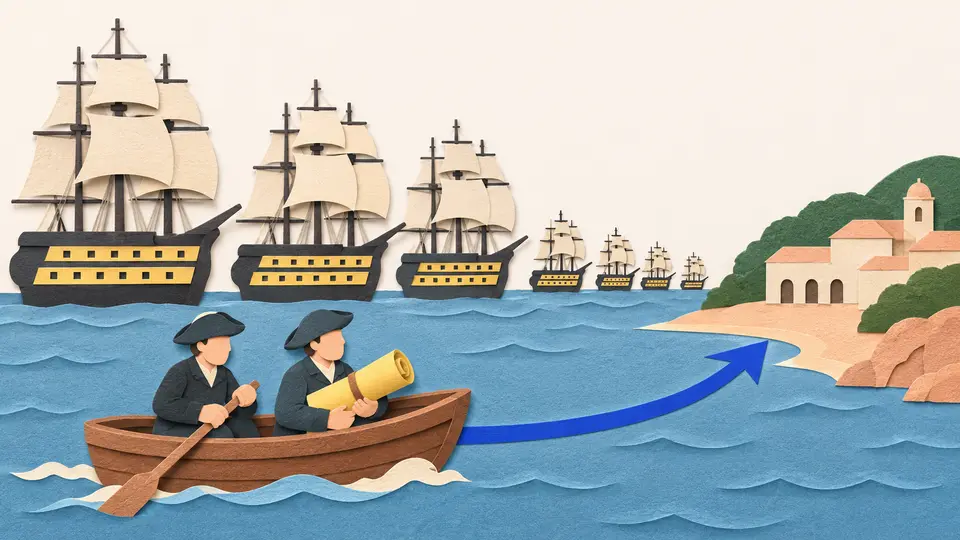
The monsoon reverses with the seasons, so a ship could sail out with the wind behind it and come home months later the same way.
A knot for each port
A navigator bound for a port at a known latitude could tie a knot for it and hold that line until the coast appeared.
Sources
- Monsoon, Wikimedia Foundation
- Table of Specific Heats, HyperPhysics, Georgia State University
- Dhow, Wikimedia Foundation
- Sewn boat, Wikimedia Foundation
- Indian Ocean trade routes, OER Project
- Kamal (navigation), Wikimedia Foundation