History · Revolutions & social change
What independence cost Haiti
Twenty-one years after Haiti declared itself free, France sent warships with a price list. Following that bill forward explains more about Haiti's next century than the revolution does.
What you will learn
- Describe what the ordinance of Charles X demanded and what it granted in return.
- Explain why the first installment couldn't have been paid out of revenue.
- Trace how the indemnity was rescheduled and when the payments actually stopped.
- State what share of the state budget the payments took up and what that pushed aside.
Lesson 1 of 4 · 6 min
The bill France sent Haiti for its independence
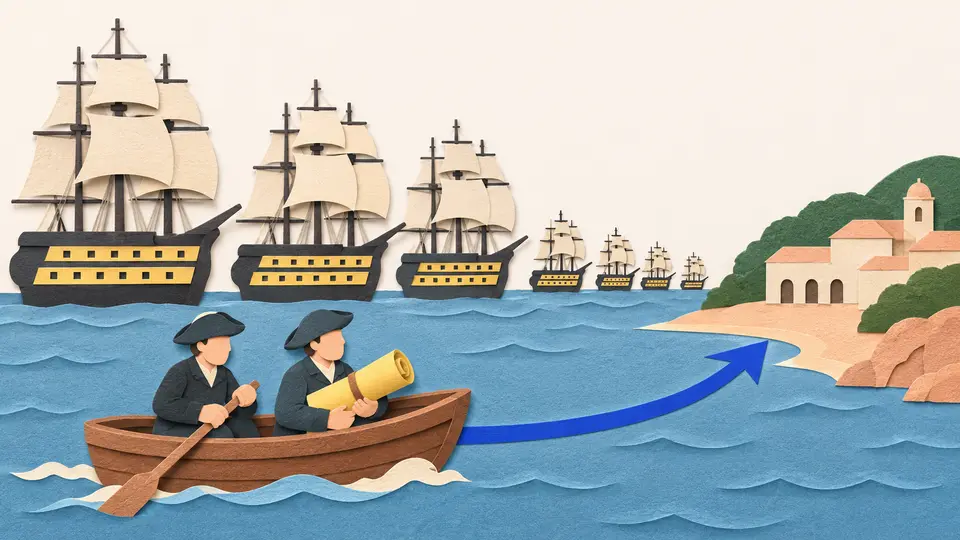
On July 3, 1825, a French captain, the baron de Mackau, anchored off Port-au-Prince with three ships. More followed, until fourteen French warships carrying 528 cannons sat off Haiti's capital. They hadn't come to invade. They'd come to deliver a piece of paper.
Haiti had declared independence on January 1, 1804. Twenty-one years later, France still hadn't recognized it. The paper was an ordinance signed that April by King Charles X, and it had three short articles.
First, Haiti's ports would be open to the commerce of all nations, with French ships paying half the duty everyone else paid. Second, the inhabitants would pay 150 million francs to compensate the former colonists, in five annual installments.
Third, on those conditions, France granted the inhabitants the full independence of their government.
The order of the articles shows what was for sale. Haiti had held its territory by force since the French withdrew in 1803, so France wasn't offering land. It was selling recognition. While France withheld it, no other power would open diplomatic relations with Haiti.
Haiti's president accepted on July 8, with the fleet threatening to blockade the ports. The senate registered the agreement three days later. Most other powers then opened relations with Haiti.
Haiti was to pay 150 million francs in five installments, so 30 million francs fell due at the end of the first year. By the New York Times's count, that one installment was about six times what the Haitian government collected in a year. No reshuffling of spending closes a gap like that.
So the money was borrowed. Haiti took a loan of 30 million francs through the French bank Ternaux Gandolphe et Cie, which sold it to investors as bonds. A group of bankers led by Jacques Laffitte paid 800 francs for each thousand-franc bond. Haiti owed 30 million and received 24 million.
Of that 24 million, 20 million had itself been borrowed at 3% from the same French state fund that was due to receive the indemnity. In 1826 Haiti shipped the contents of its treasury to France in bags to make up the remaining six million.
That's why the arrangement is called a double debt. France collected the indemnity, and French bankers collected interest on the loans Haiti took out to pay it. A French minister of the period called the debt France's principal interest in Haiti, the question that dominated everything else.
Try to recallThe first installment of Haiti's indemnity to France was 30 million francs. Why does that figure alone tell you the money would have to be borrowed?
Because 30 million francs was roughly six times the Haitian government's entire yearly revenue, so no amount of collecting or cutting could produce it. Haiti borrowed from the French bank Ternaux Gandolphe et Cie, which auctioned bonds at 800 francs for each thousand-franc note, and shipped the contents of its treasury to France in bags in 1826 to cover the rest.
So France sold Haiti something Haiti already had. The price came backed by warships, and its first installment was six times what the state collected in a year. The loan to pay it came from French bankers, which left Haiti owing France twice.
Lessons in this topic
The bill France sent Haiti for its independence
In July 1825 fourteen French warships anchored off Port-au-Prince to deliver a document. Read its three articles in order and you can see exactly what France was selling.
How a five-year bill lasted more than a century
France's bill was written to be paid in five years. Follow the money forward and you get three different end dates, the last of them in 2016.
Why Haiti's president agreed to pay France
Jean-Pierre Boyer had fought for independence and ruled the whole island. See why he accepted France's terms in 1825, and how the debt shaped his rule and his fall.
Why Haiti couldn't say no to France's bill
A demand that large only works on a country with nowhere else to turn. See how Haiti was isolated after 1804, and how France's price counted the people who had freed themselves.
Three quick stories from this topic
People counted as lost property
France's 1825 bill to Haiti counted the people who had freed themselves as lost property
Compensation was worked out under the Code Noir, the old slave law, in which enslaved workers made up 30% to 60% of a plantation's value. Haiti had offered to pay for land and buildings only.
What Haiti had offered
In 1814 President Alexandre Petion said Haiti could compensate colonists for lost real estate. He ruled out paying for enslaved people, whom France itself had freed in 1794.
Why it's called odious
The price rested on a legal definition of people as property. Haitians had fought a revolution to reject that definition, and then they paid by it.
Paid off in 1947
Haiti made the last payment on debts from its 1825 independence bill in 1947
France's bill was meant to be paid in five years. Haiti had to borrow to pay it, then borrow again to repay the lenders. In 1922 the debt passed to American investors, and the New York bank that collected the last payment is now Citibank.
A double debt
France collected the indemnity, and French bankers collected interest on the loans Haiti took out to pay it. The indemnity itself was cleared in 1878.
What it added up to
By a New York Times count, Haiti paid about 112 million francs on the indemnity and its first loan, roughly $560 million in 2022 dollars.
The price of 1825
In 1825 France sent 14 warships to Haiti with a bill for the country's independence
The ships carried 528 cannons and a royal order. Haiti was to pay 150 million francs to compensate its former colonists, and the first installment alone was about six times the government's yearly revenue.
Recognition came last
The third article of Charles X's ordinance granted full independence, on condition of the first two. Haiti had held the ground by arms since 1803. What France still controlled was the paper that let other states trade with it.
Six times the revenue
The first installment alone, 30 million francs, was about six times the annual revenue of the Haitian government. Haiti's senate signed on 11 July 1825, eight days after the first ship appeared.
Sources
- Haitian independence debt, Wikimedia Foundation
- Haiti's independence debt. The slave as a unit of account (1794-1922), Bibliothèque nationale de France
- Jean-Pierre Boyer, Wikimedia Foundation
- Historical data on Haiti's debt, The New York Times
- La double dette d'Haïti (1825-2025), une question actuelle. Les notes de la FME, no. 4, Fondation pour la mémoire de l'esclavage