History · Revolutions & social change
The Haitian Revolution
Follow the struggle that destroyed slavery and French colonial rule in Saint-Domingue, and see why freedom, citizenship, independence and control over work were connected but different demands.
What you will learn
- Distinguish equal citizenship for free people from the abolition of slavery
- Explain why the 1791 uprising required organization and agency among enslaved people
- Distinguish the 1794 abolition of slavery from Haitian independence in 1804
- Explain why the removal of one leader didn't end the revolution
Lesson 1 of 4 · 4 min
The 1791 uprising the planters refused to believe
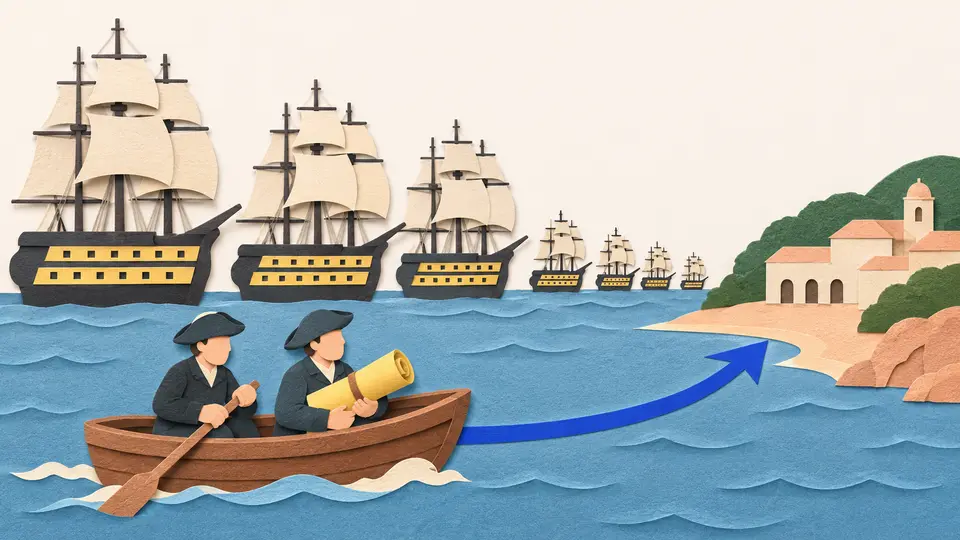
In August 1791, planters in northern Saint-Domingue were warned that the people they enslaved were about to rise. Many refused to believe it. Six days later their plantations were burning.
Saint-Domingue was a French colony on the western part of the island of Hispaniola, where Haiti is today. By the 1760s its sugar and coffee had made it the most profitable colony in the Americas. Enslaved Africans, the overwhelming majority of its people, grew those crops.
The French Revolution spoke of rights, but a promise of liberty in Paris didn't end slavery across the Atlantic. So whose freedom was being promised?
The colony's white minority had split into royalists and revolutionaries, who fought each other over power. Free people of color, people of African or mixed ancestry who weren't enslaved, campaigned for equal civil rights.
In May 1791 Paris gave voting rights to a limited number of them, those born to free parents. White colonists were furious, and the decree was revoked that September.
That fight over equal citizenship wasn't a fight to abolish slavery. A society can widen the rights of some free residents while still holding others as property.
The warning came on August 16, when some enslaved men were caught setting fire to an estate. Under questioning they revealed a planned uprising and named its leaders. One plantation manager offered his own head if the story proved true.
On August 22 it began. The plan had taken months and involved about 200 leaders from across the north. Most were commanders, enslaved men with authority over other workers, and they had built a network linking plantations. Within eight days the rebels had devastated 184 sugar plantations.
So the rebellion was more than an idea sent from Paris. People living under slavery acted on their own plans and relationships.
The plotters are remembered as sealing their pact at Bois Caiman, a ceremony in thick woods. It was a ritual of Vodou, an Afro-Haitian religion the French had forbidden. Despite the ban, Vodou was one of the few parts of life that enslaved people ran entirely themselves.
The ceremony's date is still debated, and later accounts include legend. The organizing was real even where the remembered details aren't certain.
The revolution grew from collective action. The famous leaders who emerged later are only part of the story.
Try to recallWhy is it misleading to explain the 1791 uprising in Saint-Domingue only as the arrival of French revolutionary ideas?
That leaves out the people who carried it out. About 200 enslaved leaders spent months planning the uprising and built a network across plantations. Ideas from France were part of the context, but they can't stand in for those people's own agency.
Three fights ran side by side in Saint-Domingue in 1791. White colonists fought over power, and free people of color fought for equal citizenship. Enslaved people fought slavery itself, in an uprising they planned themselves.
Lessons in this topic
The 1791 uprising the planters refused to believe
In France's most profitable colony, three groups wanted three different things. See why equal rights for free people wasn't abolition, and how enslaved people planned the 1791 uprising themselves.
Why abolishing slavery didn't end Haiti's revolution
France abolished slavery in 1794, and Saint-Domingue stayed French for ten more years. Follow how a war to keep that freedom became a war for independence.
Why freed workers rebelled against Toussaint Louverture
Abolition ended ownership of people, but it left the plantation in place. See why freed laborers and their own leaders fought over land, wages and the right to leave.
Why the world took decades to recognize Haiti
Haiti declared independence in 1804. France took 21 years to recognize it and the United States 58. See what recognition is, and how fear of slave revolt shaped the delay.
Three quick stories from this topic
The warning nobody believed
Warned of the 1791 slave uprising in Saint-Domingue, many planters refused to believe it
Six days before it began, captured plotters revealed the plan and named its leaders. One plantation manager offered his own head if the story proved true. Within eight days of the first fires, rebels had devastated 184 sugar plantations.
Months of planning
About 200 leaders from plantations across the north had planned the uprising for months. Most were commanders, enslaved men with authority over other workers.
Why the planters were wrong
Colonists had thought of the people they enslaved as passive. One wrote afterward that the revolt was too sudden, too vast and too well planned to stop.
58 years without recognition
The United States refused to recognize Haiti for 58 years after it declared independence
Thomas Jefferson, a Virginia slaveholder, cut off aid and isolated the new state because he feared its slave revolt would spread. Recognition came in 1862 under Abraham Lincoln, 37 years after France had granted it.
Why it took so long
The State Department's Office of the Historian attributes the delay to shifts in policy and domestic concerns. Many U.S. leaders were slaveowners, and under Jefferson the government isolated Haiti for fear that a successful slave revolt would spread.
Independence and recognition are different
Haiti governed itself from 1804 whether or not others agreed. Recognition is another state's decision, and going without it can shape trade and diplomacy for decades. The Haitian Revolution Timeline treats that as one factor in Haiti's later impoverishment.
Free, but bound to the plantation
Louverture's 1801 constitution ended slavery forever and made plantation work mandatory
Toussaint Louverture wanted Saint-Domingue's estates exporting again, so freed laborers stayed bound to them. When workers rose against him that October, his nephew Moïse, who had refused to force his own laborers to work, was arrested and shot.
What the workers wanted
From the start of the revolution, enslaved people had asked for small plots of land and free time to farm them. Louverture's rules kept them on large estates.
Two kinds of freedom
The constitution ended the ownership of people. It didn't give them control over where they worked, and that question split the revolution's own side.
Sources
- The United States and the Haitian Revolution, 1791-1804, U.S. Department of State, Office of the Historian
- The Haitian Revolution begins: August to September 1791, Kona Shen, The Haitian Revolution Timeline
- Upheavals in France and Saint-Domingue, Kona Shen, The Haitian Revolution Timeline
- Toussaint Louverture in power, Kona Shen, The Haitian Revolution Timeline
- General Leclerc in Saint-Domingue, Kona Shen, The Haitian Revolution Timeline
- The final years of the revolution, Kona Shen, The Haitian Revolution Timeline
- Haitian independence, Kona Shen, The Haitian Revolution Timeline
- A Guide to the United States' History of Recognition, Diplomatic, and Consular Relations, by Country, since 1776: Haiti, U.S. Department of State, Office of the Historian