History · Wars & diplomacy
Why the Western Front stopped moving
Two armies spent a month trying to get around each other and ran out of ground. Nobody planned what followed, and it took four years to undo.
What you will learn
- Say what the Race to the Sea was and what the name gets wrong.
- Explain why the outflanking attempts kept failing.
- Describe the three ways of digging a trench and the exposure each involves.
- Explain why trenches were dug in a zigzag with fire bays and traverses.
Lesson 1 of 4 · 5 min
How a month of outflanking created the trench line
By mid-September 1914 the German invasion of France had been stopped at the First Battle of the Marne, and a Franco-British counterattack had stalled in turn. Neither army could push through the other. But the line they held had an end. North of it the country lay open.
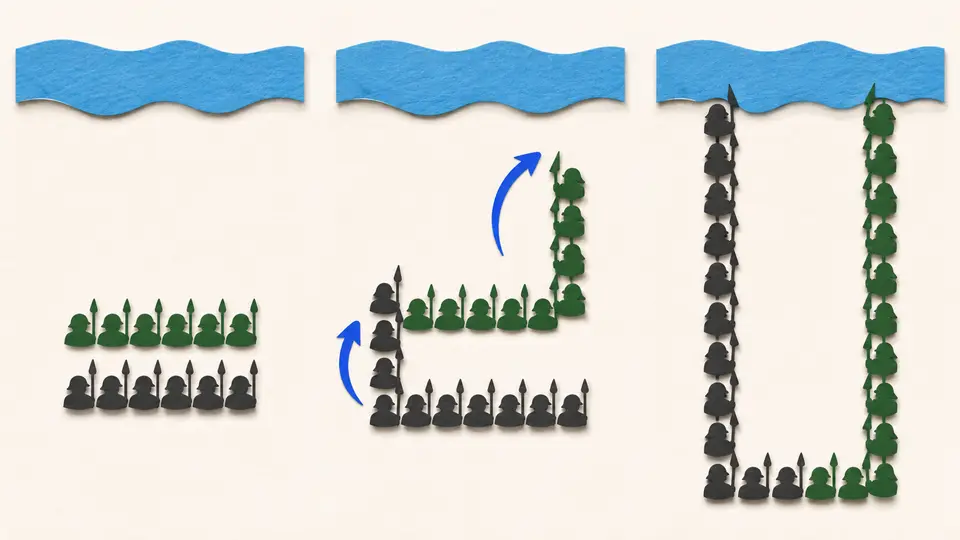
An army that got around that open end could attack its enemy from the side. So from September 17 to October 19 the Franco-British and German armies each tried it, again and again. Each reach around the northern flank, the exposed end of the line, was met by a matching reach a little farther north.
The episode is called the Race to the Sea, and the name misleads. Nobody was trying to get to the sea. It's where the land ran out.
Around October 19 Belgian troops who had retreated from Antwerp filled the last open stretch, from the town of Diksmuide to the coast. There was no flank left to turn. A continuous front soon ran from the North Sea to the Swiss border.
Why did every attempt fail? The usual explanation is timing. Neither the French nor the Germans could gather forces near the northern flank fast enough to gain a decisive advantage. The moves produced a string of clashes between armies on the march, and no victory.
The second part of the answer shaped the rest of the war. Wherever either side tried to advance, it was quickly stopped and had to improvise field defenses. Attacks on those defenses were costly failures. So the troops dug in because their advance had stalled. Nobody had planned it.
Reaching the sea didn't end the fighting. Both sides attacked again in Flanders, at the Battle of the Yser and the First Battle of Ypres, which lasted until November 22. Both battles were costly and indecisive.
By November 8 the German chief of staff, Erich von Falkenhayn, had concluded that taking Ypres was impossible. When the battle ended both sides were exhausted and short of ammunition, and some infantry units were refusing orders.
Try to recallWhy did the month of flanking maneuvers known as the Race to the Sea end with a continuous line of field defenses rather than with one side winning?
Neither side could get forces to the open end of the line faster than the other could match them. So each reach around the northern flank met an enemy arriving at the same time, and the open end just moved farther north. Wherever an advance was stopped, the troops had to improvise field defenses, and attacks on those failed at high cost. So the trenches were a result of stalled advances. It ended around October 19, when Belgian troops filled the last gap before the sea.
So the trenches weren't a plan. They marked the places where a month of advances had stalled, strung end to end until they reached the sea. The small, improvised trenches of those first months then grew deeper and more complex, until they became vast interlocking defensive works.
Lessons in this topic
How a month of outflanking created the trench line
In autumn 1914 two armies kept trying to get around each other's northern end. See why every attempt failed, and how the trenches began where the advances stalled.
How a trench was dug, and why it was never straight
A First World War trench was 2.5 meters deep and never straight. See the three ways to dig one, and why a zigzag was worth losing the view along your own line.
Why capturing a trench so rarely broke the line
British doctrine put three trench lines one behind another and held the front one lightly. See why, and how a German rule of 1915 turned a lost trench into a bend in the line.
Why barbed wire stopped armies, and what answered it
Barbed wire barely hurt anyone. It held a soldier still for a few seconds in front of a machine gun. See how armies began to answer it, and why the answer took two years.
Three quick stories from this topic
A race nobody was running
Nobody in the Race to the Sea of 1914 was trying to reach the sea
For a month the French, British and German armies each tried to get around the northern end of the other's line. Every attempt was matched a little farther north, until the Belgian coast left no end to get around. The trenches began where those advances stalled.
Too slow at the open end
Neither side could assemble forces near the northern flank fast enough for a decisive advantage, so every reach was matched by another.
Stopped, then dug
Where advances were halted, troops improvised field defenses, and attacks against those defenses were costly failures.
The trench built to be shelled
Some Western Front trenches were kept up only so the enemy would waste shells on them
British doctrine called for three trench lines. As artillery grew more powerful, some sectors turned the middle one into a decoy. Soldiers lit fires in it to make it look occupied and repaired any damage at once, to draw shellfire away from the other two lines.
Three lines, front held lightly
The front trench was manned in force only at dawn and dusk. Behind it lay a support trench, and behind that a reserve trench where troops could gather for a counterattack.
Why the front was thinly held
Early in the war trenches were packed with men shoulder to shoulder, and artillery caused heavy casualties. Armies soon held the front line with fewer men.
Wire and the machine gun
Barbed wire on the Western Front killed by holding a soldier still for a few seconds
The barbs caused only minor injuries. A man caught in a belt of wire 15 meters deep had to stop and work it off, and the wire was laid in plain sight of machine guns. Wire and firepower together caused most failed attacks.
The gun spends them
The delay was deadly because the wire sat at points of maximum exposure, in plain sight of enemy fire bays and machine guns.
The pair Liddell Hart singled out
He identified barbed wire and the machine gun as the elements that had to be broken to regain a mobile battlefield.
Sources
- Race to the Sea, Wikimedia Foundation
- Western Front (World War I), Wikimedia Foundation
- Trench warfare, Wikimedia Foundation
- Trench warfare (revision of 22 February 2026), Wikimedia Foundation