History · Ideas & discoveries
Why the printing press took hold in Europe
Gutenberg joined four things that already existed, starting with a wine press. See how his machine worked, what it turned out in a day, and why it spread across Europe when movable type was older in China and Korea.
What you will learn
- Name the four existing technologies the press combined and where each came from.
- Identify what Gutenberg had to invent himself to make the combination work.
- Walk through the steps that produced one printed sheet.
- Compare the press's daily output with the other methods available at the time.
Lesson 1 of 4 · 6 min
The printing press was built from four old inventions
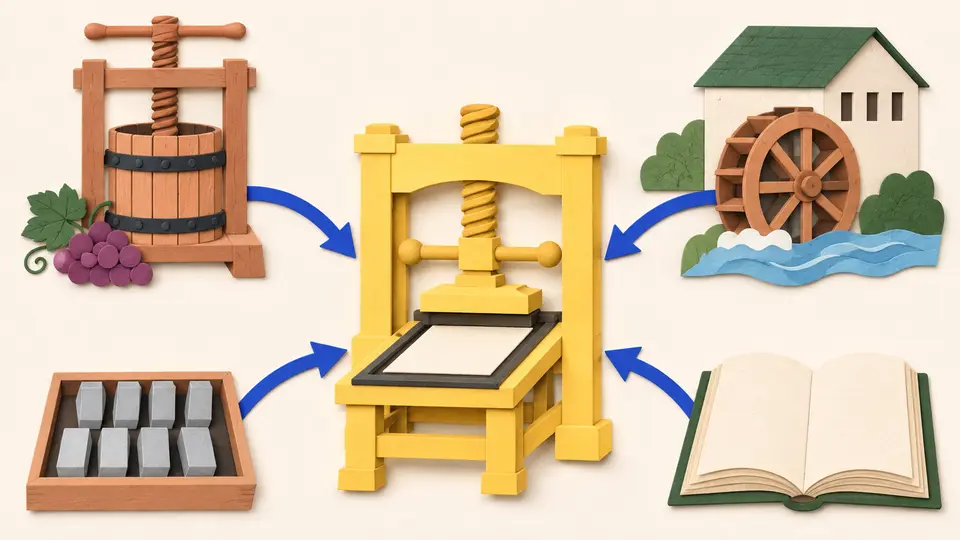
The printing press began as a wine press. The Romans introduced the screw press in the first century AD, and farmers used it to crush grapes for wine and olives for oil. Turning its screw applies direct pressure to a flat surface.
Around 1440, Johannes Gutenberg built his printing press on that design. He joined it to three other things that already existed.
One was movable type, the idea of building a text from separate reusable characters. Bi Sheng had made the first movable type in China in the eleventh century. Another was the codex, the bound book with pages. Christian scribes had adopted it in place of the scroll by about AD 500. It was easier to read, more compact and cheaper, and it opened to a left and a right page.
The last was cheap paper. Water-powered paper mills were running by 1282, and so many opened in Italy that paper came to cost much less than parchment.
So the screw press and the bound book were over a thousand years old when Gutenberg put them together. The paper mills had been turning for a century and a half. He invented none of the four. His invention was the combination.
Four borrowed parts don't print a page. Gutenberg had worked as a goldsmith, so he knew metals, and most of the gaps he had to fill were metalwork.
A page needs many copies of each letter, all the same size. So he made a hand mold that cast new pieces of type quickly and precisely from one template. His type case is estimated to have held about 290 compartments, counting punctuation and ligatures. A ligature is two or more letters joined on one piece.
Type also has to last. He was the first to cast it from an alloy of lead, tin and antimony, which made it durable. After much experimenting he settled on an oil-based ink. It worked best on metal type and lasted longer than the water-based inks used before.
He changed the press too. Its flat plate, the platen, now pressed evenly across the sheet with little smearing. A movable table underneath let the printer change sheets quickly.
The earliest record of all this is a lawsuit. In 1439, a case against Gutenberg described his types, his type molds and his collection of metals.
Try to recallMovable type existed before Gutenberg, and so did the screw press. Name two things he still had to work out for himself, and say what problem each one solved.
A hand mold, which cast many identical pieces of type quickly from one template. An alloy of lead, tin and antimony, which made the type durable. An oil-based ink, which worked best on metal type and outlasted water-based inks. Adjusting the platen to press evenly and adding a movable table for fast sheet changes also count.
A wine press, a book format, the idea of reusable letters and a paper mill were all old. They became a printing press once a goldsmith added a mold, an alloy and an ink. The first written trace of the result is a court case.
Lessons in this topic
The printing press was built from four old inventions
A wine press, reusable type, the bound book and mill-made paper all existed before Gutenberg. See what he borrowed and what he had to work out himself.
How two printers made 3,600 impressions in a day
Follow one sheet through a wooden hand press, then compare a day's output with woodblock printing and Korean metal type.
What survives of Europe's first printed books
Books printed in Europe up to 1500 are called incunables. See where that cutoff came from, and what the surviving copies can and can't tell you about what was printed.
Why movable type took off in Europe, not East Asia
Movable type was made in China four centuries before Gutenberg and cast in metal in Korea. See why woodblocks stayed the main method there while the press spread across Europe.
Three quick stories from this topic
A common rare book
The Gutenberg Bible is a fairly common book by the standards of its century
It's known in 48 or 49 copies. On average, an edition printed in Europe before 1501 survives in about 18, and many survive in a single copy. Statistical estimates say at least 20,000 editions have been lost altogether.
Books from the cradle
Books printed in Europe up to 1500 are called incunables, from a Latin word for cradle. About 30,000 editions are known.
The record holder
The most common incunable is the Nuremberg Chronicle of 1493, with about 1,250 surviving copies. It's also the most heavily illustrated.
Presses and city growth
European cities with a printing press by 1500 grew about 60% faster in the next century
That's the estimate of economist Jeremiah Dittmar, who compared them with similar cities that had no press. The equipment was portable, so when authorities restricted printing in one city, the printers moved to the next.
From one shop to a continent
Gutenberg's shop in Mainz was at first the only one in Europe. By 1480, printers were active in 110 different places.
Why it paid off there
The Latin alphabet has a small set of characters, so a full set of type was cheap. Paper from water-powered mills cost far less than parchment.
The press that came from wine
Gutenberg built his printing press on the screw press farmers used for wine and olive oil
The Romans introduced the screw press in the first century AD. Around 1440, Gutenberg adopted its design and joined it to three other things that already existed, reusable type, the bound book and paper from water-powered mills.
Three things Gutenberg worked out
He added a hand mold for casting type quickly from a uniform template, an alloy of lead, tin and antimony that survived repeated pressing, and an oil-based ink that would sit on metal.
A case of 290 boxes
Gutenberg's type case is estimated to have held about 290 separate letter boxes, including ligatures, special characters and punctuation. The first record of his work is a lawsuit of 1439 listing his types, molds and metals.
Sources
- Printing press, Wikimedia Foundation
- Incunable, Wikimedia Foundation
- Information Technology and Economic Change: The Impact of The Printing Press, The Quarterly Journal of Economics, via IDEAS/RePEc