History · Ideas & discoveries
Printing and the spread of ideas
See what reusable type changed, why Gutenberg belongs in a longer history that starts in Japan, China and Korea, and why printing more copies was only one step toward reaching more readers.

What you will learn
- Explain the difference between setting type and printing another copy
- Explain why a repeatable printing process can reproduce mistakes as well as correct text
- Use earlier Asian printing to qualify a claim about Gutenberg's invention
- Tell a technology's existence apart from its development in a particular setting
Lesson 1 of 4 · 4 min
Set the type once, print the page many times
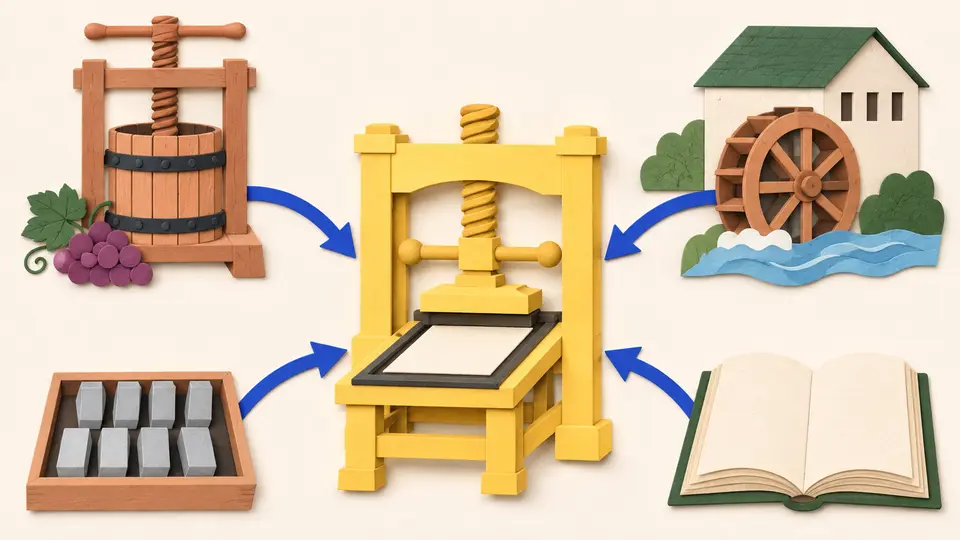
Around 1455, a workshop in Mainz finished printing a Bible. Most of its pages have two columns of 42 lines, and every line was built by hand from separate pieces of metal.
Each piece carried one character. That's movable type. A worker arranged the pieces into a page. Then, for each sheet, the type was inked and the paper pressed against it.
Setting a page was slow, but the shop did it once per page and then printed that page for every copy. Scholars think it made between 160 and 185 copies. Afterward the pieces were taken apart and set again as a different page.
The man credited with this system is Johannes Gutenberg, a goldsmith by training. His type was uniform and interchangeable, so any letter e could take the place of any other.
Letters alone wouldn't print a book. He cast his type from a lead alloy, and he had to find the right ink, a way to press paper onto the type and a routine for handling every sheet.
What changed bookmaking was that working system, with the metal letters as one part of it.
A press repeats whatever is set, mistakes included. Say a printer sets one wrong character and prints fifty sheets before anyone notices. All fifty carry the error.
Correcting the type fixes every sheet printed after that. The fifty already printed stay wrong unless someone corrects them another way, such as by hand.
It happened to the king's own printers. In 1631, Robert Barker and Martin Lucas printed a Bible in London in which one commandment read "Thou shalt commit adultery." The typesetters had left out the word "not."
The printers were fined £300 and most copies were destroyed. Twenty-five copies of this Wicked Bible are known today.
So a press checks nothing. People still had to choose the text, proofread it and decide what to fix. Ten copies that agree with each other show only that they came from the same type.
Try to recallWhy don't ten matching printed copies of a statement count as ten independent checks that it's true?
All ten were printed from the same set type, so they repeat whatever it said, mistakes included. Matching copies show that the press copied faithfully. Nobody checked the statement ten times.
Movable type meant a page was set once and printed as often as needed. The press copied whatever was set, so the checking stayed a job for people.
Lessons in this topic
Set the type once, print the page many times
See what a printer could reuse once a page of type was set, and why a press repeats a mistake as faithfully as it repeats the text.
Printing didn't begin with Gutenberg
Printed prayers from eighth-century Japan and metal type from thirteenth-century Korea show what Gutenberg did and didn't invent.
More copies, but who could read them?
The Gutenberg Bible was printed in Latin and finished by hand. See why more copies didn't mean more readers, and why two copies of the same edition can differ.
Why Korea carved its Buddhist canon twice
The Tripitaka Koreana's 81,200 woodblocks and Korea's early metal type show the difference between storing a page and storing a character.
Three quick stories from this topic
The Wicked Bible of 1631
A Bible printed in 1631 commanded "Thou shalt commit adultery" after one word was left out
The typesetters in London had dropped the word "not." A press repeats whatever is set, so every copy carried the error. The king's printers were fined £300 and most copies were destroyed. Twenty-five are known today.
Set once, printed many times
Movable type is arranged once and then prints the same page again and again. A wrong word in the type becomes a wrong word on every sheet.
Matching copies prove little
Copies that agree with each other only show they came from the same type. Checking the text was still a job for people.
Metal type before Mainz
Korean printers cast metal type some 200 years before Gutenberg
The Library of Congress holds specimens of it. The first Korean font was cast in the 1230s. Its pieces are Chinese characters, because the Korean alphabet wasn't invented until the fifteenth century.
Name the achievement
Gutenberg matters for developing a successful printing system in his own setting. He wasn't the first person anywhere to print.
Dates aren't routes
An earlier example shows what came first. Showing direct influence on a later inventor takes more evidence.
The canon carved twice
Korea carved its Buddhist canon twice, the second time onto 81,200 woodblocks
The first set was finished in 1087 and destroyed during the Mongol invasions of the thirteenth century. Each block was a stored page, so losing them meant losing the means to reprint. The second set, completed in 1251, still exists.
Carved twice over
Carving of the first set began in the early eleventh century and finished in 1087. Those blocks were destroyed during the thirteenth-century Mongol invasions, so the canon was carved again, and the 1251 edition is the one that remains.
Why blocks had to be remade
A woodblock is a page kept ready to print, so losing the blocks meant losing the ability to reprint. Metal movable type was also in use in Korea in the same decades, so carving blocks for the canon was a choice.
Sources
- The Gutenberg Bible, Library of Congress
- Recording the experience: World Treasures, Library of Congress
- A brief history of printing, University of Puget Sound, Collins Memorial Library
- Gutenberg Bible, Wikimedia Foundation
- Wicked Bible, Wikimedia Foundation