History · Human origins & civilizations
Why writing started as bookkeeping
The earliest tablets are counts of grain and livestock rather than poems or laws, and almost everything about the script follows from the job it was invented to do.
What you will learn
- Describe the token and bulla system and say what it was for.
- Explain why impressing the tokens on the outside of the envelope mattered.
- Say what the earliest proto-cuneiform records were mostly about.
- Explain why the earliest tablets are hard to assign to a language.
Lesson 1 of 4 · 5 min
Clay tokens kept the books before writing existed
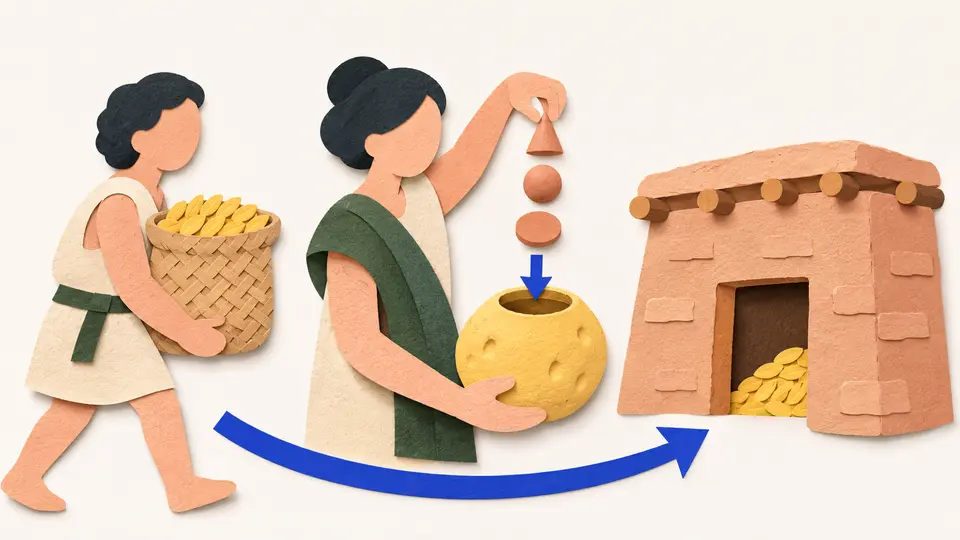
Around 8000 BC, farmers in the Near East began counting with clay. They shaped small clay tokens in their palms, and each kind stood for a particular animal or good. Writing was still more than 4,000 years away.
The tokens let them keep track of what had been traded, stored or sold. Grain had become such a large part of life that the surplus went into shared storehouses, and a shared store needs someone to account for what goes in and what comes out.
Loose tokens are easy to lose and easy to argue about. So for a transaction, the tokens went into a hollow clay ball called a bulla. Each party pressed a unique seal into the opening. The seal identified a person and their office, and it showed if anyone had tampered with the ball.
The token system went unchanged for about 4,000 years. Then the tokens started to look more elaborate, as more goods were produced and exchanged.
The clay ball solved one problem and created another. You couldn't see through it. To check what was inside, you had to break it open, and a record you destroy by reading it isn't much use.
The fix was simple. Before sealing the tokens in, people pressed each one into the outside of the wet clay. Now the surface showed what the ball held. Nobody had to break it unless someone disputed the marks.
That changed what each part was for. The marks on the outside carried the information. The tokens inside had become a backup copy, kept for settling arguments.
After that the ball itself wasn't needed. People began pressing tokens into flat clay tablets, which were easier to store and less likely to be lost. By around 3100 BC scribes had signs for numbers, and tokens were no longer needed for the accounts.
Try to recallA clerk impresses every token on the outside of a bulla before sealing it inside. What has changed about how the record is used?
The record can now be read without being destroyed. The clay ball wasn't transparent, so before this it had to be broken open to check the contents. With the tokens impressed on the outside, it only needs breaking if someone disputes the marks. The outside marks have become the working record and the tokens inside a backup, which is one step from a flat tablet with marks on it.
So the oldest ancestor of writing was a kind of receipt. Marks on clay began as copies of counters, made so that two parties could trust a count. Writing is first recorded in Uruk at the end of the fourth millennium BC, and the earliest documents there are accounts too.
Lessons in this topic
Clay tokens kept the books before writing existed
Long before anyone wrote, people sealed small clay counters inside clay balls so nobody could argue about a delivery. See how a fix to that system led to the first tablets.
The first written documents were inventories
The oldest unmistakable documents are lists of goods. See why accounts came first, and why nobody can prove which language the earliest tablets are in.
How pictures of things became signs for sounds
You can't draw a name. See how scribes around 2800 BC began using signs for their sounds, and why the script then needed fewer signs to say more.
A faster stylus, and tablets saved by fire
A change of tool gave cuneiform its wedges, and accidental fires preserved many of the tablets we have. See what that means for how far the record can be trusted.
Three quick stories from this topic
Tablets saved by fire
Most surviving cuneiform tablets exist because the buildings that held them burned down
Scribes kiln-fired the records worth keeping and left everyday tablets as raw clay, to be recycled. When fire destroyed a storeroom, it baked those throwaway tablets hard. Museums now hold an estimated half a million tablets, and comparatively few have been published.
A skewed record
Survival favored places that burned. A count of surviving tablets reflects which archives caught fire as well as what people wrote.
Mostly unread
Only some 30,000 to 100,000 tablets have been read or published, and only a few hundred people in the world are qualified to read cuneiform.
The clay envelope
Before writing, accounts were sealed in clay balls that had to be broken open to be read
Near Eastern farmers counted goods with small clay tokens and sealed them inside a hollow ball to prevent cheating. Then people began pressing each token into the outside of the ball first. Those outside marks made the contents readable, and flat tablets followed.
Four thousand years of tokens
The token system began between 8,000 and 7,500 BC and went unchanged for about 4,000 years before the tokens grew more elaborate.
Why mark the outside
With the tokens impressed on the surface, the ball only had to be broken if someone disputed the marks. The tokens inside became a backup.
Tablets in an unknown language
Nobody can prove which language the oldest cuneiform tablets were written in
The first tablets, from about 3300 BC, are made of picture signs, and most are accounts of goods. A drawing of a sheep reads the same in any language. Sumerian is usually assumed, and it becomes certain only around 2800 BC, when signs start to spell sounds.
Accounts came first
Most records in proto-cuneiform, the earliest stage of the script, were accounts. The script grew out of a token system used for accounting.
What sound signs added
Signs used for their sound tie a script to one language. They also let scribes write personal names and abstract ideas, which can't be drawn.
Sources
- Bulla (seal), Wikimedia Foundation
- Cuneiform, Wikimedia Foundation