History · Leaders & power
Genghis Khan and Mongol rule
Mongol power rested on organization and personal loyalty as well as violent conquest, and its rulers made governing choices that helped the empire work. Genghis Khan's own lifetime is only part of that story, because the empire kept growing under his successors.

What you will learn
- Explain how reorganizing groups could strengthen loyalty to a ruler
- Explain why a feigned retreat requires coordination
- Explain why support for trade doesn't erase the violence of conquest
- Distinguish religious accommodation from modern equal rights
Lesson 1 of 4 · 4 min
How Genghis Khan turned rival tribes into one army
Say a rival tribe has just come over to your side. Its warriors are skilled, and you need them. But they're loyal to their chief, and he could lead them against you next year. What do you do with them?
Genghis Khan, also written Chinggis Khan, faced that problem again and again while he united the tribes of Mongolia. His answer was to break each tribe up. When one joined him, he quickly spread its members across the units he already controlled.
Those units were built on the number ten. Ten men formed the smallest unit, and the units stacked up into hundreds, thousands and ten thousands. Men from one tribe now served in different units, so they couldn't easily rebel together.
Each commander of ten thousand had a strong personal bond with Genghis Khan. Many senior commanders came from humble families, among them the sons of blacksmiths, a carpenter and a shepherd. They owed their rank to him and not to their birth.
The old ties weakened without vanishing.
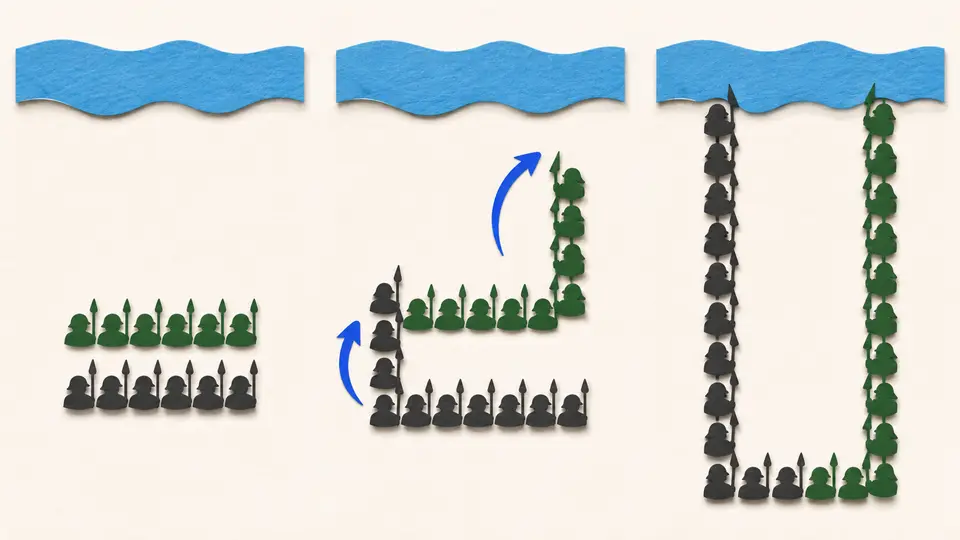
An army held together this way could try a dangerous trick. In a feigned retreat, Mongol troops pulled back in the middle of a battle and pretended they'd been beaten. The enemy chased them. Then whole detachments of armored men or cavalry appeared and overwhelmed the pursuers, who had ridden into a trap.
A real rout looks much the same to an opponent at first. But fleeing soldiers have lost control. Soldiers faking it have to keep their order while looking beaten, and then turn together on plan.
It worked in 1209, when Genghis Khan invaded the Tangut kingdom in northwest China. A Tangut army held him in a stalemate for two months. He broke it with a feigned retreat. The defenders left their positions to chase him, and his troops overpowered them.
Pursuers who think the fight is over can spread out and stop guarding themselves. But the enemy had to take the bait, and the retreating troops had to stay disciplined. It was no secret weapon that won every battle.
Try to recallWhat separates a feigned retreat from an army that has lost control and is fleeing?
A feigned retreat is planned. It draws the enemy into a vulnerable position, and the retreating troops stay organized enough to respond together. A rout is a loss of control.
So horses and bows are only part of the answer. Genghis Khan first made the army loyal to him, by scattering each tribe across units of ten. That army could then do hard things together, such as fake a defeat without it turning into a real one.
Lessons in this topic
How Genghis Khan turned rival tribes into one army
Genghis Khan split up the tribes that joined him and sorted their men into units of ten. See why that won him their loyalty, and why a fake retreat depended on it.
How the Mongols ruled the lands they conquered
After the slaughter came mail stations, tax collectors and tax breaks for priests. See what Mongol rulers did to hold conquered land, and why none of it makes the conquest gentle.
What happened to the empire after Genghis Khan died
Genghis Khan died in 1227 with much of the famous map still unconquered. See who took the rest, and why an empire built on loyalty to one man broke into four.
Genghis Khan's three wars and how each one ended
Genghis Khan won lower tariffs from his first big war and went home. See how his three campaigns ended differently, and why the third wasn't really about trade.
Three quick stories from this topic
The army that left Hungary
A Mongol army that reached Hungary in 1241 went home the same year because its khan died
The great khan Ogedei, a son of Genghis Khan, died that year, and the Mongol elite returned to Mongolia to choose his successor. They couldn't agree. The argument over who should rule went on for 19 years.
No rule for the next ruler
Genghis Khan left no orderly system of succession. His empire rested on personal loyalty to one man, so each new khan had to rebuild those ties himself.
Four parts by 1260
The disputes split the empire into four. Kublai Khan held China and Mongolia, and other descendants held Central Asia, West Asia and Russia.
A retreat that was a trap
Genghis Khan broke a two-month stalemate in 1209 by pretending to run away
A Tangut army had stopped his invasion of northwest China. He staged a retreat, the defenders left their positions to chase him, and his troops overpowered them. A fake rout only works with soldiers disciplined enough to turn around together.
The risky pursuit
Pursuers can be drawn toward waiting forces and a coordinated counterattack.
Order matters
The tactic needs control and a plan. An army that has lost control and is fleeing is in a different situation.
A khan who honored four prophets
Marco Polo reported that Kublai Khan honored Jesus, Muhammad, Moses and the Buddha
The Mongols kept their own shamanist beliefs but gave tax breaks to Buddhist, Muslim, Daoist and Christian clerics. It was a governing policy. Winning over religious leaders made newly conquered peoples easier to rule.
What the khan said
In Marco Polo's account, Kublai says he does "honor and reverence to all four" and prays to whichever is greatest in heaven to help him.
A privilege, not a right
The tax breaks went to chosen clerics for a political purpose. They gave ordinary believers no guaranteed rights, which is why this isn't modern freedom of religion.
Sources
- Tribal Group vs. Mongol Identity under Chinggis Khan, Columbia University, Asia for Educators
- Organization and military tactics under Chinggis Khan, Columbia University, Asia for Educators
- Three invasions led by Chinggis Khan, Columbia University, Asia for Educators
- Chinggis’s Successor and Further Expansion of the Empire, Columbia University, Asia for Educators
- A tactic of religious tolerance, Columbia University, Asia for Educators
- Mongols Support Trade, Facilitating East-West Contacts, Columbia University, Asia for Educators
- Genghis Khan, Wikimedia Foundation
- How a Small Group of Mongols Conquered Such a Vast Domain, Columbia University, Asia for Educators