Geography & the World · Cities & settlements
Why some countries have one giant city
Central place theory explains why bakeries are everywhere, jewelers are rare and big cities sit far apart. Then meet the countries that break the pattern, where one city dwarfs all the rest.
What you will learn
- Define threshold and range, and use them to explain why bakeries outnumber jewelers
- State what the settlement hierarchy predicts about size, number and spacing
- Define a primate city and say how urban primacy is measured
- Explain what a primate distribution suggests about a country, and what it doesn't
Lesson 1 of 4 · 5 min
Why every village has a bakery but no jeweler
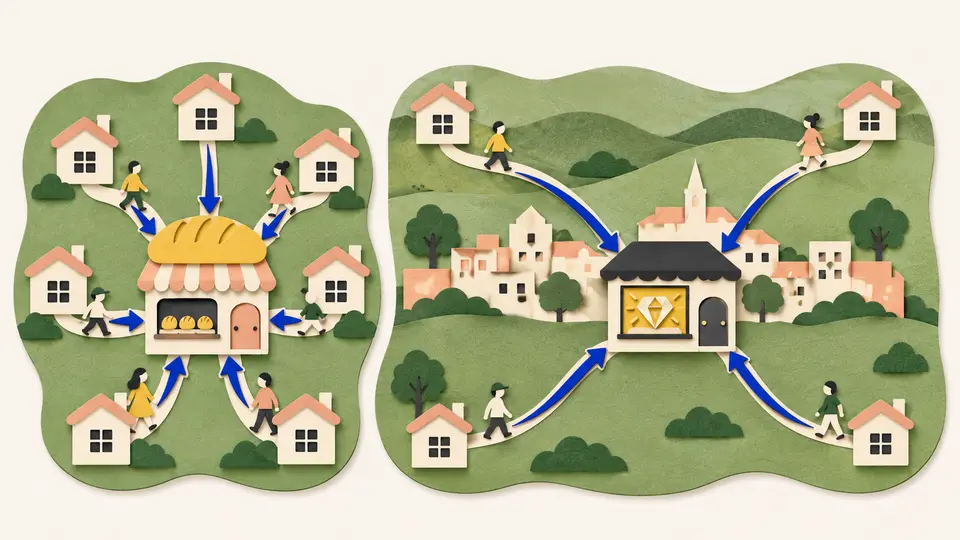
Almost any village can keep a bakery in business. A jeweler needs a town. Count the shops in any region and you'll find the same thing, lots of bakeries and very few jewelers.
In 1933 the German geographer Walter Christaller published an explanation, drawn from the towns of southern Germany. It became central place theory. He treated every settlement as a central place, somewhere that sells goods and services to the area around it. Then he asked how far people will go to buy things.
Nobody wants to travel far for bread, an everyday need. People will go much farther for an expensive or occasional purchase, such as a ring.
Two terms capture this. A good's threshold is the smallest market, in people or income, that can keep a seller in business. Its range is the farthest customers will travel for it before the cost and bother outweigh the need.
Bread has a low threshold and a short range, so bakeries are many and close together. Jewelry has a high threshold and a long range, so jewelers are few and far apart, in bigger places.
Christaller ranked goods by order. Low-order goods are the everyday ones, sold by bakeries, groceries, newspaper stalls and post offices. High-order goods such as jewelry are costlier and bought less often, so people travel farther for them.
Now put threshold and range to work on a map. Small centers selling low-order goods can survive almost anywhere, so there are many of them, close together. Centers selling high-order goods need a big market, so there are few of them, and their long range lets them sit far apart.
A bigger center offers more kinds of goods and services, and more specialized ones. The city has a jeweler and a bakery. The village has only the bakery.
That gives a hierarchy, with many villages at the bottom and a few cities at the top. Christaller didn't have to assume the pyramid. It follows from the two definitions.
Try to recallCentral place theory predicts that larger settlements are both fewer and farther apart. Explain that using threshold and range.
A high-order good needs a large threshold market before anyone can sell it, so only a few places in a region can support one. That makes large centers rare. The same goods have a long range, meaning customers will travel a long way for them, so those few centers can sit far apart without leaving anyone unserved. Low-order goods reverse both conditions, which is why small settlements are many and close together.
So when you pass through a village with a bakery and no jeweler, you're looking at two numbers at work. The bakery's market is small enough to find anywhere. The jeweler's isn't, so the jeweler sits in the town down the road, where enough customers are willing to come.
Lessons in this topic
Why every village has a bakery but no jeweler
Two ideas, threshold and range, explain why some shops are everywhere, why others gather in cities, and why big cities sit far apart.
The countries where one city dwarfs all the rest
Some countries have one enormous city and then a long drop. Learn the test for a primate city, what the pattern suggests about a country, and what it can't tell you.
Why the ideal map of towns is made of hexagons
Christaller imagined a flat, featureless plain and asked where towns would grow. See what each assumption is for, and how one theory draws three different maps.
Where the tidy map of towns goes wrong
Railroads, cars and terrain all bend Christaller's pattern. See what each distortion tells you, and why moving a capital rarely dethrones a country's biggest city.
Three quick stories from this topic
Railroad towns 12 miles apart
In 1850s California, railroad towns were set 12 miles apart, one crew's stretch of track
Larger towns were spaced 60 miles apart, the distance a steam engine could run before it needed water. Many American towns didn't grow up where trade happened to gather. The railroad put them there as it laid the track.
The theory said towns emerge
Central place theory, published in 1933, has towns appearing wherever enough customers gather. The researcher Margot Smith argued that in much of the United States they were sited by railroads.
Spacing with a different cause
The theory spaces towns by how far shoppers will travel. The railroad spaced them by how far a crew could maintain track and how far an engine could go on one tank of water.
Towns on the Dutch polders
On reclaimed Dutch polders, small towns ring a larger one, as a 1933 theory predicted
Walter Christaller's central place theory imagined a featureless plain, where nothing but the distance people will travel to shop decides where towns go. Real land is never that plain. The polders of the Netherlands come close.
Two numbers place the towns
A threshold is the smallest market that keeps a seller in business. A range is the farthest customers will travel. Bread scores low on both and jewelry high, so bakeries are everywhere and jewelers sit in bigger towns.
Why a ring
On an even plain, equal market areas pack together as hexagons, so each larger center ends up with six smaller neighbors around it.
Bangkok, 40 times the runner-up
In 2000 Bangkok was 40 times larger than Thailand's second-largest city
Geographers call a city like that a primate city. Mark Jefferson, who proposed the idea in 1939, set the bar at only twice the size of the runner-up. Bangkok also houses every national newspaper in Thailand and the country's five oldest universities.
One giant and a missing middle
A country with a primate city has one very large city, many much smaller ones and no middle-sized centers between them.
Parasite or engine
Researchers disagree on whether a primate city drains the rest of its country or drives its growth. A country's wealth doesn't predict whether it has one.
Sources
- Central place theory, Wikimedia Foundation
- Walter Christaller, Wikimedia Foundation
- Primate city, Wikimedia Foundation
- Bangkok, Wikimedia Foundation