Geography & the World · Cities & settlements
Megacities and the world's largest cities
Which city is the biggest depends on where you draw its edge. See how city populations are counted, where the cities of ten million or more are, what it takes to run one, and why some have stopped growing.
What you will learn
- Explain why city limits, built-up area and commuting zone give different populations for one city
- Explain why different lists name different cities as the world's largest
- Describe how the number of megacities has grown and where they are today
- Explain why new megacities are appearing mostly in Asia and Africa
Lesson 1 of 4 · 4 min
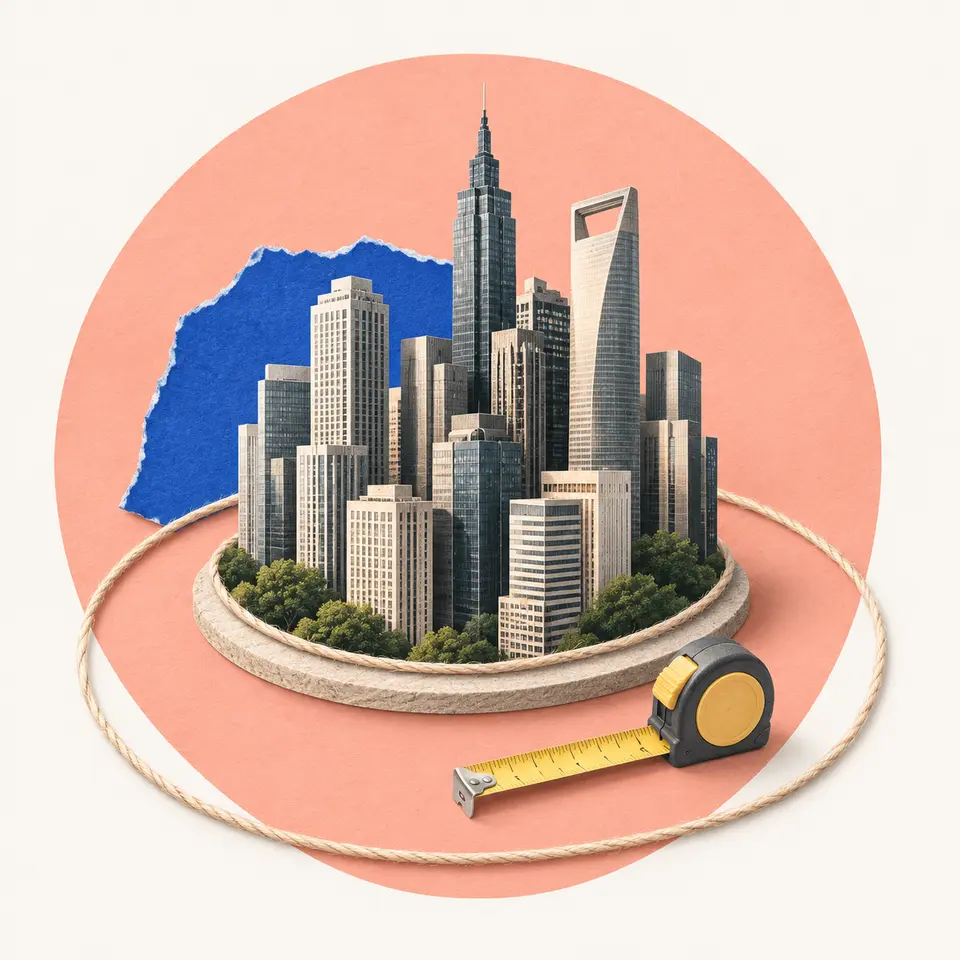
Where does a city end?
Jakarta's city government runs about 664 square kilometers and counted 11 million people in 2025. The UN puts Jakarta at nearly 42 million. Both numbers are honest. They draw the city's edge in different places.
The tightest edge is the city limits, the legal boundary of one local government. But Jakarta's houses and roads don't stop there. They spread into two neighboring provinces, West Java and Banten.
The second edge is the built-up area, the continuous spread of buildings seen from above, wherever the legal lines fall. The UN and the group Demographia both measure cities this way, though with different rules.
The third edge is the commuting zone. It takes in every place where many people travel in daily to work. One definition of Greater Tokyo counts every town where at least 10% of residents commute to Tokyo's central wards. Jakarta's commuters come in from Bogor, Depok, Tangerang and Bekasi.
Now take Guangzhou in southern China. The OECD counts about 17 million people. The UN counts about 28 million. Demographia joins Guangzhou to neighboring Shenzhen and the rest of their continuous footprint, and gets about 70 million.
So the title of world's largest city changes hands with the yardstick. The UN names Jakarta. Demographia names Guangzhou-Shenzhen. The OECD, in 2020, named Tokyo.
Even the number of megacities, cities of 10 million or more, shifts. It's 32 in one European Commission count, 33 for the UN, 39 for the OECD and 42 for Demographia.
Try to recallWhy do different lists of the world's largest cities name different winners?
Each list draws a city's edge differently. Some count only the built-up area around one center, others merge neighboring footprints, and others use commuting zones. Guangzhou is about 28 million by the UN's count but about 70 million when Demographia joins it with Shenzhen, so the UN names Jakarta and Demographia names Guangzhou-Shenzhen.
You can now tell city limits from built-up area and commuting zone, and explain why Jakarta, Guangzhou-Shenzhen and Tokyo can each be called the largest city.
Lessons in this topic
Where does a city end?
See why city limits, the built-up area and the commuting zone give three different populations for one city, and why rankings of the biggest city disagree.
The map of megacities
See how the world went from a handful of cities of ten million to 33, where they are, and where the next ones will appear.
Running a city of 20 million
See why a megacity sprawls across many governments, and how water and transport strain shows in Jakarta, Lagos and Tokyo.
Do giant cities grow forever?
See why Tokyo has stopped climbing while Dhaka races ahead, how forecasts for cities like Lagos and Kinshasa are made, and why they are so uncertain.
Three quick stories from this topic
From 8 megacities to 33
The world had 8 cities of 10 million people in 1975 and has 33 now
Nineteen of today's 33 megacities are in Asia, and nine of the ten largest cities are there. The UN expects 37 by 2050, with Addis Ababa and Dar es Salaam among the newcomers.
The biggest three
Jakarta leads with nearly 42 million, then Dhaka with almost 37 million and Tokyo with about 33 million, by the UN's 2025 count.
Most people aren't in them
Of the world's 12,000 cities, 96% have fewer than 1 million people.
Guangzhou's 70 million
One count puts Guangzhou and Shenzhen together at about 70 million people
Demographia joins the two Chinese cities' touching footprints into one urban area. The UN keeps them apart and counts Guangzhou at about 28 million. The OECD counts about 17 million.
Where a city ends
City limits, the continuous built-up area and the commuting zone each draw a different edge, and each gives a different population.
Whose largest city?
The UN names Jakarta the largest city, Demographia names Guangzhou-Shenzhen, and the OECD in 2020 named Tokyo.
Tokyo grew as Japan shrank
Tokyo added over 300,000 people in a decade when Japan lost 4 million
Between 2015 and 2025, Tokyo kept growing by drawing people from the rest of an ageing country. The UN still expects it to shrink to about 30.7 million by 2050, as that supply runs dry.
Losing the top spot
Tokyo was the world's largest city in 2000 by the UN's count. By 2025 Jakarta and Dhaka had passed it.
Who leads next
Dhaka, in fast-growing Bangladesh, is expected to become the world's largest city by about 2050.
Sources
- Jakarta, Wikipedia
- World Urbanization Prospects 2025: Summary of Results, United Nations, Department of Economic and Social Affairs, Population Division
- Demographia World Urban Areas, 20th edition, Demographia (2025)
- Urbanization, Our World in Data (Ortiz-Ospina, Samborska, Ritchie and Roser, updated May 2026)
- Greater Tokyo Area, Wikipedia
- Megacity, Wikipedia
- GHS Urban Centre Database R2024A, European Commission, Global Human Settlement Layer