Mind & Psychology · Relationships & social behavior
The bystander effect and what real crowds do
A 1964 newspaper story about 38 neighbors who watched a murder was badly exaggerated, yet it started decades of experiments. See what they found, why people in a crowd hold back and what street cameras show about real emergencies.
What you will learn
- Separate the founding story of the bystander effect from the evidence that followed it
- State the bystander effect as a claim about how many people are present
- Describe what the smoke study measured and how being in a group changed the results
- Read the seizure study as a gradient across group sizes rather than an on-off switch
Lesson 1 of 4 · 6 min
The story of 38 silent witnesses was wrong
On March 13, 1964, a 28-year-old bartender named Kitty Genovese was stabbed to death outside her apartment building in Queens, New York. Two weeks later, The New York Times ran the headline "37 Who Saw Murder Didn't Call the Police." The article itself said 38 witnesses.
The story became a parable about city people who watched a woman die and didn't care. It was badly wrong. Police and prosecutors found that about a dozen people had heard or seen parts of the attack, and none saw all of it. Many thought they were hearing a quarrel.
Some of them acted. One neighbor shouted at the attacker, who ran off before coming back. Two people called the police, in a city that had no 911 number until four years later. A neighbor, Sophia Farrar, held Genovese until the ambulance came. In 2016 the Times called its own report flawed.
The story still changed psychology. It prompted the first experiments on what's now called the bystander effect, the finding that people are less likely to help a victim when other people are present.
So keep two things apart. The newspaper story is why the research began. It isn't evidence for what the research found, which comes from staged experiments run later.
The evidence starts in 1968, when the psychologists John Darley and Bibb Latané began staging emergencies in the laboratory. The effect they found has been called one of the most replicable in social psychology.
The design barely changes from study to study. A participant is placed alone or among other people. Some of those people may be confederates, who secretly work with the researchers. Then an emergency is staged, and the researchers record whether the participant acts and how long it takes.
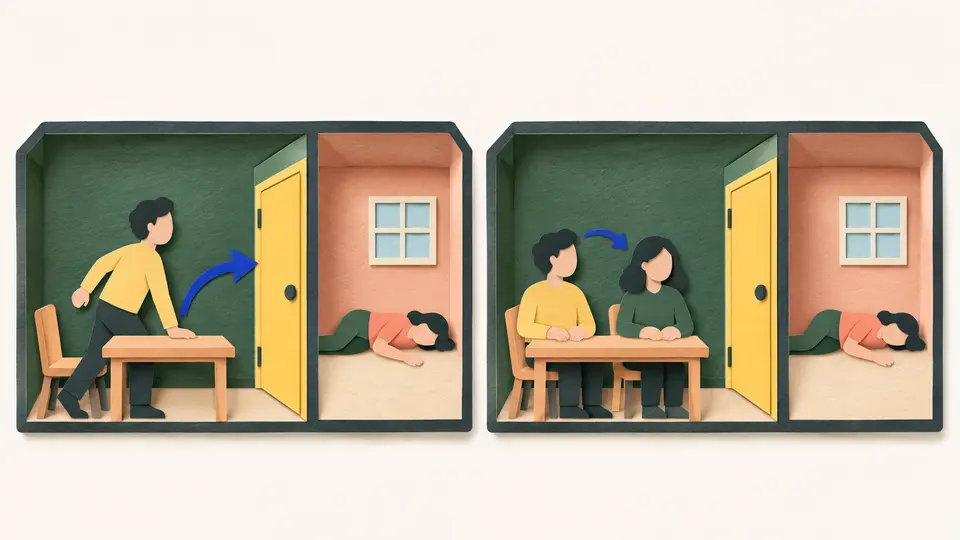
A 1969 study by Latané and Judith Rodin shows the pattern. Participants heard what they believed was a woman in the next room falling and hurting herself. Of those who were alone, 70% called out or went to help. Of those paired with a stranger, 40% did.
Nothing about the woman changed between the two conditions. The only difference was whether somebody else was in the room.
So the claim is narrower than the effect's older name, bystander apathy, suggests. It's about the number of witnesses, and what happens to each person's chance of helping as that number rises. The experiments point to the presence of other people, and away from indifference.
Try to recallA colleague says the bystander effect shows that people have stopped caring about each other. Using Latané and Rodin's 1969 study of a woman falling in the next room, say what the effect claims instead.
The effect is about how many witnesses are present, and it says nothing about character. In the 1969 study, 70% of people who were alone called out or went to help, and 40% of those paired with a stranger did. Both groups came from the same pool of participants, so they can't have differed in how much they cared. The only thing that changed was whether someone else was in the room.
The murder of Kitty Genovese didn't show what the headline claimed. The experiments it prompted did find something. Put one stranger in the room, and helping fell from 70% to 40%.
Lessons in this topic
The story of 38 silent witnesses was wrong
A 1964 newspaper story about a murder that neighbors watched and ignored was badly exaggerated. The experiments it prompted still found something real.
A room filling with smoke and a seizure on the intercom
Two experiments from 1968 show the bystander effect at work. In one, groups sat in a smoke-filled room and said nothing. In the other, the chance of helping fell from 85% to 31%.
Two reasons nobody acts when everyone could
One is about who's supposed to act. The other is about what people think is happening. They call for different fixes, and one of them shows up far from any emergency.
What street cameras showed about real bystanders
Security cameras in three countries recorded 219 real conflicts. Someone stepped in during nine out of ten, and more bystanders made that more likely.
Three quick stories from this topic
From 85% to 31%
People who believed four others could hear a seizure were far less likely to go for help
In a 1968 experiment, students heard a stranger having a seizure over an intercom. Of those who thought nobody else could hear, 85% went for help. Of those who thought four others were listening, 31% did. Each could assume that somebody else would act.
One other person
When they believed one other person was present, 62% took action.
Four other bystanders
With four others present, 31% acted. The probability slides as witnesses are added, but it never reaches zero.
The 38 witnesses
The New York Times now calls its 1964 story of 38 silent murder witnesses flawed
The paper reported that 38 neighbors watched Kitty Genovese being killed and did nothing. Police found about a dozen people who had heard or seen parts of the attack. Two called the police, and one neighbor held her until the ambulance came.
What the neighbors perceived
Nobody saw the whole attack. Many thought they were hearing a quarrel, and one man's shout drove the attacker off before he came back.
The story still mattered
It prompted the first experiments on the bystander effect. Their evidence comes from staged emergencies, and it doesn't depend on the newspaper's account.
What the cameras showed
In 219 street conflicts caught on camera, a bystander stepped in nine times out of ten
Researchers watched security footage from the United Kingdom, the Netherlands and South Africa. Typically several people intervened, and the more bystanders were present, the more likely it was that someone would. Laboratory studies measure each person's odds. A victim needs just one of them to act.
Help was the norm
In over 90% of conflicts, one or more bystanders stepped in to help.
More people, more help
The more bystanders were present, the more likely it was that someone would intervene. That's the opposite of the laboratory gradient.
Sources
- Bystander effect, Wikimedia Foundation
- Murder of Kitty Genovese, Wikimedia Foundation
- The Kitty Genovese murder and the social psychology of helping: the parable of the 38 witnesses, American Psychologist (PubMed record)
- Diffusion of responsibility, Wikimedia Foundation
- How the social context influences helping (Principles of Social Psychology, section 9.3), Saylor Academy open textbook
- Would I be helped? Cross-national CCTV footage shows that intervention is the norm in public conflicts, American Psychologist (PubMed record)