Mind & Psychology · Brain & consciousness
A map of the brain and the autonomic nervous system
Tour the brain's three units, four lobes and inner structures, then meet the autonomic nervous system, which runs your heart rate and digestion without being asked.
What you will learn
- Name the three basic units of the brain and say what each one handles
- Explain what joins the two cerebral hemispheres and why damage on one side shows up on the other
- Match each of the four lobes to the work it does
- Say what the structures beneath the cortex handle that the lobes don't
Lesson 1 of 4 · 5 min
The brain's three units and its two halves
A stroke in the right half of the brain can paralyze the left arm and leg. To see why, you need the brain's basic layout. This three-pound organ divides into three units, the hindbrain, the midbrain and the forebrain. Start at the bottom.
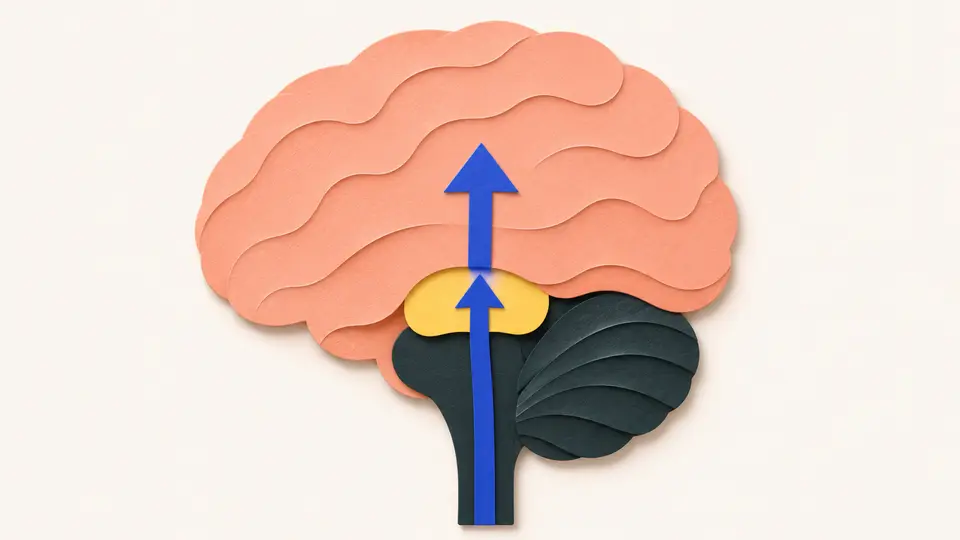
The hindbrain takes in the top of the spinal cord, the brainstem and a wrinkled ball of tissue called the cerebellum. It runs functions you can't do without, such as breathing and heart rate. The cerebellum coordinates movement, including learned movements. Playing the piano or hitting a tennis ball puts it to work.
The midbrain is the top of the brainstem. It controls some reflexes and is part of the circuit that steers eye movements and other voluntary movements.
The forebrain is the largest and most developed part. Most of it is the cerebrum, the part you notice in any picture of a brain. The cerebrum is the source of conscious thought and action. It holds your memories and lets you plan, imagine, read and recognize a friend.
A deep groove splits the cerebrum into two halves, the cerebral hemispheres. They aren't cut off from each other. At the bottom of the groove a thick band of nerve fibers, the corpus callosum, carries signals between them.
The halves look like mirror images, but they differ. The ability to form words seems to lie mainly in the left hemisphere, and the right seems to handle many abstract reasoning skills.
The wiring between brain and body has an odd feature. Nearly all the signals cross over on the way. So the right hemisphere mainly controls the left side of the body, and the left hemisphere the right. The reason is still unknown.
That's why damage on one side of the brain shows up on the opposite side of the body. A stroke in the right hemisphere can leave the left arm and leg paralyzed.
Try to recallAfter a stroke, a patient has weakness in the left arm and leg. Which cerebral hemisphere would you expect to be damaged, and what explains the mismatch?
The right hemisphere. Nearly all signals between the brain and the body cross over on the way, so each hemisphere mainly controls the opposite side of the body. Damage on the right therefore shows up on the left. Why the signals cross is still unknown.
The brain has three units. The hindbrain keeps you breathing, the midbrain handles some reflexes and eye movements, and the forebrain does the thinking. The forebrain's cerebrum is split in two and joined by the corpus callosum, and each half mainly runs the opposite side of your body.
Lessons in this topic
The brain's three units and its two halves
Tour the hindbrain, midbrain and forebrain, then see why a stroke on one side of the brain shows up on the other side of the body.
What the four lobes and the inner brain do
Most of the brain's processing happens in a layer as thick as a few stacked coins. Learn what its four lobes handle, and what the structures underneath add.
The nervous system that runs your organs for you
Meet the autonomic nervous system, which adjusts your heart, pupils and digestion without being asked, and see why calling its two branches an accelerator and a brake is only a first sketch.
Why no brain region or chemical has just one job
Careful statements about the brain say "seems" and "primarily." See what those words protect, why nobody is left-brained or right-brained, and why dopamine isn't the pleasure chemical.
Three quick stories from this topic
Standing up, automatically
Each time you stand up, a reflex speeds your heart and tightens your blood vessels
Standing lets gravity pull blood down toward your legs. The sympathetic nervous system answers before you notice, which keeps blood reaching your brain. A head rush is what you feel when you stand up faster than the reflex can act.
Nobody asked you
The reflex belongs to the autonomic nervous system, which runs the heart, digestion, breathing rate and pupils largely without conscious control.
More than fight or flight
The sympathetic branch is known for emergencies, but much of its work is routine, such as holding blood pressure steady when you change position.
The brain's crossed wiring
A stroke in the right half of the brain can paralyze the left arm and leg
Nearly all signals between the brain and the body cross to the other side on the way. So each half of the brain mainly controls the opposite half of the body. Why the wiring crosses is still unknown.
Damage shows up on the opposite side
When one side of the brain is damaged, the opposite side of the body is affected. A stroke in the right cerebral hemisphere can leave the left arm and leg paralyzed.
Still one organ
A deep fissure splits the cerebrum into two hemispheres, but a thick tract of nerve fibers at its base, the corpus callosum, keeps the halves communicating.
A brain layer thin as coins
Most of the brain's processing happens in a layer as thick as two or three stacked dimes
The layer is the cortex, the brain's gray matter, named from the Latin word for bark. It's folded because folds add surface area, and more surface means more gray matter to process information with.
Why it's gray
The cortex looks gray because its nerves lack the insulation that makes most other parts of the brain look white.
Four lobes
Each half of the cortex divides into lobes. The frontal lobes plan and reason, the parietal lobes take in touch and taste, the occipital lobes process vision and the temporal lobes handle hearing and memory.
Sources
- Brain Basics: Know Your Brain, National Institute of Neurological Disorders and Stroke
- Autonomic nervous system, Wikimedia Foundation
- 15.2 Autonomic Reflexes and Homeostasis, OpenStax, Anatomy and Physiology 2e