Mind & Psychology · Perception & attention
How the senses become perception
Your senses turn light, sound and pressure into nerve signals, and your brain turns those signals into a world. See how each step works and why the same input can look different twice.
What you will learn
- Explain how receptors turn energy into nerve signals and why the nerve, not the energy, sets the kind of sensation
- Explain why the senses stop responding to an input that doesn't change and what that buys you
- Describe perception as a best guess that combines sense signals with knowledge
- Explain how perceptual constancy keeps objects looking stable when the signal from them changes
Lesson 1 of 4 · 4 min
Why you stop smelling a room you're sitting in
Press on your closed eye and you see a glow. No light has entered, so where does it come from? The answer explains how every sense works.
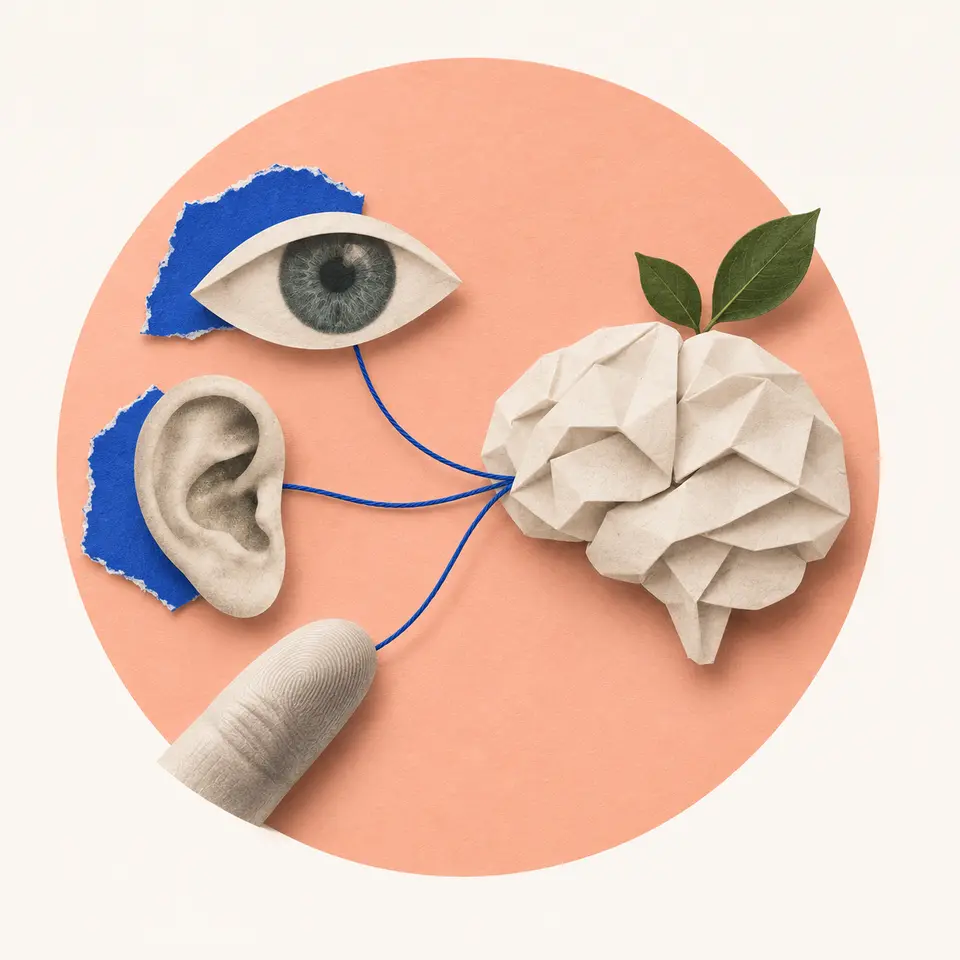
Your brain can't use light, sound or pressure directly. It only reads electrical pulses traveling along nerves. So each sense organ has sensory receptors, cells that respond to one kind of energy. Turning that energy into nerve pulses is called transduction.
What you experience depends on which nerve carries the pulses, not on what started them. Johannes Muller set this out in 1835 as the law of specific nerve energies. Pressure on the eye fires the same retinal cells that light does, so the brain reports light. An electric current on the inner ear's hearing cells produces sound for the same reason.
Receptors can be very sensitive. Researchers measure this as an absolute threshold, the weakest input you detect half the time. In a 1942 study at Columbia University, people saw a flash in the dark when just 5 to 14 rod cells in the eye each caught one particle of light.
Walk into a restaurant and the smell of food is strong. After a while you barely notice it, though the air hasn't changed. Your nose has turned itself down.
This is sensory adaptation, a falling response to an input that stays the same. In smell cells, the chemical signal that makes a cell fire also starts a feedback loop that lowers the cell's sensitivity. Leave the room and your sensitivity returns with time.
Adaptation keeps the senses free to report what's new. You stop feeling a shirt you've worn for hours, yet you'd notice something new touching your arm. The cost is that a steady signal can fade away, which is why people can stop smelling a chemical hazard in the air they're breathing.
Try to recallWhy do you stop noticing the smell of a room after you've been in it a while, and what do the senses gain from it?
Smell cells and the brain respond less and less to an odor that doesn't change, which is sensory adaptation. A feedback loop in the smell cells lowers their sensitivity. This keeps the senses ready to report something new instead of repeating what hasn't changed.
Every sense starts with receptors turning energy into nerve pulses, and the nerve decides what kind of sensation you get. Those receptors quiet down for anything that stays the same, so what reaches you is mostly change.
Lessons in this topic
Why you stop smelling a room you're sitting in
How sense organs turn energy into nerve signals, why the nerve decides what you feel, and why steady inputs fade from notice.
Why your brain sees a best guess, not the raw image
Why the brain fills in what the senses leave open, using a flipping cube, and how it keeps objects looking the same as light and distance change.
How two flat images become a 3D world
How your brain gets depth from the small difference between your two eyes' views, and from the one-eye clues painters use.
The senses you forget you have and how they team up
Meet the senses for balance, body position and the inside of your body, and see how the brain weighs the senses against each other.
Three quick stories from this topic
The coffee bean myth
Sniffing coffee beans between perfumes cleared noses no better than plain air
In a 2011 Beloit College study, students smelled three fragrances nine times, then sniffed coffee beans, lemon slices or air. Coffee didn't help them spot a new scent any better than the others.
Why shops offer beans
Perfume sellers hand out coffee beans as a nose cleanser, to undo smell adaptation, the fading response to an odor that doesn't change.
What actually resets your nose
Time away from the smell. Once you leave a strong odor behind, your sensitivity to it gradually comes back.
Hearing with your eyes
Hearing 'ba' while watching lips say 'ga' makes people hear 'da'
Harry McGurk and John MacDonald found it by accident in 1976, after a technician dubbed a video with a different syllable. The brain blends what the eyes and ears report, even into a sound nobody made.
Seeing changes hearing
The effect is stronger when the sound is poor and the face is clear, so the brain leans harder on what it sees.
Why the brain blends
The brain combines senses into one best guess and gives more weight to the sharper report, which usually serves you well.
The hidden dot square
A square hidden in random dots appears only when your two eyes see it together
In 1960 Bela Julesz at Bell Labs shifted a patch in one of two identical random-dot pictures. Each picture alone shows only noise. Viewed one to each eye, the patch sinks into depth.
An old argument
In the 1800s, Charles Wheatstone and David Brewster argued over whether depth came from comparing the eyes or from perspective in each picture.
What the dots proved
With no shape or perspective in either image, the only clue was the shift between them. So the brain can compute depth from that difference alone.
Sources
- Sensation versus Perception, OpenStax, Psychology 2e
- Sensation and perception (Privitera), Noba Project
- Law of specific nerve energies, Wikipedia
- Phosphene, Wikipedia
- Energy, quanta, and vision (Hecht, Shlaer and Pirenne, 1942), Journal of General Physiology, via PubMed
- Olfactory fatigue, Wikipedia
- Neural adaptation, Wikipedia
- An exploratory investigation of coffee and lemon scents and odor identification (Grosofsky and others, 2011), Perceptual and Motor Skills, via PubMed
- McGurk effect, Wikipedia
- Hearing lips and seeing voices (McGurk and MacDonald, 1976), Nature, via PubMed
- Choices: the science of Bela Julesz (Siegel, 2004), PLOS Biology