Mind & Psychology · Perception & attention
Your eye's blind spot and how the brain fills gaps
Each of your eyes has a patch that detects no light, and you've never noticed it. Learn why it's there, how to find it, and how the same gap-filling habit turns dots and fragments into whole shapes.
What you will learn
- Say what creates the physiological blind spot and where it sits in the visual field
- Explain why you don't normally notice the blind spot and what the octopus eye shows
- State what the principles of grouping claim and name the five categories they're sorted into
- Describe closure and good continuation and say what they add to incomplete input
Lesson 1 of 4 · 6 min
Why each of your eyes has a blind spot
Right now, in each of your eyes, there's a patch of your view where you see nothing at all. It isn't a pinprick. By one description it's about as wide as your four fingers held at arm's length. You've never noticed it. Why is it there?
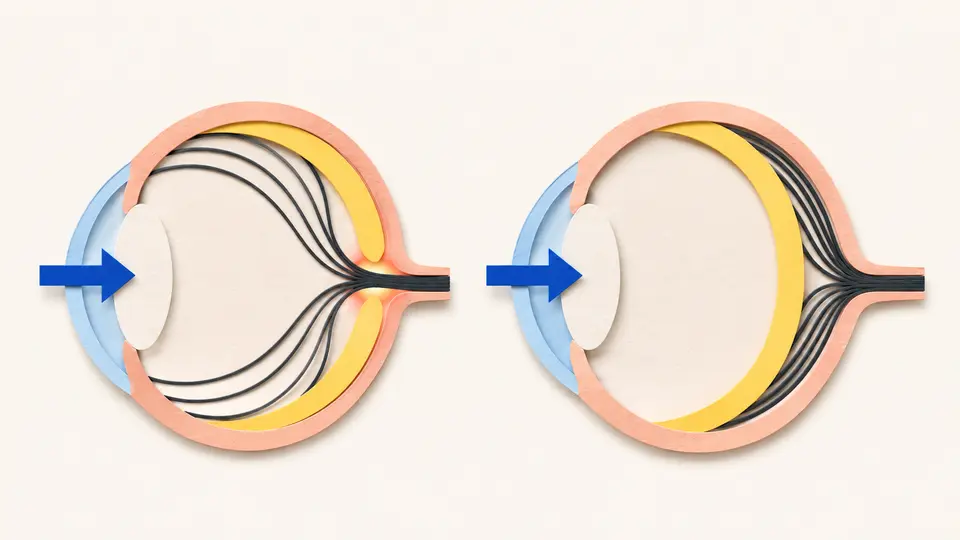
The patch is called the blind spot. It matches a place on the retina, the light-sensing layer at the back of the eye, called the optic disc. The optic disc has no photoreceptors, the cells that detect light. Whatever lands there goes undetected.
The reason is the eye's wiring. In your eye, the nerve fibers that carry signals to the brain run across the front of the retina, on the side the light comes from. To leave the eye they gather into the optic nerve and pass back through the retina. The optic disc is that exit, a hole in the sensor.
So nothing has gone wrong in your eye. Every animal with a backbone has this gap, for the same reason.
It sits off to the side. In each eye the blind spot lies about 12 to 15 degrees from the point you're looking at, toward your ear and slightly below the midline.
So why don't you see a hole? Part of the answer is that you have two eyes. Each blind spot sits toward that eye's ear, so the two fall on different parts of the scene. What one eye misses, the other sees.
But close one eye and there's still no hole. Your brain fills the gap with whatever surrounds it. Put the blind spot on a white page and you see white. Put it on a pattern and you see more pattern. The patch is a guess, and from the inside it looks exactly like seeing.
The octopus shows the hole was never necessary. Octopus eyes look a lot like ours, but they evolved separately. In an octopus the nerve fibers run behind the retina, so the optic nerve leaves without passing through the light detectors. An octopus has no blind spot.
Two kinds of animal solved the same problem, getting signals out of an eye. Only one of the solutions costs a patch of vision.
Try to recallWith one eye closed, your blind spot still doesn't show up as a dark patch. What covers it, and what does the octopus eye add to the explanation?
With one eye closed, the other eye can't help, so the brain fills the gap from the surrounding detail. You see a continuation of whatever is around the blind spot instead of a hole. The octopus shows the gap isn't something every eye must have. Its eye evolved separately, and its nerve fibers run behind the retina, so nothing has to pass through the light detectors.
Each of your eyes has a blind patch where the optic nerve leaves, because your nerve fibers run in front of the retina. Your other eye and your brain's guesswork cover it so well that you can go a lifetime without noticing. An octopus has no such patch.
Lessons in this topic
Why each of your eyes has a blind spot
Each eye has a patch with no light detectors, because the eye's wiring has to leave somewhere. The octopus shows it didn't have to be built that way.
How your mind turns dots and fragments into objects
Meet the grouping principles, the tendencies that sort what you see into objects, and see how closure and continuity add structure the page never contained.
Find your own blind spot in ten seconds
Make a dot vanish with one eye closed, learn why nobody recorded the blind spot until the 1660s, and meet the second blind spot that appears in the dark.
Did your eye miss it, or did your brain add it?
Sort the topic's cases into things the eye never measured and things the brain added, then weigh how firmly each claim stands.
Three quick stories from this topic
The octopus has no blind spot
An octopus has no blind spot, because its eye is wired from behind
In your eye the nerve fibers run across the front of the retina and have to pass back through it to reach the brain, which leaves a patch with no light detectors. Octopus eyes evolved separately, with the fibers behind the retina.
The other solution
Cephalopod eyes evolved independently and are only superficially similar. In them the optic nerve approaches the receptors from behind, so it creates no break in the retina.
Not a defect
All vertebrates have this blind spot. It follows from how signals leave the eye, not from a fault in any particular one.
Looking away to see
Pilots are taught to look slightly to one side of a dim light at night to see it
The center of your gaze is packed with cones, which lose much of their sensitivity in the dark. The rods around it are estimated to be 10,000 times more sensitive once adapted, so the FAA's pilot handbook says to look 5 to 10 degrees off center.
The night blind spot
In very dim light the middle of your visual field can go blind. Look straight at a faint light and it dims or disappears.
The other blind spot
Each eye also has a permanent gap where the optic nerve leaves the retina. It sits 12 to 15 degrees toward the ear, and you don't normally notice it.
Why words have spaces
Spaces between words work by a rule of perception, and ancient writing did without them
Your eye groups things that sit close together, so a gap wider than the gap between letters turns each word into a unit. Takethegapsawayandthegroupingisgone. The rule is called proximity, one of the grouping principles Max Wertheimer described in 1923.
Proximity
Things near each other tend to be seen as a group, even when they differ in shape and size.
More grouping rules
Things that look alike group together, lines are seen as carrying on through crossings, and broken outlines are seen as closed shapes.
Sources
- Blind spot (vision), Wikimedia Foundation
- The Blind Spot, Richard Gregory and Patrick Cavanagh, Scholarpedia
- Principles of grouping, Wikimedia Foundation
- Pilot's Handbook of Aeronautical Knowledge, chapter 17, Aeromedical Factors, Federal Aviation Administration
- Gestalt principles, Dejan Todorovic, Scholarpedia