Mind & Psychology · Relationships & social behavior
Attraction and why we like who we like
Who people fall for is less mysterious than it feels. See how nearness, familiarity, similarity and looks shape attraction, and what speed-dating and app data added.

What you will learn
- Explain how nearness and shared routes through daily life shape who becomes a friend or partner
- Describe the mere-exposure effect and the limits on what familiarity can do
- Explain why similarity attracts and why believing you're alike matters more than being alike once a relationship is established
- Describe the matching pattern, in which people prefer attractive partners yet pair with people of similar attractiveness
Lesson 1 of 4 · 4 min
Why you like the people you keep running into
In 2008, 54 new students at the University of Leipzig each drew a seat number and sat down. Nobody chose a neighbor. A year later, pairs who had sat side by side rated their friendships as stronger. Even sharing a row helped.
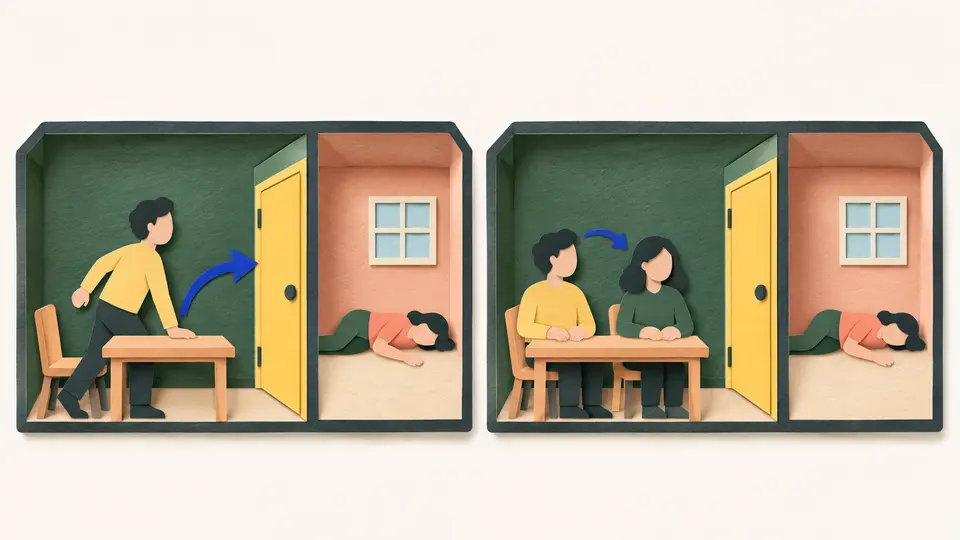
Psychologists call this pull of nearness propinquity, an old word for being close by. A study published in 1950 by Leon Festinger, Stanley Schachter and Kurt Back traced it through Westgate, a student housing complex at MIT. Friendships there followed the layout of the buildings.
What counted was how often daily life brought people past each other, which researchers call functional distance. Residents who lived by a stairway made more friends on other floors, because people from those floors walked past their doors. So the map of who meets whom shapes the map of who likes whom.
Nearness works partly through familiarity. In the 1960s, psychologist Robert Zajonc showed people nonsense words, Chinese characters and photos of faces, some often and some rarely. People rated the ones they'd seen more as more pleasant. This is the mere-exposure effect, where simply encountering something again makes you like it a little more.
It works with people too. In a 1992 study, four women of similar appearance attended a large university course. One never came, and the others came to 5, 10 or 15 sessions. At the end of term, students rated the women who'd come more often as more familiar and more attractive.
Try to recallWhy might a commuter come to like a stranger seen on the same train every morning, and when would seeing that stranger more often backfire?
Repeated sightings make the stranger familiar, and the mere-exposure effect turns familiarity into mild liking. It would backfire if the first impression were bad, such as the stranger shouting into a phone, because exposure can deepen dislike. The boost also levels off after many sightings.
The people you pass every day are the ones you're most likely to befriend or fall for. Repeated contact makes a neutral face feel likable, though it can't fix a bad first impression.
Lessons in this topic
Why you like the people you keep running into
Learn how the layout of daily life decides who you meet, and why simply seeing someone often makes them more likable.
Why couples tend to think and look alike
See why shared views draw people together, why everyone wants a good-looking partner, and how couples still end up matched.
What speed dating revealed about what we want
Find out why the partner you describe isn't the one you pick, and why even 100 questions can't predict who'll click.
What's shared across cultures, and what apps changed
See which partner preferences hold from country to country, why scientists argue over the sex differences, and how meeting online changed who meets whom.
Three quick stories from this topic
Chemistry beats the questionnaire
Over 100 questions about singles couldn't predict which speed-dating pairs would click
In two 2017 studies, a machine-learning model studied each dater's traits and preferences. It could partly tell who was popular, but not who would like whom in particular.
Four-minute dates
Each person met every opposite-sex attendee for 4 minutes, then the researchers tried to forecast the results.
Why it failed
The pull between two particular people seems to arise in the meeting itself, so no profile holds it in advance.
Online overtook friends
Meeting online went from 2% to 39% of new US heterosexual couples between 1995 and 2017
It passed meeting through friends around 2013, becoming the most common way couples met. Meeting through neighbors fell from 8% to 3% over the same years.
Strangers, mostly
In 2017, 89% of couples who met online had no connection before they matched.
The friend as matchmaker fades
Meeting through friends fell from 33% to 20%, as apps took over the job of introducing people.
Friends by seat number
Students given random seats on day one were closer friends with their neighbors a year on
In a 2008 Leipzig study, 54 new students drew seat numbers at their first session. A year on, those who had sat side by side, or even in the same row, reported stronger friendships.
Chance did the choosing
Nobody picked their neighbor, so the friendships can't be explained by people seeking out others like them.
Nearness works
Psychologists call it propinquity. The people your routine puts next to you are the ones you're most likely to get to know.
Sources
- Friends by chance (Association for Psychological Science release), ScienceDaily
- Becoming friends by chance, Psychological Science (PubMed)
- Propinquity, Wikipedia
- Proximity principle, Wikipedia
- Mere-exposure effect, Wikipedia
- Interpersonal attraction, Wikipedia
- Is romantic desire predictable? Machine learning applied to initial romantic attraction, Psychological Science (PubMed)
- Disintermediating your friends: how online dating in the United States displaces other ways of meeting, Proceedings of the National Academy of Sciences (PubMed Central)