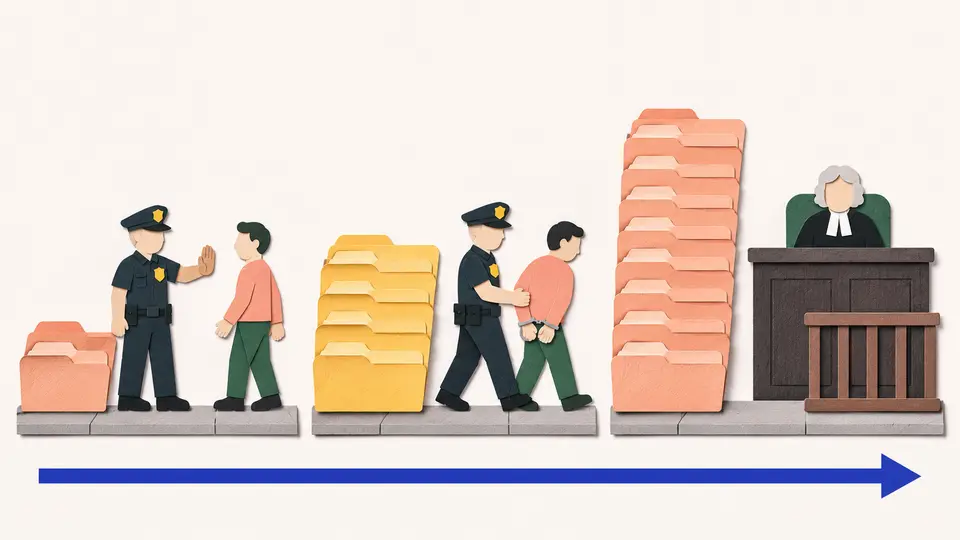
Politics & Law · Public policy & regulation
Why a policy has unintended effects
See how a reward can backfire, why delivering a program isn't the same as helping, and how evaluators work out what a policy really changed.

What you will learn
- Identify how a performance measure can encourage behavior that misses a policy goal.
- Explain why an unintended consequence is a possibility to investigate rather than an automatic outcome.
- Distinguish inputs, outputs, and outcomes.
- Identify an assumption that connects a delivered service to its intended benefit.
Lesson 1 of 4 · 4 min
Why a target can reward the wrong behavior
In 1902, French officials in Hanoi wanted fewer rats, so they paid 1 cent for every rat tail handed in. Tails poured in. Then officials started seeing live rats with no tails. Hunters were cutting the tail off and letting the rat go to breed, and rat farms had opened outside the city.
The bounty paid for tails, and the goal was fewer rats. Now say a town rewards its service desk for closing more cases each day. Staff might solve problems faster, or they might close hard cases before resolving them. Both raise the count, but only one meets the goal.
The UK Treasury's Green Book, its guide to judging spending proposals, warns that performance targets and payment-by-results schemes can encourage unintended behavior. Researchers name two kinds.
Effort substitution means putting less effort into the parts of a job nobody measures. Gaming means making the measured number look better when the real performance hasn't improved. Tailless rats and closed cases nobody resolved are both gaming.
A bad incentive doesn't always do the damage you'd predict. England's National Health Service set a target that no patient in an emergency department should wait more than four hours for treatment. Critics predicted both kinds of distortion.
Steven Kelman and John Friedman tested that with data from all 155 hospital trusts in England. They found dramatic improvements in waiting times between 2003 and 2006, and no evidence of the harmful side effects critics had predicted.
So a possible mechanism isn't proof that it happened. Hanoi's bounty was gamed, and officials canceled it. The four-hour target could have been gamed too, and the study found no sign that it was, at least in those years and on the measures it checked.
So an evaluation checks what people did and what resulted, including effects nobody planned, before it calls a policy a failure.
Try to recallA reviewer notes that a town's reward for closing cases could lead service-desk staff to close unresolved cases. Does spotting that possible incentive problem prove the policy failed? Explain.
No. It identifies a mechanism worth investigating. You'd need evidence about actual behavior, service quality, and outcomes to show whether the effect happened.
Lessons in this topic
Why a target can reward the wrong behavior
A bounty on rat tails and a hospital waiting-time target show how a measure can drift from its goal, and why spotting a bad incentive isn't proof that it did harm.
Why a delivered program can still change nothing
Tell inputs, outputs and outcomes apart with a library's workshops and Peru's school laptops, and find the assumption that links delivery to benefit.
How to tell whether a policy caused the change
See why a before-and-after improvement can't show what a policy did, and how a comparison group exposed a prison-visit program that made things worse.
How many jobs did the grant really create?
Work through a town's grant scheme to separate the jobs it created from jobs that would have appeared anyway or only moved in from next door.
Three quick stories from this topic
The Hanoi rat bounty
A 1902 bounty on rat tails in Hanoi ended with people breeding rats for the reward
French colonial officials paid 1 cent for each tail handed in. Hunters cut off tails and released the rats to breed, and rat farms opened outside the city. The bounty bought tails, and a tail doesn't require a dead rat.
Why officials asked for tails
They didn't want to be overrun with rat corpses, so hunters only had to hand in the tail. When tailless rats and rat farms turned up, officials canceled the bounty.
A reward can be gamed
The UK Treasury's Green Book tells analysts to check whether a target or payment scheme gives people a reason to game the system for their own benefit.
Scared Straight backfired
Prison visits meant to scare young people away from crime made them more likely to offend
Scared Straight programs took young people in trouble into prisons to show them where crime leads. Seven US trials compared them with similar young people who got no program at all. The visitors went on to offend more, so the visits were worse than doing nothing.
Only a comparison showed it
Each trial set the visitors beside similar young people who didn't go. That comparison stands in for the counterfactual, meaning what would have happened without the program.
What the reviewers concluded
The Cochrane reviewers found that programs like Scared Straight increase delinquency compared with doing nothing, and said they couldn't recommend them as a way to prevent crime.
The Treasury's optimism rule
The UK Treasury tells its analysts to assume their own forecasts are too rosy
Its Green Book calls optimism bias a demonstrated, systematic tendency. Projects typically cost more, take longer and deliver less than planned. So analysts must raise their cost and time estimates and cut the expected benefits at the very start.
What the adjustment does
Practitioners raise estimated costs and timeframes and lower estimated benefits. The size of the adjustment should come from measured past forecast errors, meaning the gap between what earlier appraisals expected and what actually happened, in the same or similar public bodies.
It shrinks as risks are managed
As specific risks are identified and prevented, the optimism-bias adjustment shrinks in proportion to the risk removed. What's left of the adjustment feeds into contingency, an allowance in the financial case for residual risk.
Sources
- The Green Book (2026) - GOV.UK, HM Treasury
- Magenta Book: Central Government guidance on evaluation, HM Treasury and Evaluation Task Force
- Great Hanoi Rat Massacre, Wikipedia
- Performance Improvement and Performance Dysfunction: An Empirical Examination of Distortionary Impacts of the Emergency Room Wait-Time Target in the English National Health Service, Journal of Public Administration Research and Theory
- 'Scared Straight' and other juvenile awareness programs for preventing juvenile delinquency, Cochrane