Politics & Law · Courts, crime & justice
How sure a court has to be
Courts in the US and UK can't know for certain what happened, so the law sets how sure they must be, from more likely than not up to beyond a reasonable doubt for a conviction.
What you will learn
- Explain what a burden of proof and a standard of proof are
- Match the main US standards of proof to the decisions that use them
- Explain what the US Supreme Court decided in In re Winship
- Explain why US law sets a higher bar for criminal convictions than for civil cases
Lesson 1 of 4 · 5 min
Is being 60% sure enough for a US court?
Say a jury comes away from a case 60% sure that something happened. Is that enough? In US courts, it depends on what's being decided.
A court has to rule on what happened without ever knowing for certain. So the law sets a standard of proof, the level of certainty a party must reach before a disputed fact counts as established. The burden of proof says which party has to reach it. In a criminal case that's the prosecution. In a civil case it's usually the plaintiff, the side that brought the suit.
Most civil cases, such as a lawsuit over money, use a preponderance of the evidence. The plaintiff wins on a disputed fact by showing it's more likely true than not, which means better than a 50% chance. A Pennsylvania court said in 2005 that it's enough "to tip a scale slightly." So 60% wins a civil case.
A criminal conviction needs proof beyond a reasonable doubt, the most demanding standard in law. The evidence must leave jurors firmly convinced of guilt. Being 60% sure is nowhere near that.
Between the two sits clear and convincing evidence. The US Supreme Court described it in 1984 as evidence that's highly and substantially more likely to be true than untrue. States differ on when they use it, but claims involving fraud, wills or withdrawing life support typically require it.
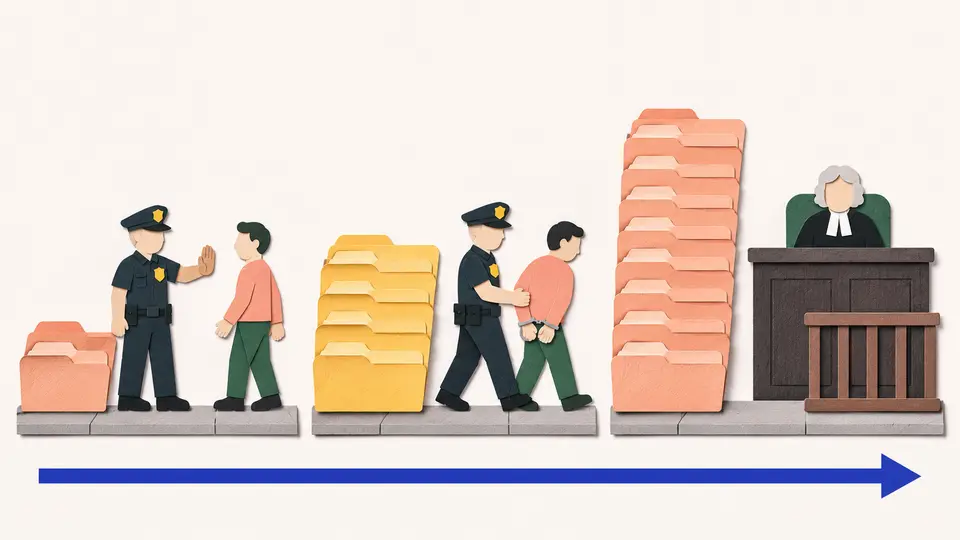
Some decisions can't wait for a trial. They're made early, while the evidence is still thin, so US law gives them lower bars.
A police stop and search needs reasonable suspicion. In Terry v. Ohio in 1968, the US Supreme Court said the suspicion has to be specific and individualized, meaning it's about this particular person, and the officer must be able to put it into words. A guess or a hunch isn't enough.
An arrest, a search warrant or a grand jury indictment needs probable cause, a higher bar. In 1989 the Court said that means "a fair probability that contraband or evidence of a crime will be found."
There are other rungs too. Child protection cases that need immediate action can run on a standard called some credible evidence. Higher up, clear and convincing evidence also covers high-stakes civil matters such as child custody and petitions to remove a person from life support.
Try to recallPut reasonable suspicion, probable cause and proof beyond a reasonable doubt in order from lowest to highest, and name a US decision each one governs.
Reasonable suspicion is the lowest and lets police stop and search someone. Probable cause comes next and is needed for an arrest, a search warrant or a grand jury indictment. Proof beyond a reasonable doubt is the highest and is needed for a criminal conviction.
So being 60% sure wins a US civil suit and falls well short of a criminal conviction. Each rung is set by what a mistake would cost. A wrong civil verdict usually costs money, and a wrong conviction can cost someone their liberty.
The US Supreme Court turned that reasoning into a constitutional rule in 1970, in a case about $112.
Lessons in this topic
Is being 60% sure enough for a US court?
A standard of proof sets how sure a court must be. See why 60% certainty wins a US civil suit and falls far short of a criminal conviction, and which lower bars govern police stops and arrests.
How a $112 theft made reasonable doubt a constitutional rule
Follow a 1970 case about a stolen $112 that made proof beyond a reasonable doubt a US constitutional rule, and see why the justices set the bar so high.
The middle standard of proof, and why the UK rejects it
Compare the US Supreme Court's 1979 demand for clear and convincing evidence in civil commitment cases with the UK House of Lords' 2008 rejection of any middle standard.
Can reasonable doubt be defined?
See why judges struggle to explain reasonable doubt in words, and why Scotland dropped its third verdict, not proven, for new trials from 2026.
Three quick stories from this topic
The $112 case
A case about $112 taken from a pocketbook made reasonable doubt a US constitutional rule
The words appear nowhere in the Constitution. In 1970 the Supreme Court read them into the Due Process Clause, after a New York judge sent 12-year-old Samuel Winship away for up to six years on proof he admitted might fall short.
The case
In 1967, a New York Family Court judge found that a 12-year-old had stolen $112 from a woman's pocketbook, while admitting the proof might fall short of reasonable doubt.
What changed
The Court ruled that juveniles charged with acts that would be crimes for adults get the same protection. Chief Justice Burger, dissenting, objected to turning juvenile courts into criminal courts.
The lion in Regent's Park
A UK judge used a lion in Regent's Park to explain how much evidence a claim needs
An animal seen on the park's dog-walking lawn is more likely a dog than a lion, Baroness Hale said in 2008. Beside the zoo's open lion enclosure, it may well be a lion. The standard of proof doesn't change. What changes is how likely the claim was to begin with.
Context counts
Seen in the zoo next to the lions' enclosure with the door open, she said, the same animal "may well be more likely to be a lion than a dog."
One standard
The House of Lords held that the civil standard stays the balance of probabilities, however serious the allegation or its consequences.
Scotland's third verdict
Until 2026 a Scottish jury could acquit in two ways, not guilty or not proven
Both verdicts set the accused free, with the same legal effect. A popular saying held that not proven meant "not guilty, but don't do it again." Scotland removed it for new trials from January 1, 2026, after mock-jury research found people confused about what it did.
Why it went
Mock-jury research in 2019 found people understood not proven inconsistently and were confused about its effect. Calls to scrap it went back to the middle of the 20th century.
The trade-off
Opponents of abolition feared more wrongful convictions. The 2025 law that removed the verdict also required a two-thirds jury majority to convict, where eight of 15 votes used to be enough.
Sources
- burden of proof | Wex | US Law | LII / Legal Information Institute, Cornell Legal Information Institute
- In re Winship, 397 U.S. 358 (1970) | LII, Cornell Legal Information Institute
- preponderance of the evidence | Wex | US Law | LII / Legal Information Institute, Cornell Legal Information Institute
- beyond a reasonable doubt | Wex | US Law | LII / Legal Information Institute, Cornell Legal Information Institute
- clear and convincing evidence | Wex | US Law | LII / Legal Information Institute, Cornell Legal Information Institute
- Burden of proof (law) - Wikipedia, Wikipedia
- Not proven - Wikipedia, Wikipedia