Politics & Law · Courts, crime & justice
How courts and appeals work
Follow a case from its first hearing to the highest court. See who does what in a courtroom, what an appeal can and can't reopen, and what keeps judges free from pressure.
What you will learn
- Describe what the judge, the parties and their lawyers each do in a trial court
- Tell a question of fact from a question of law and say who answers each
- Explain what an appeal court reviews and why it rarely overturns findings of fact
- Explain why courts sit in tiers and why a higher court's ruling binds the courts below
Lesson 1 of 4 · 4 min
Who does what in a trial courtroom
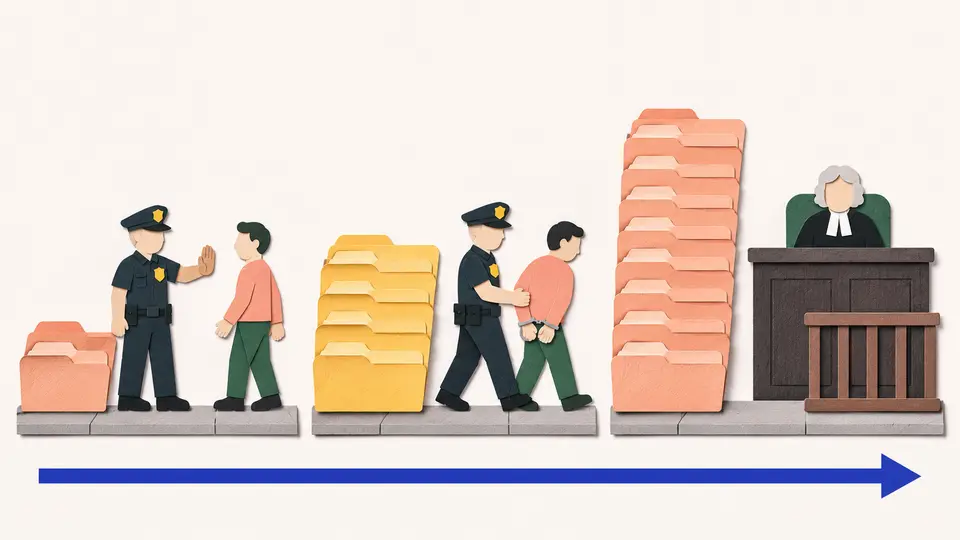
Say a delivery van smashes into your parked car and the company won't pay. You sue. You're the plaintiff, the one bringing the claim, and the company is the defendant. In a criminal case the government brings the charge instead.
Each side's lawyers build its case. They call witnesses, ask the questions and show documents. When the other side asks an unfair question, they object.
The judge runs the trial. The judge applies the rules of evidence, decides what the jury may hear and rules on every objection. Witnesses wait outside until they testify, so nobody shapes their story to match.
A court reporter writes down everything said. That written record matters later, because it's what an appeal court will read.
Back to the crash. Was the van speeding? Did it run a red light? These are questions of fact, about what happened. Someone answers them by weighing evidence and witnesses.
What counts as careless driving in law? Can a police report be shown to the jury? These are questions of law, about what the rules are and what they mean. A judge answers them.
In a jury trial the two jobs are split. The judge explains the law, and the jury decides the facts. With no jury, in a bench trial, the judge does both.
Try to recallIn a trial over a bike accident, give one question of fact and one question of law, and say who answers each in a jury trial.
A question of fact is whether the cyclist went through a red light, which the jury decides from the evidence. A question of law is what legal duty a cyclist owes to people crossing, which the judge decides and explains to the jury.
In a trial the parties' lawyers present the evidence and the judge controls the rules. The jury, or a judge alone, decides what happened, and the judge decides what the law says about it.
Lessons in this topic
Who does what in a trial courtroom
Meet the people in a trial court and learn the split that organizes everything they do, between questions of fact and questions of law.
What an appeal can and can't reopen
See why appeal judges rarely second-guess the facts, what they check instead, and why their rulings bind every court below them.
When lawyers lead the trial and when the judge does
Compare trials where lawyers drive the questioning, as in England and the US, with trials where the judge does, as in Germany and France, and see how French appeals work.
What keeps judges free from pressure
See how secure jobs and protected pay shield judges from governments, how countries choose their judges, and what happened when a judge's biggest backer had a case before him.
Three quick stories from this topic
France's quashing court
When France's top court quashes a ruling, the next court doesn't have to agree with it
The Court of Cassation reviews only questions of law. It sends a quashed case to a different appeal court, never the same judges, and that court can decide the case its own way.
Where the name comes from
Casser means to break or quash, and quashing rulings is the court's main job.
No binding precedent
France has no formal rule that lower courts follow higher ones. A steady line of matching decisions persuades instead.
The $3 million judge
A coal boss spent $3 million electing a judge who then overturned a $50 million verdict
The verdict against his company, Massey, was waiting at West Virginia's top court when he helped Brent Benjamin win a seat there in 2004. In 2009 the US Supreme Court said Benjamin should have stepped aside.
A 3 to 2 vote
Benjamin refused to step aside and joined the 3 to 2 majority that threw out the verdict.
A probability of bias
The Supreme Court ruled 5 to 4 that the facts were extreme enough to break due process.
Fewer than 100 cases
The US Supreme Court hears arguments in fewer than 100 cases a year
The federal courts of appeals below it decide more than 50,000 cases a year. For almost everyone who appeals, the court of appeals has the last word.
It picks its cases
The Court doesn't have to take a case. It mostly chooses big legal questions or laws that appeals courts read differently.
Why so few is enough
Lower courts must follow its rulings, so one decision settles the law for every court in the country.
Sources
- Civil Cases, United States Courts
- Criminal Cases, United States Courts
- Structure of the Courts and Tribunals system, Courts and Tribunals Judiciary (England and Wales)
- Magistrates' courts, Courts and Tribunals Judiciary (England and Wales)
- Question of law, Wikipedia
- Court Role and Structure, United States Courts
- Court of Cassation (France), Wikipedia
- Caperton v. A.T. Massey Coal Co., Wikipedia
- About the U.S. Courts of Appeals, United States Courts
- Appeals, United States Courts