Politics & Law · Political ideas & systems
Left and right in politics
Where the words left and right come from, what they usually signal about equality, markets and tradition, and why one line can't place every party or voter.
What you will learn
- Explain how seating in France's revolutionary assembly gave politics the words left and right
- Describe the core contrast between left and right as an attitude to equality
- Name the economic questions that place a party on the left-right line
- Describe how expert surveys and manifesto coding give a party a left-right score
Lesson 1 of 4 · 4 min
How a seating plan in 1789 named left and right
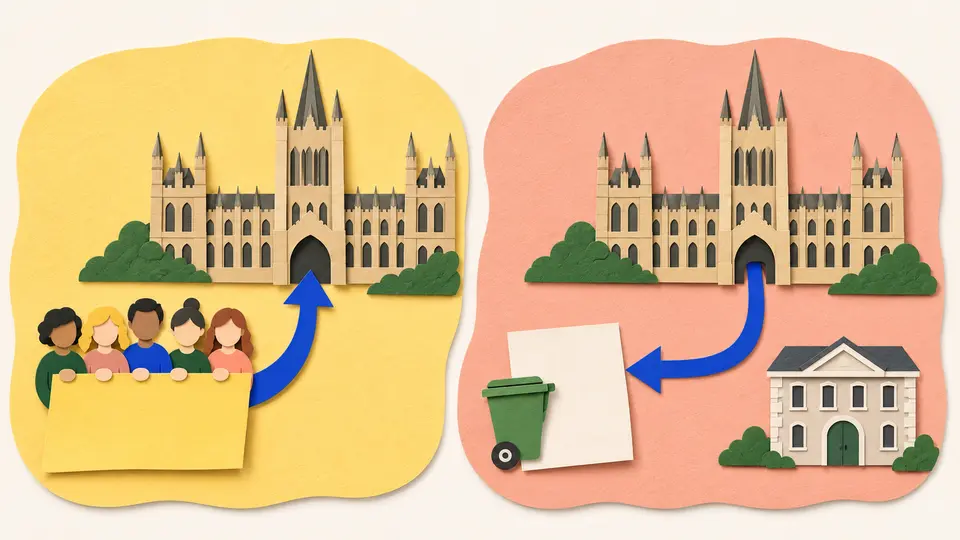
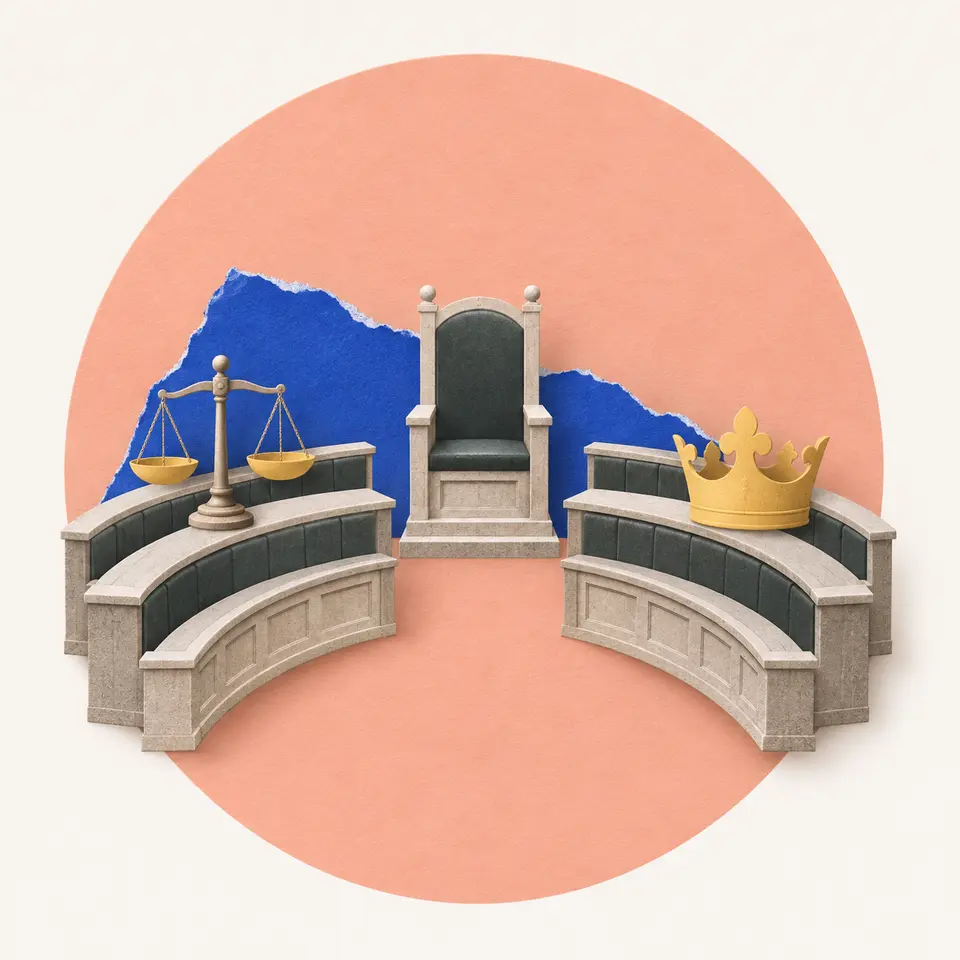
In 1789, France's new National Assembly argued over how much power the king should keep. Deputies who wanted him to keep a veto over laws sat to the right of the presiding officer's chair. Deputies who opposed the veto sat to the left.
One royalist, the Baron de Gauville, explained it plainly. Those loyal to religion and the king moved right "so as to avoid the shouts, oaths, and indecencies" of the other camp. So the first right was a group of people keeping their distance.
The habit outlived the hall. A new assembly in 1791 had entirely new members, yet innovators still sat left and defenders of the constitution sat right. After 1871, French parties put the words in their names, like the Republican Left. In the early 1900s the terms spread worldwide.
So what did each side come to stand for? The Italian philosopher Norberto Bobbio gave a one-word answer in his 1994 book Left and Right. The split, he argued, is an attitude to equality.
In Bobbio's account, the left believes most inequalities are social and can be removed. The right believes most are natural and can't be. That's why the left treats more equality as a goal, while the right sees some hierarchy as normal.
The words each side stresses follow from this. The left tends to talk about equality, rights, progress and reform. The right tends to talk about authority, order and tradition.
Try to recallAccording to Norberto Bobbio, what separates the political left from the right?
Bobbio said the split is an attitude to equality. The left sees most inequalities as social and removable, so it treats more equality as a goal. The right sees most inequalities as natural, so it accepts some hierarchy as normal.
Left and right began as two sides of a French hall in 1789. You can now name the idea most often used to tell them apart, which is how each side treats inequality.
Lessons in this topic
How a seating plan in 1789 named left and right
See how where French deputies sat gave politics its two directions, and what each side has stood for since.
How researchers place a party from left to right
Learn the economic questions that sort parties from left to right, and the two main ways political scientists turn a party into a score.
Why one line isn't enough to map politics
See why social questions need their own line, and what a two-axis map revealed about parties in Western and Eastern Europe.
Why liberal means opposite things in different countries
See why liberal names the left in the US but often the pro-market right elsewhere, and how left and right have swapped ideas over time.
Three quick stories from this topic
China's reversed labels
In China, people who support liberal democracy get called right-wing
China's Communist Party counts itself as the progressive left, so backing the party and its system is the left position. Calls for liberal democracy therefore land on the right, the opposite of how many Western readers would sort them.
A relative line
Left and right name the two sides of a country's main argument, not a fixed list of beliefs.
Not the only case
Classical liberal ideas also started out on the left and are now seen as right-wing in most countries.
Europe's sideways map
After communism, many Eastern European parties were left-wing and traditional at once
In a 2002 expert survey, 50 of 73 parties in nine post-communist countries sat in the two corners Western parties rarely used. The old regime had paired economic equality with strict authority, so its defenders kept both.
The Western pattern
In Western Europe, 81 of 98 parties were either left and libertarian or right and traditional.
Why it flipped
In the West, defending the status quo meant defending markets. In the East it meant defending what communism left behind.
Why the right sat right
France's royalists first sat on the right in 1789 to get away from the shouting
A royalist deputy, the Baron de Gauville, said those loyal to king and church moved right of the chair to avoid the "shouts, oaths, and indecencies" opposite. Their opponents, who fought the king's veto, filled the left.
A habit that stuck
New assemblies kept the seating. After 1871 French parties used Left and Right in their own names.
Then everywhere
In the early 1900s the words spread from France to parties around the world, which often believed very different things.
Sources
- Left-right political spectrum, Wikipedia
- Left-wing politics, Wikipedia
- A sense of the left (New Left Review I/231, 1998), Perry Anderson, New Left Review
- Right-wing politics, Wikipedia
- Party competition and European integration in the East and West (Comparative Political Studies, 2006), Gary Marks, Liesbet Hooghe, Moira Nelson and Erica Edwards, UNC Chapel Hill