Politics & Law · Elections & civic participation
What petitions and citizens' initiatives can do
Compare what signatures can win in the UK, Switzerland and the EU, from a government reply to a national vote, and weigh the case for citizens' initiatives.
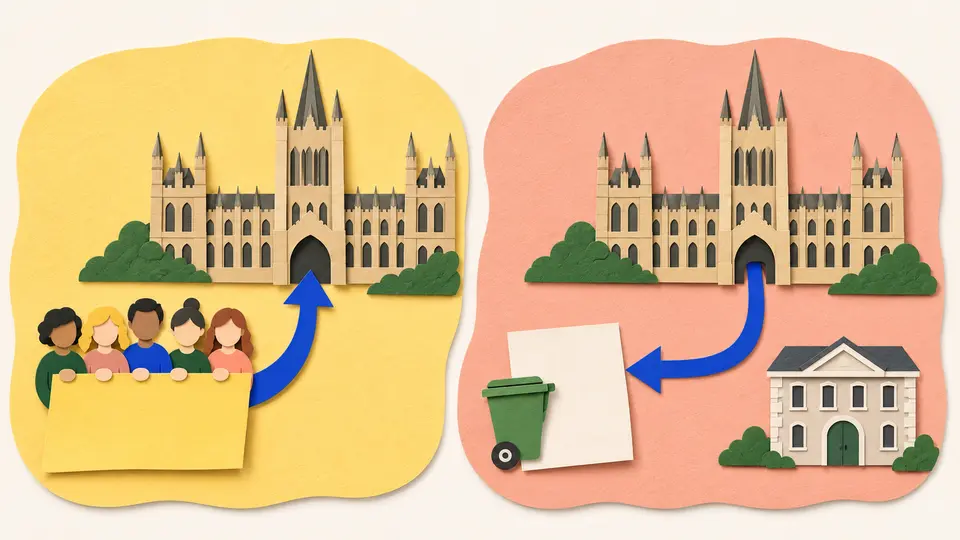
What you will learn
- Describe who can start a UK Parliament e-petition and what it has to ask for
- Explain what the 10,000 and 100,000 signature thresholds trigger
- Trace what the 2019 Revoke Article 50 petition gained at each signature threshold
- Compare the petitioners' case with the reasons the UK Government gave for refusing it
Lesson 1 of 4 · 5 min
How UK Parliament e-petitions work
On the UK Parliament's petitions website, 10,000 signatures earn a written answer from the Government. At 100,000, MPs consider holding a debate. Any British citizen or UK resident can start one of these e-petitions.
The petition has to ask for a clear action, and the action has to be something the UK Government or Parliament is responsible for. A request about something your local council handles belongs with the council, and a petition asking for it will be rejected.
To start, you sum up what you want done, check that no open petition already asks for something similar, and explain why. Then you need five supporters to sign through a link. They must be British citizens or UK residents too.
Once five have signed, the petitions team checks the petition against the site's published standards. One that fails never opens for signatures, though its creator is told why and can start again. One that passes stays open for six months. Only this site counts. A petition hosted anywhere else obliges the Government to do nothing, however many people sign.
Once a petition is published, what it gets depends on how many people sign. At 10,000 signatures, it gets a response from the UK Government. The department responsible for the subject writes it, and it appears on the petition's own page.
At 100,000 signatures, the petition is considered for a debate in Parliament. The Petitions Committee, a group of 11 MPs from government and opposition parties, decides. Petitions that reach 100,000 are usually debated, but the committee can say no, for example when the issue was debated recently or is already scheduled for debate.
And a debate is all it is. Petition debates don't end with a vote on whether to do what the petition asks. MPs discuss the issue, question the Government's position and can press it to act.
E-petitions aren't the only kind. You can ask your MP, your elected Member of Parliament, to present a paper petition to the House of Commons. That works under different rules and can be about local issues.
Try to recallWhat does a UK Parliament e-petition get when it reaches 10,000 signatures, and what changes at 100,000?
At 10,000 signatures the petition gets a response from the UK Government, written by the department responsible for the subject and posted on the petition's page. At 100,000 signatures it's considered for a debate in Parliament. The Petitions Committee of 11 MPs decides, and such petitions are usually debated, though the committee can decline, for example if the issue was debated recently or a debate is already scheduled.
So a UK e-petition is a way to make the Government answer, first in writing and then in a debate. It can't make the Government agree.
In 2019 a petition with more than 6 million signatures got its answer and its debate. The answer was no.
Lessons in this topic
How UK Parliament e-petitions work
On the UK Parliament's petition site, 10,000 signatures earn a Government reply and 100,000 a likely debate. See who can start a petition and what those thresholds don't give you.
What 6 million signatures could and couldn't do
Follow the 2019 Revoke Article 50 petition from its first thresholds to a Government refusal and a debate in Parliament.
How a Swiss popular initiative reaches the ballot
With 100,000 signatures, Swiss voters can force a national vote on an amendment they wrote themselves. See the steps, and how Parliament can answer with a counter-proposal.
What 1 million signatures can ask of the EU
A million signatures oblige the European Commission to reply, but not to act. Compare two initiatives that ended differently, and weigh the arguments over citizens' initiatives.
Three quick stories from this topic
Six million signatures and a no
More than 6 million people signed a 2019 UK petition to stop Brexit, and the answer was no
The petition asked the Government to revoke Article 50 and remain in the EU. Under Parliament's rules, 10,000 signatures earn a written reply and 100,000 a likely debate. It got both. No number of signatures obliges the Government to agree.
What the signatures won
Passing 10,000 signatures earned a written response from the Government. Passing 100,000 got the petition considered for a debate, and Parliament debated it on April 1, 2019.
The limit
A UK e-petition can require a government response and consideration for a debate. Neither obliges the Government to do what the petition asks.
Two EU initiatives, two endings
Two EU citizens' initiatives each passed 1.8 million signatures, and only one led to a law
Right2Water's campaign ended with a revised EU drinking water directive in 2020. One of Us, which sought to end EU funding of activities that destroy human embryos, got a refusal and lost in court. A million signatures oblige the European Commission to reply, not to act.
What a million signatures buy
Organizers meet the Commission and get a public hearing in the European Parliament. Within 6 months the Commission must say what it will do, if anything, and why.
The bar to clear
An initiative needs 1 million signatures in 12 months, with minimum numbers in at least 7 EU countries. By January 2026, 14 had made it.
Signatures that force a Swiss vote
In Switzerland, 100,000 signatures force a national vote on changing the constitution
Swiss voters have had this power since 1891, and they get 18 months to collect the signatures. More than 200 initiatives have gone to a vote. Only about one in ten passed. Winning takes a majority of voters and a majority of the cantons.
Two majorities
An initiative amends the Federal Constitution only if a majority of voters and a majority of the cantons vote yes. Around 10% of the more than 200 voted on since 1891 have passed.
The limits
Federal initiatives can change only the constitution, never an ordinary law. Parliament may declare one invalid if it breaches binding international law, such as the ban on torture, or mixes unrelated subjects.
Sources
- How petitions work, UK Parliament
- Revoke Article 50 and remain in the EU. - Petitions, UK Parliament
- European Citizens' Initiative - Wikipedia, Wikipedia
- How it works - European Citizens' Initiative - European Union, European Commission
- What is a popular initiative?, ch.ch, Swiss Confederation, cantons and communes