Politics & Law · Government & institutions
Separation of powers and checks and balances
Why constitutions split lawmaking, governing and judging between different bodies, how each gets tools to block the others, and what happens when the checks fail.
What you will learn
- Explain Montesquieu's argument that liberty needs lawmaking, enforcing and judging held by different hands
- Describe the job of the legislature, the executive and the judiciary
- Explain why separated branches also need checks, the tools to resist each other
- Give examples of checks in the US and in a parliamentary system, and say which branch each restrains
Lesson 1 of 4 · 4 min
Why Montesquieu split power three ways
In 1748, a book called The Spirit of the Laws appeared in France without its author's name. Its author, Montesquieu, had studied governments from ancient Rome to England. His question was simple. What stops a government from crushing the freedom of the people it rules?
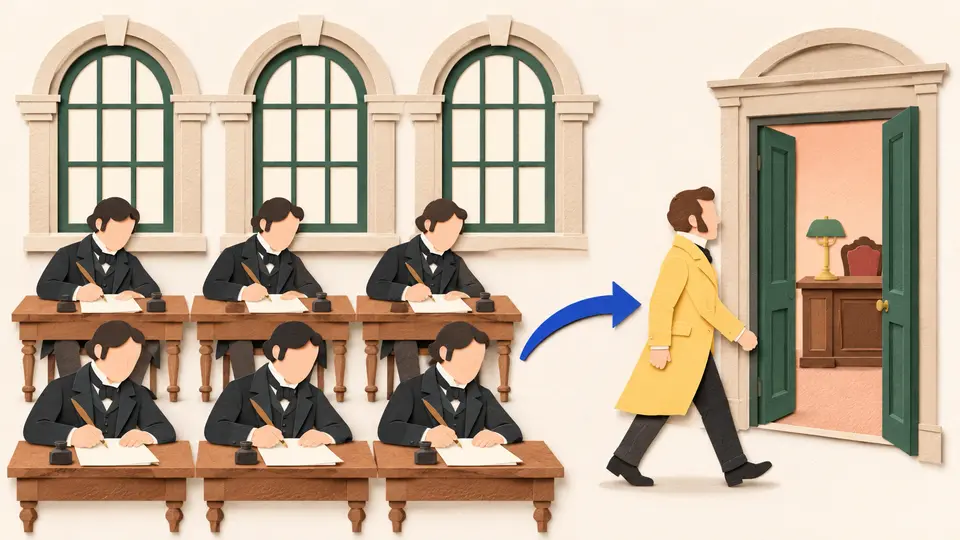
His answer was to keep three kinds of power in different hands. If one person or body both makes and enforces the laws, he warned, it could pass tyrannical laws and then carry them out tyrannically.
Judging has to stand apart too. Join it to lawmaking and "the judge would then be the legislator". Join it to enforcement and the judge could act like an oppressor. Forty years later James Madison put it bluntly. Holding all three powers in the same hands is "the very definition of tyranny".
Montesquieu named the three jobs. The legislature makes laws and can change or repeal them. The executive runs the state, keeps public security, sends ambassadors and makes war or peace. The judiciary punishes crimes and settles disputes between people.
Say a parliament passes a law setting a speed limit. Police and a transport ministry, both part of the executive, put it into practice. If a driver says she wasn't speeding, a court decides who's right. Each body does its part, and none can do the whole thing alone.
Montesquieu wasn't the first to split power. John Locke, writing in 1690, had already separated lawmaking from enforcement. Montesquieu's version, with judging as a power of its own, is the one constitutions copied.
Try to recallWhat does each of the three branches of government do?
The legislature makes, changes and repeals laws. The executive carries out the laws and runs the state, including security and foreign affairs. The judiciary punishes crimes and settles disputes by deciding what the law means in each case.
You can now explain why Montesquieu wanted lawmaking, enforcing and judging in different hands, and say what each of the three branches does.
Lessons in this topic
Why Montesquieu split power three ways
See why an 18th-century French judge argued that making, enforcing and judging laws must sit in different hands, and what each of the three branches does.
How each branch can block the others
Learn why separate branches also need tools to resist each other, with checks from the United States and Britain.
How parliaments join powers and still limit them
See why parliamentary systems fuse the executive with the legislature, and what still stops a government with a big majority.
When checks and balances stop checking
See how party loyalty can switch off the rivalry between branches, and how court packing and fired agency heads shift power to the executive.
Three quick stories from this topic
Germany's replace-to-remove rule
Germany's parliament can only fire a chancellor by electing a new one
Article 67 of the 1949 Basic Law makes removal and replacement one vote. It has worked once, on 1 October 1982, when Helmut Kohl replaced Helmut Schmidt.
Why the rule
The drafters wanted to avoid the instability of the Weimar Republic, when governments fell to majorities that agreed on nothing else.
A close call
A 1972 attempt to replace Willy Brandt fell two votes short of the majority it needed.
Toppled by one vote
Britain's government fell in 1979 by a single vote, 311 to 310
On 28 March 1979, the House of Commons passed a motion of no confidence in James Callaghan's Labour government. The one-vote margin forced a general election, which Margaret Thatcher's Conservatives won.
How it works
In a parliamentary system the government survives only while the legislature backs it, so a lost confidence vote can end it.
Rarely used
The previous time a Commons vote had forced an election was in 1924.
A 91-year limit ends
A 1935 ruling that shielded US agency heads from firing was overturned in 2026
Humphrey's Executor let Congress protect commissioners of bodies like the Federal Trade Commission from removal except for cause. On 29 June 2026, the Supreme Court overruled it 6 to 3.
What changed
The president may now remove such agency heads at will. The ruling set the Federal Reserve aside.
Two views
The majority said the president needs officers he can trust. Critics said agency independence is now gone.
Sources
- The Spirit of Law, Wikipedia
- The Federalist No. 47, Avalon Project, Yale Law School
- Separation of powers, Wikipedia
- Constructive vote of no confidence, Wikipedia
- 1979 vote of no confidence in the Callaghan ministry, Wikipedia
- Trump v. Slaughter, Wikipedia
- Court allows Trump to fire FTC commissioner and overturns major restraint on presidential power, SCOTUSblog