Politics & Law · Government & institutions
What a civil service does
Trace how permanent officials came to be hired on merit, why they serve whichever party wins, and where the line with political staff runs.
What you will learn
- Explain how the spoils system filled US federal jobs in the 1800s
- Describe the protections the Pendleton Act of 1883 gave covered federal employees
- Describe the four core values the UK Civil Service Code sets for civil servants
- Explain what political impartiality asks of an official whose views differ from the government's
Lesson 1 of 4 · 5 min
How an assassination brought exams to US government jobs
On July 2, 1881, Charles Guiteau shot President James A. Garfield in a Washington train station. Guiteau had wanted a job as a US consul in Europe, and Garfield hadn't given him one. Garfield died that September. To see why a stranger thought a president owed him a post, look at how federal jobs were filled.
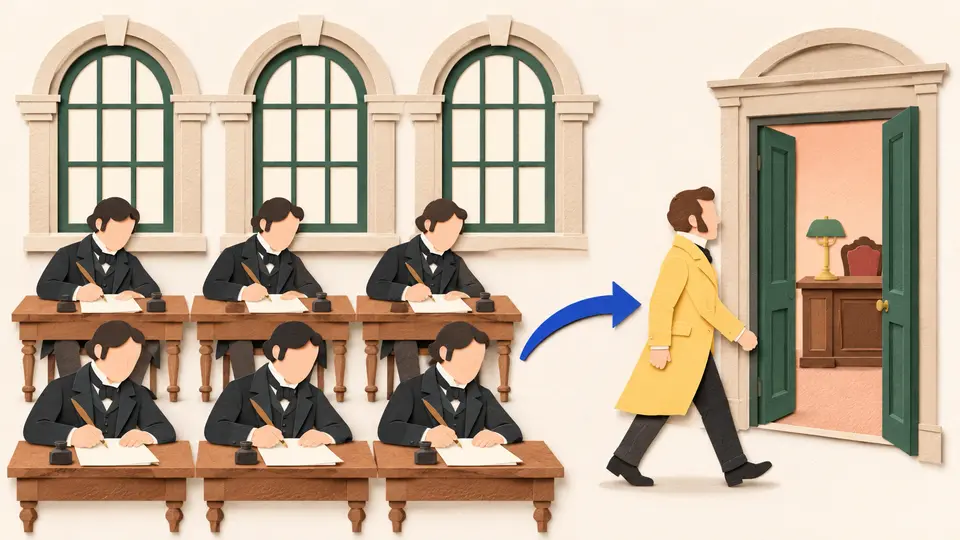
After each election, the winners handed out government jobs to their political friends and supporters. This was the spoils system, named for the phrase "to the victor go the spoils." George Washington had appointed mostly on merit, but later presidents drifted from that. By the time Andrew Jackson was elected in 1828, the system was in full force.
It got harder to live with as the government grew. There were about 20,000 federal employees in Jackson's time and more than 130,000 by 1884. Job seekers hounded each president-elect. Candidates pushed the people they'd appointed to give more time and money to political work. And industrialization made many federal jobs more specialized, so they needed specific skills.
Garfield's death forced the issue. In January 1883 Congress passed a reform law named for Senator George Hunt Pendleton of Ohio, a longtime reformer. Chester A. Arthur, who became president when Garfield died, signed it. The assassination had made him an ardent reformer.
The Pendleton Act, approved on January 16, 1883, set up a merit system. The jobs it covered were to be filled through open, competitive examinations. The act said these should be "practical in their character" and test whether applicants were fit for the work. Posts went to the candidates who scored highest.
The act went after patronage directly. Examiners couldn't consider a recommendation from a senator or representative, except on an applicant's character or residence. And once hired, covered employees couldn't lawfully be fired or demoted for political reasons, or made to give political service or contributions.
A new Civil Service Commission enforced the law. It had three commissioners, and no more than two could belong to the same party.
The reform started small. When the act took effect, its hiring rules covered only 10% of the government's 132,000 employees. Its reach grew over the years to most federal positions, which the National Archives puts at 2.9 million.
Try to recallWhat protections did the US Pendleton Act of 1883 give federal employees in the jobs it covered?
Covered jobs were filled through open, competitive exams that tested fitness for the work, so appointments rested on merit. Once hired, covered employees couldn't lawfully be fired or demoted for political reasons, and no one could require them to give political service or contributions.
So the Pendleton Act changed what a federal job was. It had been a prize for backing the winner. For covered posts it became something you earned on an exam and kept when the government changed hands.
That creates a permanent official who stays while politicians come and go. What that official owes each new government is a separate question, and the UK's Civil Service Code answers it in writing.
Lessons in this topic
How an assassination brought exams to US government jobs
US federal jobs were once rewards for party loyalty. See how the spoils system worked, and how a president's assassination pushed Congress to hire by competitive exam.
How UK officials serve whichever party wins
UK civil servants advise ministers of any party. See the four values their code sets, and what it tells an official who can't go along with a decision.
What US federal employees may do in campaigns
Most US federal employees may campaign off duty under the Hatch Act, while staff of agencies such as the FBI may vote and donate but not campaign.
Where political staff end and career officials begin
UK ministers' political advisers may comment on officials' advice but not block it. Compare that with the US fight over making senior career officials easier to fire.
Three quick stories from this topic
The shooting behind civil service exams
US civil service exams began after a rejected job seeker shot President Garfield
Charles Guiteau wanted a post as a US consul in Europe and didn't get one. He shot Garfield in a Washington train station on July 2, 1881. In January 1883 Congress passed the Pendleton Act, which filled covered federal jobs by competitive exam.
Jobs as rewards
Under the spoils system, election winners gave government jobs to political friends and supporters. The name comes from the phrase "to the victor go the spoils."
A small start
When the act took effect, its hiring rules covered only 10% of the government's 132,000 employees. Its reach grew over the years to most federal positions.
FBI agents and campaign speeches
An FBI agent may donate to a US election campaign but may not give a speech for one
The 1939 Hatch Act lets most federal employees campaign off duty. Staff of agencies such as the FBI, the CIA and the Secret Service face a tighter rule. They can vote, donate and attend rallies, but can't take an active part in a partisan campaign.
Rules for everyone covered
No covered employee may do political activity on duty, in a federal building, in uniform or in a federal vehicle. That includes wearing a campaign button at work.
Why the law exists
Its stated purposes are to keep federal programs nonpartisan, protect employees from political coercion at work, and base advancement on merit.
Carry it out or resign
A UK civil servant who can't carry out a minister's instructions is told to resign
Officials can raise a concern with a manager, a nominated officer and then the Civil Service Commission. If that fails, the Civil Service Code says they "will have to resign." Officials serve whichever party governs, so the code offers no way to stay and refuse.
Serving any government
The code asks officials to serve the government, whatever its political persuasion, no matter what their own political beliefs are, and to be able to serve a future government just as well.
Where their say comes in
Officials give advice based on the evidence. Once ministers decide, they mustn't frustrate the policy by declining to take the action that flows from the decision.
Sources
- Pendleton Act (1883) | National Archives, US National Archives
- James A. Garfield: Death of the President, Miller Center, University of Virginia
- The Civil Service code, UK Civil Service
- Federal Employee Hatch Act Information | U.S. Office of Special Counsel, US Office of Special Counsel
- Hatch Act Overview | U.S. Office of Special Counsel, US Office of Special Counsel