Politics & Law · Courts, crime & justice
What a fair trial requires
What the European Convention on Human Rights demands of a criminal trial, from a judge nobody could suspect of bias to a free interpreter, and what it leaves out, such as a jury.
What you will learn
- Identify independence, impartiality, and establishment by law as tribunal requirements.
- Explain why a public hearing and reasonable timing are distinct aspects of fairness.
- Identify the presumption of innocence and the right to understand the accusation.
- Explain how preparation, legal assistance, and interpretation support an effective defense.
Lesson 1 of 4 · 4 min
What a court must be before it can judge you
Say a judge has already promised one side it'll win. The hearing could run perfectly, with every witness heard and every rule followed, and it would still be worthless. The outcome was settled before anyone weighed the evidence.
So a fair trial starts with who decides. In Europe the conditions come from Article 6 of the European Convention on Human Rights, the treaty that the European Court of Human Rights enforces.
Article 6 applies when a court decides a criminal charge against you or a dispute over your civil rights and obligations. It promises "a fair and public hearing within a reasonable time by an independent and impartial tribunal established by law." A tribunal is the body that decides the case.
That one sentence makes six separate demands, three of the hearing and three of the tribunal. Passing five doesn't excuse failing the sixth.
Two of the tribunal's conditions are easy to mix up. Independence is about pressure from outside. The government, the legislature and the parties must not steer the decision. Impartiality is about the judge's own neutrality toward the case and the people in it.
Impartiality is stricter than it sounds. In 1978 a Belgian court convicted Christian Piersack of murder. The presiding judge had earlier headed the prosecutors' section that handled the case. Nobody claimed he was actually biased.
The European Court of Human Rights still found a violation in 1982. The public was entitled to fear that the judge wasn't neutral, and that was enough. Appearances count too.
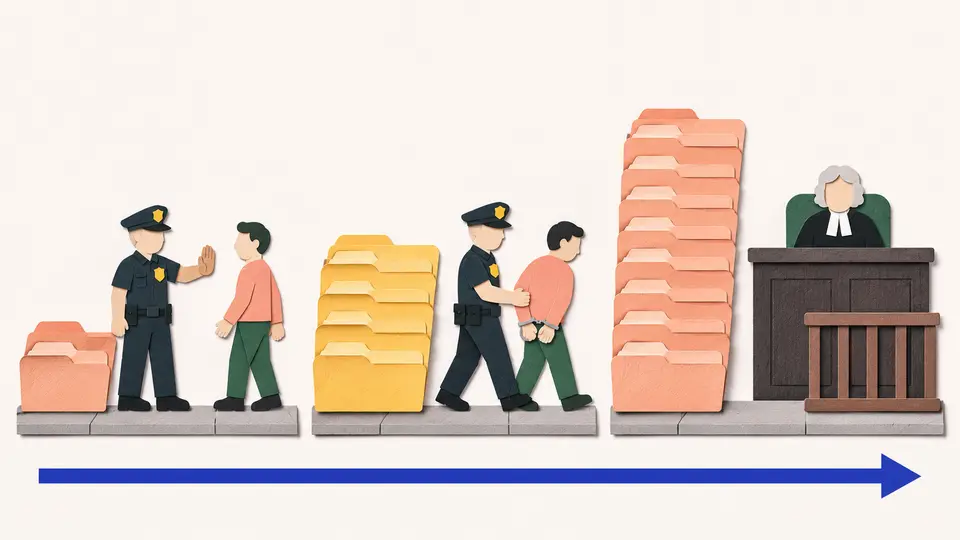
The hearing has conditions of its own. It must be public, because justice done in secret escapes scrutiny. It must also come within a reasonable time, so that nobody lives under a charge for too long. An open trial can drag on for years, and a quick one can happen behind closed doors.
Publicity has written limits. The court may exclude the press and public for reasons the article lists, such as protecting juveniles, private life or national security. The judgment itself must still be pronounced publicly.
Try to recallWhy are a public hearing and a hearing within a reasonable time separate requirements under Article 6 of the European Convention on Human Rights?
They guard against different failures. A public hearing lets outsiders scrutinize how justice is done, within the exceptions the article lists. The reasonable-time rule stops a charge from hanging over someone for too long. A trial can be open and still far too slow, or quick and still closed.
Lessons in this topic
What a court must be before it can judge you
Europe's human rights convention demands an independent, impartial tribunal set up by law, and a public hearing within a reasonable time. A Belgian murder trial shows how strict those demands are.
What you're owed when you're charged with a crime
See what Europe's human rights convention gives anyone accused of a crime, from the presumption of innocence to a free interpreter, and how real cases tested each promise.
The right to question the witness against you
Europe's fair-trial right lets an accused person question prosecution witnesses and call their own. See what happens when a witness never appears, and why the right promises a fair process and no particular verdict or jury.
No crime without a law, and the right to appeal
Europe's human rights convention bars punishing an act that wasn't a crime when it was done. A later protocol adds a right of appeal, with three exceptions.
Three quick stories from this topic
The guilty plea that won
A man who pleaded guilty to drug-driving won in Strasbourg over how a judge was appointed
Iceland's justice minister had swapped four names on an expert committee's shortlist for a new appeals court, and one of her picks heard his appeal. In 2020 the European Court of Human Rights ruled that his court wasn't "established by law," as a fair trial requires.
Why his guilt didn't matter
Article 6 of the European Convention on Human Rights tests the court as well as the verdict. A tribunal must be independent, impartial and established by law, whoever stands before it.
What the minister changed
The committee had named the 15 best-qualified candidates. The minister replaced four of them, and the judge who sat in his case had been ranked 18th.
Guilty by press conference
A French press conference broke a man's presumption of innocence before any trial
In 1976, beside the interior minister, a police chief named Patrick Allenet de Ribemont as an instigator of a politician's murder. He was never tried. In 1995 the European Court of Human Rights ruled that officials had declared him guilty in public, and ordered France to pay him 2 million francs.
The rule binds officials too
A minister, a prosecutor or the police can breach the presumption of innocence, as well as a judge. They may tell the public about an investigation, but with discretion.
What the Court objected to
The officers called him an instigator "without any qualification or reservation." That encouraged the public to believe him guilty and prejudged the work of the courts.
East Germany's own law
East Germany's own laws were used to convict its leaders for killings at the border
After reunification, three of them argued that the killings of people fleeing West weren't crimes under East German law at the time. In 2001 the European Court of Human Rights disagreed. The written law had protected life all along, and a state's practice of ignoring its law isn't law.
The rule they relied on
Article 7 of the European Convention on Human Rights says no one can be held guilty of an act that wasn't a criminal offense when it was committed.
Why it didn't protect them
The Court said the border policy had "emptied of its substance" the legislation it claimed to rest on, so it couldn't count as law. The convictions applied the law of the time.
Sources
- European Convention on Human Rights, Council of Europe
- Guide on Article 6 of the Convention: Right to a fair trial (criminal limb), European Court of Human Rights
- Case of Piersack v. Belgium, judgment of 1 October 1982 (application no. 8692/79), European Court of Human Rights
- Case of Guðmundur Andri Ástráðsson v. Iceland, Grand Chamber judgment of 1 December 2020 (application no. 26374/18), European Court of Human Rights
- Case of Allenet de Ribemont v. France, judgment of 10 February 1995 (application no. 15175/89), European Court of Human Rights
- Case of Streletz, Kessler and Krenz v. Germany, Grand Chamber judgment of 22 March 2001, European Court of Human Rights
- Guide on Article 7 of the Convention: No punishment without law, European Court of Human Rights