Philosophy & Ethics · Ethics & moral choices
Confucius
A teacher who never won the office he wanted shaped two thousand years of East Asian life. See what Confucius taught about humaneness, ritual and family, and why he has been both revered and attacked.
What you will learn
- Describe Confucius's life and how his failed search for office led him to teaching
- Explain how the Analects came together and why historians debate how well it records him
- Explain humaneness, ren, as Confucius used it
- Explain how ritual, li, trains character and why reverence counts more than form
Lesson 1 of 4 · 4 min
The teacher who never found his ruler
Picture China around 500 BCE. The Zhou kings still reign in name, but their power is fading, and regional states act on their own. Into this world, by tradition in 551 BCE, comes a boy later called Master Kong. In the West he's Confucius.
He was born in Zou, near the state of Lu. His father died when he was small, leaving the family poor but respectable. As a young man he became known for mastering the old Zhou rituals, and he worked as an official for noble families in Lu.
How high he rose is unclear. One early text calls him Director of Corrections. Another has him keeping accounts at a granary. The historian Sima Qian, writing centuries later, even makes him acting chancellor.
What we know of his teaching comes mostly from the Analects, twenty chapters of short sayings and conversations. A historian in the first century CE said Confucius's disciples and their students compiled it. That view held for many centuries.
In 1986 the scholar Zhu Weizheng pointed out a gap. No one quotes the Analects by name before the second century BCE, about 300 years after Confucius died. Historians such as Michael Hunter found that interest in the book took off only then.
Tombs back this up. Copies on bamboo slips turned up in graves dated to 55 and 59 BCE. Other excavated texts hold sayings of Confucius that the Analects leaves out. So the book may be one selection from a larger pool of sayings. That doubts the book's authority, not that Confucius lived.
Try to recallWhy do some historians doubt that the Analects is the oldest and best record of Confucius's words?
Nobody quotes the Analects by name until about 300 years after Confucius, and interest in it rises only around then. Excavated texts also contain sayings of his that the Analects omits. So the book may be a later selection from a bigger collection, not the earliest record.
You can now tell how a ritual expert who failed to win a ruler's trust became a teacher. You can also explain why the book of his sayings may be one selection among many.
Lessons in this topic
The teacher who never found his ruler
Follow Confucius from the small state of Lu through years of wandering, and see how his students' notes became the Analects, and why scholars now argue over that book.
Why Confucius thought manners make you good
Learn the two ideas at the center of Confucius's ethics, humaneness and ritual, and why he thought bowing and ceremony could train a person's character.
The son who wouldn't report his father
See why Confucius put respect for parents at the root of all public virtue, what he meant by the exemplary person, and why critics say family loyalty can trample justice.
After Confucius, from state doctrine to a target
See how his followers split over whether people are born good, how emperors made his teachings the core of government, and why 20th-century reformers turned on him.
Three quick stories from this topic
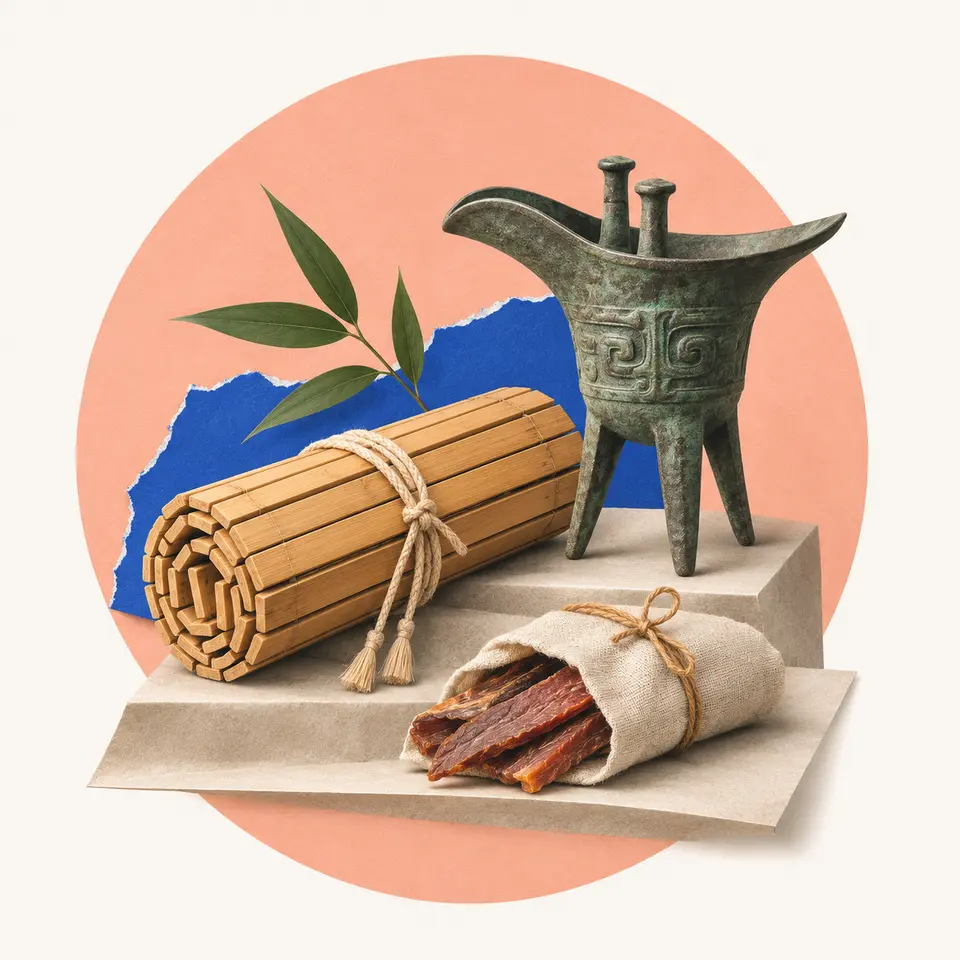
Tuition in dried meat
Confucius said he would teach anyone who brought him even a bundle of dried meat
In the Analects he says he never refused instruction to anyone, starting from that humble gift. Dried meat belonged to the old sacrificial system. It fit his habit of valuing things by ritual worth, not money.
A teacher late in life
He turned to teaching after failing to win high office. One early historian credits him with some 3,000 students.
Why it mattered
Today his birthday is celebrated as Teacher's Day in some parts of Asia.
The longest family tree
Confucius's family tree runs through 83 generations and two million registered descendants
The Kong family has the longest recorded father-to-son pedigree in the world, kept since his death. For centuries emperors gave the senior heir a noble title, which survived until 1935.
Honored by the state
Emperors made works linked to Confucius the core of official training for about two thousand years.
Then attacked
In the Cultural Revolution, Red Guards attacked the family cemetery at Qufu, his hometown.
The stolen sheep
Confucius said a truly upright son would cover for a father who stole a sheep
A duke boasted that in his land a son would testify against such a father. Confucius replied that in his circle, father and son conceal each other's misconduct. He held that real uprightness includes special care for kin.
Family as the root
Confucius taught that respect for parents is the root of all good conduct, including loyalty in public life.
Still argued over
Some scholars in China today say this loyalty to kin breeds nepotism and corruption. Others read the passage differently.
Sources
- Confucius, Stanford Encyclopedia of Philosophy
- The Analects of Confucius, translated by James Legge, Project Gutenberg
- Confucius, Wikipedia