Body & Health · Sleep & body rhythms
Sleep stages and what losing sleep costs
A night of sleep is one short cycle repeated four to six times, with deep sleep early and REM late. See how the stages are measured, the four ways sleep can fall short, and why you're a poor judge of your own shortfall.
What you will learn
- Describe the phases and stages of a sleep cycle and how often it repeats.
- Say what the stage names are actually defined by.
- Say how deep sleep and REM are distributed across a night.
- Work out what an early alarm removes and what a late bedtime removes.
Lesson 1 of 4 · 5 min
Your night is one sleep cycle, repeated four to six times
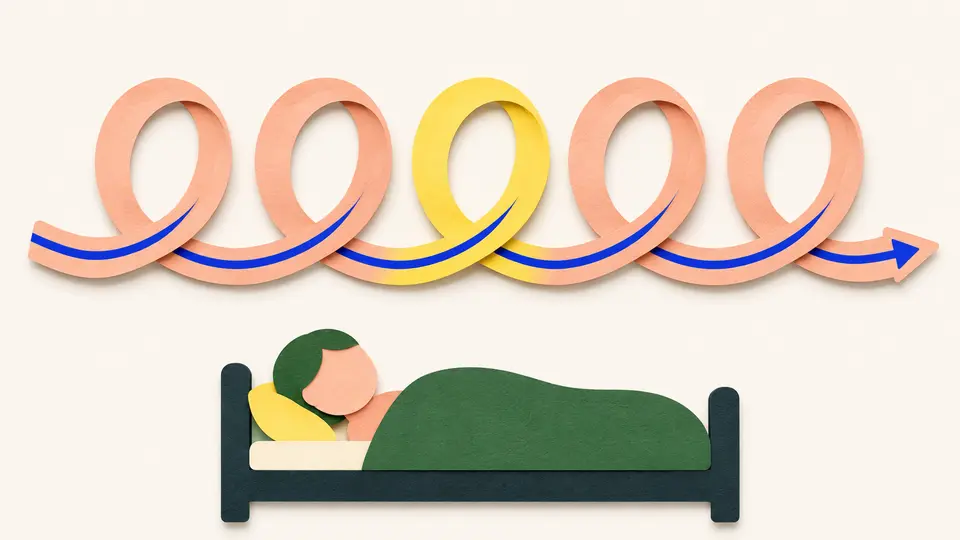
A night of sleep is one short unit on repeat. A cycle lasts 80 to 100 minutes, and you usually go through four to six of them. You may even wake up briefly between cycles.
Each cycle has two phases, non-REM and REM. Non-REM sleep has three stages. Stage 1 is the transition from being awake. In stage 2 you're asleep. Stage 3 is deep sleep, also called slow-wave sleep.
REM, short for rapid eye movement, is unlike the rest. Your eyes twitch. Your brain's activity looks much like it does when you're awake, and dreaming usually happens here.
Meanwhile your muscles normally go limp, which stops you from acting out your dreams. So in REM, a brain running near waking levels sits in a body that has gone slack.
The stages are defined by machines. In a sleep study, sensors record your eye movements and brain activity through the night, and each stretch of the recording is sorted into a stage. Slow-wave sleep is named after a pattern in the brain trace.
So a stage is a measurement, and how the sleep felt doesn't come into it. "Deep sleep" doesn't mean the sleep that felt deepest. And nobody can tell from the inside which stage they were in at three in the morning.
Keep that in mind when you hear claims about sleep. "I got no deep sleep last night" might come from a recording. It might also be a guess from feeling tired, and tiredness can have other causes.
Try to recallA friend says they know they got no deep sleep last night because they woke up tired. What's wrong with that reasoning, and what would settle it?
Deep sleep, or slow-wave sleep, is defined by measurements of brain activity taken in a sleep study, and it's named after a pattern in those measurements. Feeling tired isn't that measurement, so it can't show which stages a night contained, and something else could easily explain the tiredness. Settling it would take a sleep study, with sensors recording eye movements and brain activity, because that's the only way to see the stages of a particular night.
A night is four to six cycles of 80 to 100 minutes, each passing through three non-REM stages and REM. The stage names describe what sensors record. So when someone tells you how much deep sleep they got, ask what measured it.
Lessons in this topic
Your night is one sleep cycle, repeated four to six times
Learn the stages of a sleep cycle and how often it repeats, and why only a recording can say which stage you were in.
What an early alarm and a late bedtime each cost you
Deep sleep is concentrated in the first cycles after you fall asleep and REM in the last ones. Use that to work out what an early alarm removes, and why a late bedtime is different.
Eight hours in bed can still leave you short of sleep
Sleep deprivation and sleep deficiency mean different things. Deficiency has four parts, and a count of hours can see only one of them.
Why you can't judge your own lack of sleep
Sleep deficiency wears down attention, reactions and judgment, the same faculties you'd use to notice it. See why feeling fine on five hours proves little, and how the wording of a health claim shows its strength.
Three quick stories from this topic
An hour or two short, night after night
Sleeping 1 to 2 hours short for several nights impairs you like a day or two with no sleep
That's the US National Heart, Lung, and Blood Institute's summary. Sleep-deficient people take longer to finish tasks, react more slowly and make more mistakes. Some don't realize it. Even with limited or poor sleep, they may still think they function well.
Asleep without knowing
Lack of sleep can lead to microsleep, brief moments of sleep while you're normally awake. You can't control it, and you might not be aware of it.
At the wheel
Studies show sleep deficiency harms driving ability as much as being drunk, or more. Driver sleepiness is estimated to be a factor in about 100,000 car accidents each year.
Deep sleep fades with age
Deep sleep peaks in early childhood, and older people may get none of it at all
Deep sleep, also called slow-wave sleep, drops sharply in the teenage years and keeps decreasing through adulthood. NHLBI describes this as part of how sleep changes as people mature. Newborns, at the other end of life, spend more of their sleep in REM.
Where it sits in the night
You usually spend more time in deep sleep early in the night and more time in REM sleep later.
Named after a trace
Slow-wave sleep is named after a pattern in the brain-activity measurements taken in sleep studies. The stages of sleep are defined by those measurements.
Every 80 to 100 minutes
A night's sleep is one 80-to-100-minute cycle repeated four to six times
Each cycle passes through three stages of non-REM sleep and through REM, when dreaming usually happens. You may wake briefly between cycles. The cycles aren't identical, either. Early ones hold more deep sleep, and later ones hold more REM.
Three stages, then REM
Non-REM sleep has three stages. They're the transition into sleep, being asleep, and deep or slow-wave sleep. REM is the fourth state.
Named after a trace
The stages are defined by measurements of brain activity taken in sleep studies. Slow-wave sleep is named after a pattern in those measurements.
Sources
- How Sleep Works: Sleep Phases and Stages, NHLBI, NIH
- Sleep Deprivation and Deficiency: How Sleep Affects Your Health, National Heart, Lung, and Blood Institute